Email Alert | RSS 帮助

中国防痨杂志 ›› 2026, Vol. 48 ›› Issue (5): 707-715.doi: 10.19982/j.issn.1000-6621.20250449
黄震洋1,2, 李文君2, 孙岩松2( ), 李浩2()
收稿日期:2025-11-14
出版日期:2026-05-10
发布日期:2026-04-27
通信作者:
孙岩松,李浩
E-mail:sunys6443@126.com;lihao88663239@126.com
基金资助:
Huang Zhenyang1,2, Li Wenjun2, Sun Yansong2(), Li Hao2()
Received:2025-11-14
Online:2026-05-10
Published:2026-04-27
Contact:
Sun Yansong,Li Hao
E-mail:sunys6443@126.com;lihao88663239@126.com
Supported by:摘要:
由结核分枝杆菌(Mycobacterium tuberculosis, MTB)引起的结核病严重危害着全球的公共卫生安全。而传统的MTB检测方法如涂片、培养等,敏感度不足、耗时久、耐药检测滞后,制约了世界卫生组织(World Health Organization, WHO)“终结结核病流行”战略目标的实现。成簇规律间隔短回文重复序列(clustered regularly interspaced short palindromic repeats, CRISPR)技术以其高特异度和快速性,为MTB的检测带来了革新潜力。笔者系统梳理了CRISPR在MTB现场检测、耐药基因检测、多靶标联合检测中的最新研究进展,重点对现有研究中样本前处理复杂、试剂稳定性与基层适配性欠佳等问题进行了剖析,未来将聚焦于样本前处理简化与集成化、优化试剂冻干技术,为CRISPR-MTB的临床转化及结核病的精准防控提供参考。
中图分类号:
黄震洋, 李文君, 孙岩松, 李浩. 基于CRISPR-Cas系统的结核分枝杆菌检测研究进展[J]. 中国防痨杂志, 2026, 48(5): 707-715. doi: 10.19982/j.issn.1000-6621.20250449
Huang Zhenyang, Li Wenjun, Sun Yansong, Li Hao. Advances in CRISPR-Cas system-based detection of Mycobacterium tuberculosis[J]. Chinese Journal of Antituberculosis, 2026, 48(5): 707-715. doi: 10.19982/j.issn.1000-6621.20250449
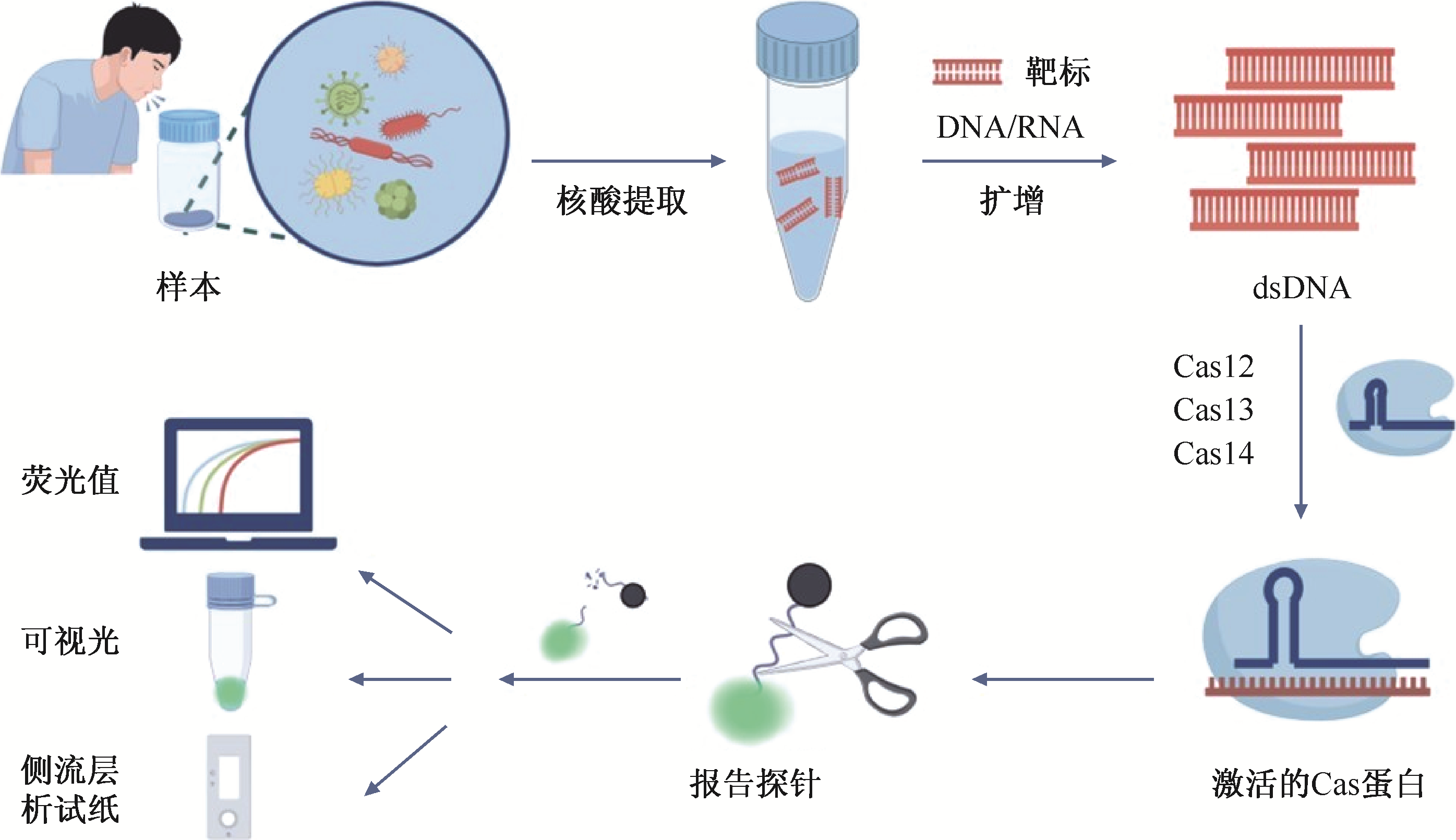
图1
CRISPR与扩增技术联用的检测流程图
| [1] |
Chen X, Huang J, Xiao Z, et al. Highly specific and sensitive detection of the Mycobacterium tuberculosis complex using multiplex loop-mediated isothermal amplification combined with a nanoparticle-based lateral flow biosensor. Braz J Microbiol, 2021, 52(3): 1315-1325. doi:10.1007/s42770-021-00520-4.
URL pmid: 34176103 |
| [2] | 王小敏, 陈锦云, 曾昱芹, 等. 《世界卫生组织结核病整合指南模块3:诊断——结核病检测的快速诊断》第三版解读. 中国防痨杂志, 2024, 46(9): 1006-1022. doi:10.19982/j.issn.1000-6621.20240221. |
| [3] | Allemailem KS, Almatroudi A, Alrumaihi F, et al. Current Updates of CRISPR/Cas System and Anti-CRISPR Proteins: Innovative Applications to Improve the Genome Editing Strategies. Int J Nanomedicine, 2024, 19: 10185-10212. doi:10.2147/ijn.S479068. |
| [4] | Lin Z, Song Z, Yu H, et al. Ultra-sensitive in situ detection of intracellular Mycobacterium tuberculosis with CRISPR/Cas12a. Front Immunol, 2025, 16: 1597654. doi:10.3389/fimmu.2025.1597654. |
| [5] | Liu S, Xiao G, Li P, et al. Plasma-based ultrasensitive detection of Mycobacterium tuberculosis ESAT6/CFP10 fusion antigen using a CRISPR-driven aptamer fluorescence testing (CRAFT). Biosens Bioelectron, 2025, 284: 117566. doi:10.1016/j.bios.2025.117566. |
| [6] | Huang Z, Song Z, Zeng J, et al. Sensitive pathogen DNA detection by a multi-guide RNA Cas12a assay favoring trans-versus cis-cleavage. Nat Commun, 2025, 16(1): 8257. doi:10.1038/s41467-025-63094-x. |
| [7] | Huang Z, Zhang G, Lyon CJ, et al. Outlook for CRISPR-based tuberculosis assays now in their infancy. Front Immunol, 2023, 14: 1172035. doi:10.3389/fimmu.2023.1172035. |
| [8] |
Tong X, Zhang K, Han Y, et al. Fast and sensitive CRISPR detection by minimized interference of target amplification. Nat Chem Biol, 2024, 20(7): 885-893. doi:10.1038/s41589-023-01534-9.
URL pmid: 38332130 |
| [9] |
Zein-Eddine R, Refrégier G, Cervantes J, et al. The future of CRISPR in Mycobacterium tuberculosis infection. J Biomed Sci, 2023, 30(1): 34. doi:10.1186/s12929-023-00932-4.
URL pmid: 37245014 |
| [10] |
Sodani M, Misra CS, Kulkarni S, et al. CRISPR/Cas12a-mediated gene silencing across diverse functional genes demonstrates single gene-specific spacer efficacy in Mycobacterium smegmatis. J Biol Eng, 2025, 19(1): 21. doi:10.1186/s13036-025-00490-3.
URL pmid: 40022115 |
| [11] |
Gootenberg JS, Abudayyeh OO, Lee JW, et al. Nucleic acid detection with CRISPR-Cas13a/C2c2. Science, 2017, 356(6336): 438-442. doi:10.1126/science.aam9321.
URL pmid: 28408723 |
| [12] |
Chen JS, Ma E, Harrington LB, et al. CRISPR-Cas12a target binding unleashes indiscriminate single-stranded DNase activity. Science, 2018, 360(6387): 436-439. doi:10.1126/science.aar6245.
URL pmid: 29449511 |
| [13] | Li SY, Cheng QX, Wang JM, et al. CRISPR-Cas12a-assisted nucleic acid detection. Cell Discov, 2018, 4: 20. doi:10.1038/s41421-018-0028-z. |
| [14] | Pei S, Song Z, Yang W, et al. The catalogue of Mycobacterium tuberculosis mutations associated with drug resistance to 12 drugs in China from a nationwide survey: a genomic analysis. Lancet Microbe, 2024, 5(11): 100899. doi:10.1016/s2666-5247(24)00131-9. |
| [15] | Domínguez J, Boeree MJ, Cambau E, et al. Clinical implications of molecular drug resistance testing for Mycobacterium tuberculosis: a 2023 TBnet/RESIST-TB consensus statement. Lancet Infect Dis, 2023, 23(4): e122-e137. doi:10.1016/s1473-3099(22)00875-1. |
| [16] | Li X, Liu J, Wang R, et al. CRISPR-based one-pot detection: A game-changer in nucleic acid analysis. Biosens Bioelectron, 2025, 288: 117786. doi:10.1016/j.bios.2025.117786. |
| [17] | Chen L, Hu M, Zhou X. Trends in developing one-pot CRISPR diagnostics strategies. Trends Biotechnol, 2025, 43(1): 98-110. doi:10.1016/j.tibtech.2024.07.007. |
| [18] | Liu H, Yin H, Xiu L, et al. One-Pot Isothermal Nucleic Acid Amplification Assisted CRISPR/Cas Detection Technology: Challenges, Strategies, and Perspectives. Adv Sci (Weinh), 2025, 12(37): e06716. doi:10.1002/advs.202506716. |
| [19] | Peng L, Fang T, Cai Q, et al. Rapid detection of Mycobacterium tuberculosis in sputum using CRISPR-Cas12b combined with cross-priming amplification in a single reaction. J Clin Microbiol, 2024, 62(1): e0092323. doi:10.1128/jcm.00923-23. |
| [20] | Reddy KP, Denkinger CM, Broger T, et al. Cost-effectiveness of a Novel Lipoarabinomannan Test for Tuberculosis in Patients With Human Immunodeficiency Virus. Clin Infect Dis, 2021, 73(7): e2077-e2085. doi:10.1093/cid/ciaa1698. |
| [21] | Bell AG, Dunkley ORS, Modi NH, et al. A streamlined CRISPR-based test for tuberculosis detection directly from sputum. Sci Adv, 2025, 11(32): eadx2067. doi:10.1126/sciadv.adx2067. |
| [22] |
Arizti-Sanz J, Freije CA, Stanton AC, et al. Streamlined inactivation, amplification, and Cas13-based detection of SARS-CoV-2. Nat Commun, 2020, 11(1): 5921. doi:10.1038/s41467-020-19097-x.
URL pmid: 33219225 |
| [23] |
Wang B, Wang R, Wang D, et al. Cas12aVDet: A CRISPR/Cas12a-Based Platform for Rapid and Visual Nucleic Acid Detection. Anal Chem, 2019, 91(19): 12156-12161. doi:10.1021/acs.analchem.9b01526.
URL pmid: 31460749 |
| [24] | Uno N, Li Z, Avery L, et al. CRISPR gel: A one-pot biosensing platform for rapid and sensitive detection of HIV viral RNA. Anal Chim Acta, 2023, 1262: 341258. doi:10.1016/j.aca.2023.341258. |
| [25] | Ali Z, Aman R, Mahas A, et al. iSCAN: An RT-LAMP-coupled CRISPR-Cas12 module for rapid, sensitive detection of SARS-CoV-2. Virus Res, 2020, 288: 198129. doi:10.1016/j.virusres.2020.198129. |
| [26] | Li SY, Cheng QX, Liu JK, et al. CRISPR-Cas12a has both cis- and trans-cleavage activities on single-stranded DNA. Cell Res, 2018, 28(4): 491-493. doi:10.1038/s41422-018-0022-x. |
| [27] | Youngquist BM, Saliba J, Kim Y, et al. Rapid tuberculosis diagnosis from respiratory or blood samples by a low cost, portable lab-in-tube assay. Sci Transl Med, 2025, 17(793): eadp6411. doi:10.1126/scitranslmed.adp6411. |
| [28] | Horne DJ, Zifodya JS, Shapiro AE, et al. Xpert MTB/RIF Ultra assay for pulmonary tuberculosis and rifampicin resistance in adults and adolescents. Cochrane Database Syst Rev, 2025, 7(7): Cd009593. doi:10.1002/14651858.CD009593.pub6. |
| [29] | Chen H, Song F, Wang B, et al. Ultrasensitive detection of clinical pathogens through a target-amplification-free collateral-cleavage-enhancing CRISPR-CasΦ tool. Nat Commun, 2025, 16(1): 3929. doi:10.1038/s41467-025-59219-x. |
| [30] |
Wang M, Chen M, Wu X, et al. CRISPR applications in cancer diagnosis and treatment. Cell Mol Biol Lett, 2023, 28(1): 73. doi:10.1186/s11658-023-00483-4.
URL pmid: 37674114 |
| [31] | Guk K, Yi S, Kim H, et al. Hybrid CRISPR/Cas protein for one-pot detection of DNA and RNA. Biosens Bioelectron, 2023, 219: 114819. doi:10.1016/j.bios.2022.114819. |
| [32] | Hu F, Liu Y, Zhao S, et al. A one-pot CRISPR/Cas13a-based contamination-free biosensor for low-cost and rapid nucleic acid diagnostics. Biosens Bioelectron, 2022, 202: 113994. doi:10.1016/j.bios.2022.113994. |
| [33] | Jiang Y, Wu J, Xiang X, et al. A cleavage-gated terminal exposure-driven CRISPR-RCA self-amplifying system for ultra-fast DNA detection. Biosens Bioelectron, 2025, 289: 117857. doi:10.1016/j.bios.2025.117857. |
| [34] | Singh M, Bindal G, Misra CS, et al. The era of Cas12 and Cas 13 CRISPR-based disease diagnosis. Crit Rev Microbiol, 2022, 48(6): 714-729. doi:10.1080/1040841x.2021.2025041. |
| [35] |
Huyke DA, Ramachandran A, Bashkirov VI, et al. Enzyme Kinetics and Detector Sensitivity Determine Limits of Detection of Amplification-Free CRISPR-Cas12 and CRISPR-Cas13 Diagnostics. Anal Chem, 2022, 94(27): 9826-9834. doi:10.1021/acs.analchem.2c01670.
URL pmid: 35759403 |
| [36] | Ren W, Zhou Y, Li H, et al. Development and clinical evaluation of a CRISPR/Cas13a-based diagnostic test to detect Mycobacterium tuberculosis in clinical specimens. Front Microbiol, 2023, 14: 1117085. doi:10.3389/fmicb.2023.1117085. |
| [37] | Thakku SG, Lirette J, Murugesan K, et al. Genome-wide tiled detection of circulating Mycobacterium tuberculosis cell-free DNA using Cas13. Nat Commun, 2023, 14(1): 1803. doi:10.1038/s41467-023-37183-8. |
| [38] |
Shihong Gao D, Zhu X, Lu B. Development and application of sensitive, specific, and rapid CRISPR-Cas13-based diagnosis. J Med Virol, 2021, 93(7): 4198-4204. doi:10.1002/jmv.26889.
URL pmid: 33599292 |
| [39] | World Health Organization. Global tuberculosis report 2025. Geneva: World Health Organization, 2025. |
| [40] | World Health Organization. Global tuberculosis report 2024. Geneva: World Health Organization, 2024. |
| [41] | Cao G, Yang N, Xiong Y, et al. Completely Free from PAM Limitations: Asymmetric RPA with CRISPR/Cas12a for Nucleic Acid Assays. ACS Sens, 2023, 8(12): 4655-4663. doi:10.1021/acssensors.3c01686. |
| [42] | 白晓鹏. 基于Cas13a的结核分枝杆菌氟喹诺酮药耐受相关突变的快速检测技术. 重庆: 重庆医科大学, 2021. |
| [43] | Yang J, Li X, He Q, et al. Structural basis for the activity of the type Ⅶ CRISPR-Cas system. Nature, 2024, 633(8029): 465-472. doi:10.1038/s41586-024-07815-0. |
| [44] | Li W, Jiang X, Wang W, et al. Discovering CRISPR-Cas system with self-processing pre-crRNA capability by foundation models. Nat Commun, 2024, 15(1): 10024. doi:10.1038/s41467-024-54365-0. |
| [45] | Lai Y, Guo K, Zhu C, et al. Cas14VIDet: A visual instant method free from PAM restriction for antibiotic resistance bacteria detection. Biosens Bioelectron, 2025, 268: 116884. doi:10.1016/j.bios.2024.116884. |
| [46] | 王苑柠, 杜宗敏. CRISPR/Cas分子诊断技术在结核分枝杆菌耐药性检测中的研究进展. 中国防痨杂志, 2025, 47(5): 666-672. doi:10.19982/j.issn.1000-6621.20240523. |
| [47] | Xiao G, Liu H, Xu H, et al. Direct detection from sputum for drug-resistant Mycobacterium tuberculosis using a CRISPR-Cas14a-based approach. BMC Microbiol, 2025, 25(1): 188. doi:10.1186/s12866-025-03899-4. |
| [48] | Zhou X, Han X, Liu L, et al. Cas12b-assisted one-step dual-target CRISPR system for Mycobacterium tuberculosis detection. Biosensors and Bioelectronics: X, 2025, 27: 100692. doi:10.1016/j.biosx.2025.100692. |
| [49] | Olbrich L, Franckling-Smith Z, Larsson L, et al. Sequential and parallel testing for microbiological confirmation of tuberculosis disease in children in five low-income and middle-income countries: a secondary analysis of the RaPaed-TB study. Lancet Infect Dis, 2025, 25(2): 188-197. doi:10.1016/s1473-3099(24)00494-8. |
| [50] | Freitag B, Sultanli A, Grilli M, et al. Clinically diagnosed tuberculosis and mortality in high burden settings: a systematic review and meta-analysis. EClinicalMedicine, 2025, 84: 103251. doi:10.1016/j.eclinm.2025.103251. |
| [51] | Baik Y, Rickman HM, Hanrahan CF, et al. A clinical score for identifying active tuberculosis while awaiting microbiological results: Development and validation of a multivariable prediction model in sub-Saharan Africa. PLoS Med, 2020, 17(11): e1003420. doi:10.1371/journal.pmed.1003420. |
| [52] | Kokuto H, Sasaki Y, Yoshimatsu S, et al. Detection of Mycobacterium tuberculosis (MTB) in Fecal Specimens From Adults Diagnosed With Pulmonary Tuberculosis Using the Xpert MTB/Rifampicin Test. Open Forum Infect Dis, 2015, 2(2): ofv074. doi:10.1093/ofid/ofv074. |
| [53] | Paris L, Magni R, Zaidi F, et al. Urine lipoarabinomannan glycan in HIV-negative patients with pulmonary tuberculosis correlates with disease severity. Sci Transl Med, 2017, 9(420): eaal2807. doi:10.1126/scitranslmed.aal2807. |
| [54] |
Lopez AL, Aldaba JG, Morales-Dizon M, et al. Urine Xpert MTB/RIF for the diagnosis of childhood tuberculosis. Int J Infect Dis, 2019, 79: 44-46. doi:10.1016/j.ijid.2018.11.013.
URL pmid: 30496848 |
| [55] |
Vogt SL, Patel M, Lakha A, et al. Feasibility of Cell-Free DNA Collection and Clonal Immunoglobulin Sequencing in South African Patients With HIV-Associated Lymphoma. JCO Glob Oncol, 2021, 7: 611-621. doi:10.1200/go.20.00651.
URL pmid: 33909482 |
| [56] |
Pohl C, Rutaihwa LK, Haraka F, et al. Limited value of whole blood Xpert(®) MTB/RIF for diagnosing tuberculosis in children. J Infect, 2016, 73(4): 326-335. doi:10.1016/j.jinf.2016.04.041.
URL pmid: 27394403 |
| [57] |
Mosquera-Restrepo SF, Zuberogoïtia S, Gouxette L, et al. A Mycobacterium tuberculosis fingerprint in human breath allows tuberculosis detection. Nat Commun, 2022, 13(1): 7751. doi:10.1038/s41467-022-35453-5.
URL pmid: 36517492 |
| [58] | Wood RC, Luabeya AK, Dragovich RB, et al. Tongue swab testing on two automated tuberculosis diagnostic platforms, Cepheid Xpert(®) MTB/RIF Ultra and Molbio Truenat(®) MTB Ultima. J Clin Microbiol, 2024, 62(4): e0001924. doi:10.1128/jcm.00019-24. |
| [59] | Wood RC, Luabeya AK, Weigel KM, et al. Detection of Mycobacterium tuberculosis DNA on the oral mucosa of tuberculosis patients. Sci Rep, 2015, 5: 8668. doi:10.1038/srep08668. |
| [60] | Rockman L, Abdulgader SM, Minnies S, et al. Oral washes and tongue swabs for Xpert MTB/RIF Ultra-based tuberculosis diagnosis in people with and without the ability to make sputum. Clin Infect Dis, 2026, 81(6):e632-e642. doi:10.1093/cid/ciaf397. |
| [61] | Bezuidenhout C, Long L, Nichols B, et al. Using sputum and tongue swab specimens for in-home point-of-care targeted universal testing for TB of household contacts: an acceptability and feasibility analysis. BMJ Glob Health, 2025, 10(8):e018131. doi:10.1136/bmjgh-2024-018131. |
| [62] | Wang Y, Cui J, Li Y, et al. Rapid quantitative PCR on tongue swabs for pulmonary tuberculosis in adults: a prospective multicentre study. Eur Respir J, 2025, 65(1):2401493. doi:10.1183/13993003.01493-2024. |
| [63] | 夏强. 基于序列特异性DNA结合蛋白靶向捕获DNA的研究. 南京:东南大学, 2019. |
| [64] |
Mizuguchi T, Toyota T, Miyatake S, et al. Complete sequencing of expanded SAMD12 repeats by long-read sequencing and Cas9-mediated enrichment. Brain, 2021, 144(4): 1103-1117. doi:10.1093/brain/awab021.
URL pmid: 33791773 |
| [65] | 田甜, 周小明. 基于CRISPR/Cas9的基因分析方法研究进展. 激光生物学报, 2020, 29(1):18-25. doi:10.3969/j.issn.1007-7146.2020.01.003. |
| [66] | Lee J, Lim H, Jang H, et al. CRISPR-Cap: multiplexed double-stranded DNA enrichment based on the CRISPR system. Nucleic Acids Res, 2019, 47(1): e1. doi:10.1093/nar/gky820. |
| [67] |
Jiang W, Zhu TF. Targeted isolation and cloning of 100-kb microbial genomic sequences by Cas9-assisted targeting of chromosome segments. Nat Protoc, 2016, 11(5): 960-975. doi:10.1038/nprot.2016.055.
URL pmid: 27101517 |
| [68] | Tram TTB, Ha VTN, Trieu LPT, et al. FLASH-TB: an Application of Next-Generation CRISPR to Detect Drug Resistant Tuberculosis from Direct Sputum. J Clin Microbiol, 2023, 61(4): e0163422. doi:10.1128/jcm.01634-22. |
| [69] | Park S, Koo B, Kim MG, et al. CADEM: Species-level detection of mycobacterial cfDNA via CRISPR for pulmonary disease diagnosis. Anal Chim Acta, 2026, 1388: 345085. doi:10.1016/j.aca.2026.345085. |
| [70] | Tian Z, Yan H, Zeng Y. Solid-Phase Extraction and Enhanced Amplification-Free Detection of Pathogens Integrated by Multifunctional CRISPR-Cas12a. ACS Appl Mater Interfaces, 2024, 16(12): 14445-14456. doi:10.1021/acsami.3c17039. |
| [71] |
Cheng Y, Guo W, Wan Y, et al. Ultrasensitive Detection of Nucleic Acid and Protein at Ambient Temperature by Using an Engineered CRISPR-Cas12a-Based Digital Assay. Anal Chem, 2025, 97(33): 18355-18363. doi:10.1021/acs.analchem.5c03865.
URL pmid: 40817853 |
| [72] | Nguyen LT, Rananaware SR, Yang LG, et al. Engineering highly thermostable Cas12b via de novo structural analyses for one-pot detection of nucleic acids. Cell Rep Med, 2023, 4(5): 101037. doi:10.1016/j.xcrm.2023.101037. |
| [73] | 张胜胜, 吴芳, 罗志丹, 等. CRISPR/Cas12b核酸检测试剂的冻干配方筛选与优化. 江苏海洋大学学报(自然科学版), 2023, 32(3): 43-48. |
| [74] | Srisuma P, Chen G, Braatz RD. Mechanistic Modeling of Continuous Lyophilization for Biopharmaceutical Manufacturing. Adv Sci (Weinh), 2025, 12(47): e11693. doi:10.1002/advs.202511693. |
| [75] | Srisuma P, Barbastathis G, Braatz RD. Real-time estimation of bound water concentration during lyophilization with temperature-based state observers. Int J Pharm, 2024, 665: 124693. doi:10.1016/j.ijpharm.2024.124693. |
| [76] | 刘梅. 基于侧流层析试纸条的冻干RPA-CRISPR/Cas12a核酸即时检测方法的研究. 天津: 天津理工大学, 2023. |
| [77] |
Wang Y, Chen H, Lin K, et al. Ultrasensitive single-step CRISPR detection of monkeypox virus in minutes with a vest-pocket diagnostic device. Nat Commun, 2024, 15(1): 3279. doi:10.1038/s41467-024-47518-8.
URL pmid: 38627378 |
| [78] | Cao Y, Wang J, Fan Z, et al. An extraction-free, lyophilized one-pot RAA-CRISPR assay for point-of-care testing of Haemophilus influenzae. J Clin Microbiol, 2025, 63(11): e0053525. doi:10.1128/jcm.00535-25. |
| [79] | Wang YM, Xu T, Duan JQ, et al. An Integrated One-Tube RPA-CRISPR/Cas13d Assay Coupled with Lateral Flow for Rapid PRRSV-1 Detection. J Agric Food Chem, 2025, 73(42): 27080-27088. doi:10.1021/acs.jafc.5c07919. |
| [80] | Fu J, Mo R, Li Z, et al. An extraction-free one-pot assay for rapid detection of Klebsiella pneumoniae by combining RPA and CRISPR/Cas12a. Biosens Bioelectron, 2025, 267: 116740. doi:10.1016/j.bios.2024.116740. |
| [81] | Drzewnioková P, Brian I, Mancin M, et al. Validation and multi-site deployment of a lyophilized qRT-PCR reagent for the molecular diagnosis of avian influenza and rabies in Sub-Saharan African regions. J Clin Microbiol, 2025, 63(8): e0008025. doi:10.1128/jcm.00080-25. |
| [82] | Auer A, Panzarin V, Monne I, et al. Comparative assessment of lyophilized and wet reagents for the molecular detection of H5N1 high pathogenic avian influenza virus and H9N2 low pathogenic avian influenza virus. J Virol Methods, 2023, 314: 114686. doi:10.1016/j.jviromet.2023.114686. |
| [1] | 郭宸浩, 刘鑫宇, 詹斯蕊, 王丽丽, 马梦婷, 李秀梅, 祁琳萍, 李卫平. γ-干扰素释放试验诊断成人肺外结核准确性的系统综述与荟萃分析[J]. 中国防痨杂志, 2026, 48(6): 803-812. |
| [2] | 袁绍莹, 崔中锋, 杜江, 曹雪芳, 冯博轩, 何翼君, 李子涵, 赵雅琪, 于怡麟, 高磊, 辛赫男, 李洪智. QuantiFERON-TB Gold Plus检测在活动性肺结核诊断及治疗反应监测中的应用价值[J]. 中国防痨杂志, 2026, 48(6): 865-873. |
| [3] | 乔晓博, 李静, 王宝千, 周伟东, 王飞, 张齐波, 李同霞. 肺泡灌洗液GeneXpert MTB/RIF、BACTEC MGIT 960联合外周血IGRA检测对病原学阴性肺结核的诊断价值[J]. 中国防痨杂志, 2026, 48(6): 874-881. |
| [4] | 侯田勇, 任丽萍, 李静颖, 王建伟, 樊姝慧, 吴渊明, 王全红, 丁卫民. 支气管肺泡灌洗液分子生物学联合检测对涂阴肺结核患者的诊断价值[J]. 中国防痨杂志, 2026, 48(3): 329-334. |
| [5] | 周藏, 李国莉, 蒋晖, 邵燕, 宋红焕, 薛浩, 宁静娴, 潘昱辰, 费心如, 孙郑, 陈诚, 竺丽梅, 刘巧. AIMTB-荧光免疫层析法对结核分枝杆菌潜伏感染筛查的诊断价值[J]. 中国防痨杂志, 2026, 48(2): 289-298. |
| [6] | 王珏, 姚瀚鑫, 孙雪娟, 冯丹, 吴秒一, 张铭锦, 马昕启. 结核病分子诊断技术的进展[J]. 中国防痨杂志, 2025, 47(S1): 366-371. |
| [7] | 赖晓宇, 段鸿飞, 陈珣珣, 郭卉欣, 廖庆华, 陈茜, 梁丹. 结核性葡萄膜炎临床特征、诊断策略与分级标准研究进展[J]. 中国防痨杂志, 2025, 47(9): 1204-1211. |
| [8] | 中国防痨协会结核病控制专业分会, 中国防痨协会标准化专业分会, 中国防痨协会老年结核病防治专业分会单位. 结核分枝杆菌感染检测技术应用专家共识[J]. 中国防痨杂志, 2025, 47(7): 813-829. |
| [9] | 杨泽亮, 马子淳, 尚媛媛, 石金, 荆玮, 逄宇, 秦林. 靶向二代测序技术对无痰肺结核患者的诊断效能评估[J]. 中国防痨杂志, 2025, 47(7): 878-883. |
| [10] | 赵琰枫, 屠霞, 王嫩寒, 陈双双, 田丽丽, 樊瑞芳, 于兰, 李洁, 李传友, 代小伟. 三种检测方法在肺结核患者病原学阳性检出中的贡献分析[J]. 中国防痨杂志, 2025, 47(6): 701-707. |
| [11] | 孙晓柯, 魏金星, 张春艳, 梁瑞霞, 史慧敏, 阮祥林, 段鸿飞. 纳米孔靶向测序技术对福尔马林固定石蜡包埋组织中肉芽肿性疾病的诊断价值[J]. 中国防痨杂志, 2025, 47(5): 582-588. |
| [12] | 应广智, 蔡青山, 马晓卿, 陈凌燕, 陈园园. Nanopore靶向测序在呼吸道样本中检测非结核分枝杆菌的诊断价值研究[J]. 中国防痨杂志, 2025, 47(5): 589-596. |
| [13] | 王苑柠, 杜宗敏. CRISPR/Cas分子诊断技术在结核分枝杆菌耐药性检测中的研究进展[J]. 中国防痨杂志, 2025, 47(5): 666-672. |
| [14] | 罗莉, 罗林紫, 尹曲华, 周磊, 卢志斌, 丁衍, 肖阳宝. 淋巴结瘘型气管支气管结核的支气管镜下诊疗进展[J]. 中国防痨杂志, 2025, 47(4): 505-512. |
| [15] | 贾辉, 景辉, 凌晓洁, 王燕, 李学政. GeneXpert MTB/RIF Ultra检测痰液样本对新发肺结核的诊断价值[J]. 中国防痨杂志, 2025, 47(3): 298-304. |
| 阅读次数 | ||||||
|
全文 |
|
|||||
|
摘要 |
|
|||||
 京公网安备11010202007215号
ip访问总数: ip当日访问总数: 当前在线人数:
京公网安备11010202007215号
ip访问总数: ip当日访问总数: 当前在线人数:
 本作品遵循Creative Commons Attribution 3.0 License授权许可
