Email Alert | RSS    帮助

中国防痨杂志 ›› 2026, Vol. 48 ›› Issue (10): 1552-1560.doi: 10.19982/j.issn.1000-6621.20260270

• 论著 • 上一篇    下一篇

重组结核杆菌融合蛋白(EC)皮肤试验判读时间与阳性标准的合理性研究:一项Ⅳ期临床试验

陈骏籍1, 祁平平2, 吕榜军3, 覃玉玲4, 钟再新2, 王熙路2, 白祥建2, 莫毅1(), 邵杰5()   

  1. 1 广西壮族自治区疾病预防控制中心疫苗临床研究所, 南宁 530028
    2 安徽智飞龙科马生物制药有限公司临床研究管理部, 合肥 230601
    3 广西壮族自治区柳州市疾病预防控制中心办公室, 柳州 545007
    4 广西壮族自治区柳州市柳江区疾病预防控制中心免疫规划管理科, 柳州 545100
    5 重庆智飞生物制品股份有限公司临床研究管理中心, 重庆 401147
  • 收稿日期:2026-05-12 出版日期:2026-10-10 发布日期:2026-09-30
  • 通信作者: 莫毅,Email:moyi0415@qq.com;邵杰,Email:shaobo@zhifeishengwu.cn
  • 基金资助:
    广西医疗卫生适宜技术开发与推广应用项目(S2023055)

Study on the rationality of reading time points and positive criteria for recombinant Mycobacterium tuberculosis fusion protein (EC) skin test: A phase Ⅳ clinical trial

Chen Junji1, Qi Pingping2, Lyu Bangjun3, Qin Yuling4, Zhong Zaixin2, Wang Xilu2, Bai Xiangjian2, Mo Yi1(), Shao Jie5()   

  1. 1 Institute of Vaccine Clinical Research, Guangxi Zhuang Autonomous Region Center for Disease Control and Prevention, Nanning 530028, China
    2 Department of Clinical Research Management, Anhui Zhifei Longcom Biopharmaceutical Co., Ltd., Hefei 230601, China
    3 Office, Liuzhou Center for Disease Control and Prevention, Guangxi Zhuang Autonomous Region, Liuzhou 545007, China
    4 Department of Immunization Planning and Management, Liuzhou Liujiang District Center for Disease Control and Prevention, Guangxi Zhuang Autonomous Region, Liuzhou 545100, China
    5 Clinical Research Management Center, Chongqing Zhifei Biological Products Co., Ltd., Chongqing 401147, China
  • Received:2026-05-12 Online:2026-10-10 Published:2026-09-30
  • Contact: Mo Yi, Email:moyi0415@qq.com;Shao Jie, Email: shaobo@zhifeishengwu.cn
  • Supported by:
    Guangxi Medical and Health Appropriate Technology Development and Promotion Application Project(S2023055)

摘要:

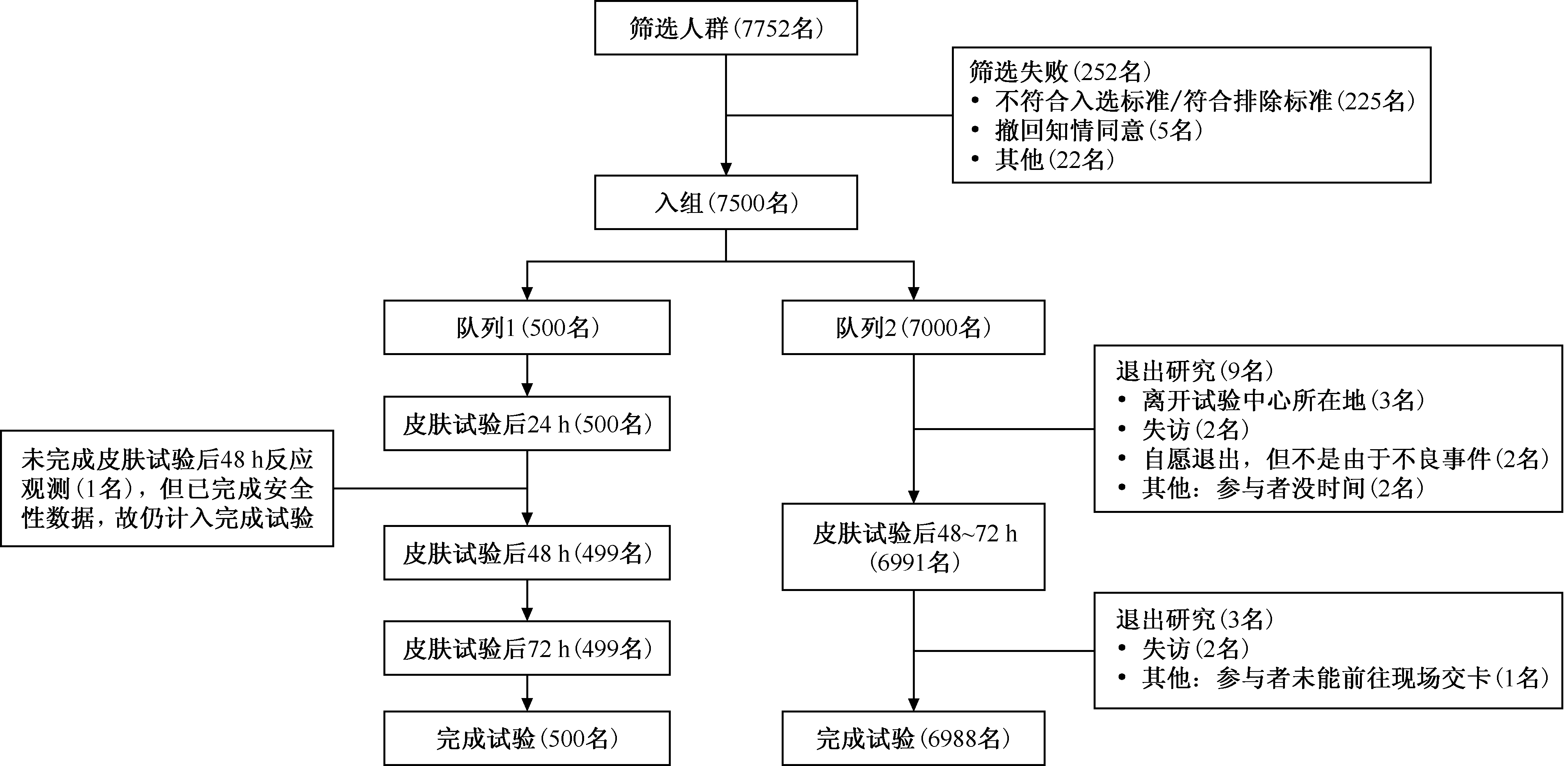
目的: 基于社区人群重组结核杆菌融合蛋白(EC)皮肤试验Ⅳ期临床研究数据,评价EC皮肤试验不同判读时间及阳性判定标准的合理性,并分析其与结核感染T细胞斑点试验(T-SPOT.TB)的诊断一致性,为EC皮肤试验的规范化判读提供依据。方法: 2023年4月17日至2024年5月13日,由广西壮族自治区疾病预防控制中心在广西壮族自治区柳州市疾病预防控制中心及柳州市柳江区疾病预防控制中心两个研究现场组织开展6月龄及以上社区人群的前瞻性多队列EC皮肤试验Ⅳ期临床试验研究。参照试验需求,设置队列1[皮肤试验前行T-SPOT.TB检测,皮肤试验时同体双臂分别注射EC和结核菌素纯蛋白衍生物(TB-PPD)]和队列2(于当日注射1剂同一批次EC),分别用于评价EC注射后的判读时间、阳性判定标准及其与T-SPOT.TB结果的一致性,以及观察EC皮肤试验在社区大规模人群中48~72h的判读结果及安全性。结果: 参照纳入和排除标准共纳入7498名参与者,其中,队列1和队列2分别为500名和6998名。498名队列1参与者的EC皮肤试验结果与T-SPOT.TB结果的诊断一致率随判读时间的延长(24、48、72h)而呈逐渐升高趋势[分别为91.06%(Kappa=0.62)、94.39%(Kappa=0.80)、96.05%(Kappa=0.86)],但48~72h内的诊断一致率(95.84%,Kappa=0.86)与72h单次判读结果基本一致;以红晕或硬结平均直径中较大者≥5mm为阳性判定标准时,EC皮肤试验与T-SPOT.TB的诊断一致率[分别为95.84%(Kappa=0.86)或95.63%(Kappa=0.84)]均优于TB-PPD与T-SPOT.TB[分别为54.26%(Kappa=0.20)或65.70%(Kappa=0.29)],且EC皮肤试验与T-SPOT.TB在3~6mm反应阈值下48~72h的诊断一致率[95.84%(Kappa=0.86)]与≥7mm反应阈值下的结果[95.63%(Kappa=0.85)]基本一致。亚组分析显示,498名队列1参与者中,≥65岁老年人群、病原学阳性肺结核患者密切接触者及糖尿病患者等重点人群的EC皮肤试验结果与T-SPOT.TB具有较高的诊断一致性[诊断一致率为86.67%(Kappa=0.72)~100.00%(Kappa=1.00)],均高于TB-PPD皮肤试验结果[60.00%(Kappa=0.18)~76.67%(Kappa=0.52)]。6975名队列2参与者中,48~72h EC皮肤试验阳性率为20.04%(1398/6975),≥65岁人群、18岁以下人群、病原学阳性肺结核患者密切接触者、糖尿病患者及HIV感染者的EC皮肤试验阳性率分别为29.94%(595/1987)、2.16%(23/1066)、27.43%(65/237)、28.98%(91/314)和2/6。EC皮肤试验不良反应发生率为4.13%(289/6998),以轻中度局部反应为主,≥3级的发生率仅为0.04%(3/6998),未见与EC皮肤试验相关的严重不良事件。结论: EC皮肤试验注射后局部红晕和硬结均为特异性免疫反应表现,与T-SPOT.TB结果的诊断一致性均优于TB-PPD皮肤试验。采用红晕或硬结平均直径中较大者≥5mm作为阳性判定标准,并于48~72h进行判读,可获得与T-SPOT.TB结果较好的诊断一致性与临床可操作性,并对一般人群、老年人及特殊人群均具有良好的耐受性和安全性,适合于基层医疗机构及大规模筛查场景。

关键词: 分枝杆菌,结核, 重组融合蛋白质类, 皮肤试验, 临床试验,Ⅳ期(主题)

Abstract:

Objective: To evaluate the rationality of different result reading time points and positive criteria for the recombinant Mycobacterium tuberculosis fusion protein (ESAT6/CFP10, EC) skin test based on data from a phase Ⅳ clinical trial among community population, and analyze its diagnostic agreement with the interferon-gamma release assay T-SPOT.TB, to provide evidence for standardized reading and interpretation of the EC skin test. Methods: From April 17, 2023 to May 13, 2024, a prospective, multi-cohort phase Ⅳ clinical trial of the EC skin test targeting community residents aged ≥6 months was carried out by Guangxi Zhuang Autonomous Region Center for Disease Control and Prevention at two study sites: Liuzhou Center for Disease Control and Prevention and Liuzhou Liujiang District Center for Disease Control and Prevention. According to study setting, participants were divided into two cohorts. Cohort 1 received T-SPOT.TB before skin testing, followed by intradermal injection of EC and tuberculin purified protein derivative (TB-PPD) into separate forearms of the same person. This cohort was used to evaluate the reading time and positive criteria of EC, as well as its diagnostic agreement with T-SPOT.TB. Cohort 2 received one dose of EC from the same batch on the same day, and was used to observe the 48-72 h reading results and safety of EC skin test in large-scale community population. Results: A total of 7498 subjects were enrolled according to inclusion and exclusion criteria, including 500 subjects in Cohort 1 and 6998 subjects in Cohort 2. Among the 498 evaluable participants in Cohort 1, the diagnostic agreement rates between EC skin test results and T-SPOT.TB results at 24 h, 48 h and 72 h (91.06% (Kappa=0.62), 94.39% (Kappa=0.80), and 96.05% (Kappa=0.86), respectively) showed a gradual upward trend as the reading time was prolonged. However, the diagnostic agreement rate within the 48-72 h reading window (95.84%, Kappa=0.86) was basically consistent with that obtained by single reading at 72 h. When the large of the mean diameter of erythema and induration was ≥5 mm (as the positive criterion), the diagnostic agreement rates between EC skin test and T-SPOT.TB (95.84% (Kappa=0.86) and 95.63% (Kappa=0.84), respectively) were superior to those of TB-PPD (54.26% (Kappa=0.20) and 65.70% (Kappa=0.29), respectively). In addition, the diagnostic agreement rates between EC skin test read at 48-72 h and T-SPOT.TB under skin reaction thresholds of 3-6 mm and ≥7 mm were both roughly consistent (95.84% (Kappa=0.86) and 95.63% (Kappa=0.85), respectively). Subgroup analysis demonstrated that among key populations including elderly adults aged ≥65 years, close contacts of bacteriologically confirmed pulmonary tuberculosis patients and patients with diabetes mellitus, the EC skin test exhibited high diagnostic agreement with T-SPOT.TB results in the 498 evaluable participants of Cohort 1, with diagnostic agreement rates ranging from 86.67% (Kappa=0.72) to 100.00% (Kappa=1.00). The lower and upper bounds of this range was higher than those of the TB-PPD skin test, which varied from 60.00% (Kappa=0.18) to 76.67% (Kappa=0.52). In Cohort 2, the positive rate of EC skin test read at 48-72 h was 20.04% (1398/6975). The corresponding positive rates of EC skin test in people aged ≥65 years, individuals aged under 18 years, close contacts of bacteriologically confirmed pulmonary tuberculosis patients, patients with diabetes mellitus, and people living with HIV were 29.94% (595/1987), 2.16% (23/1066), 27.43% (65/237), 28.98% (91/314) and 2/6, respectively. The incidence of adverse reactions to EC skin test was 4.13% (289/6998), predominantly mild-to-moderate local reactions. The incidence of Grade ≥3 adverse reactions was 0.04% (3/6998). No serious adverse events related to the EC skin test were observed. Conclusion: Local erythema and induration after EC skin test administration reflect specific immune responses, and both demonstrate higher diagnostic agreement with T-SPOT.TB results compared with TB-PPD skin testing. Using the large of the mean diameter of erythema and induration ≥5 mm as positive criterion and reading results within 48-72 h achieves favorable diagnostic consistency and clinical operability, the EC skin test shows good tolerability and safety across the general population, elderly individuals, and special populations, making it suitable for use in primary medical institutions and for large-scale population screening.

Key words: Mycobacterium tuberculosis, Recombinant fusion proteins, Skin tests, Clinical trials, phase Ⅳ as topic

中图分类号: