
Chinese Journal of Antituberculosis ›› 2026, Vol. 48 ›› Issue (10): 1579-1589.doi: 10.19982/j.issn.1000-6621.20260022
• Original Articles • Previous Articles Next Articles
Wen Shufang1,2, Ren Weicong2, Shang Yuanyuan2, Su Biyi3, Li Haoran2, Pang Yu2( ), Liu Yi1()
Received:2026-01-13
Online:2026-10-10
Published:2026-09-30
Contact:
Pang Yu,Email:Supported by:CLC Number:
Wen Shufang, Ren Weicong, Shang Yuanyuan, Su Biyi, Li Haoran, Pang Yu, Liu Yi. Differential analysis of subspecies distribution and antimicrobial resistance profiles of 91 acid-fast bacilli smear-negative clinical Mycobacterium abscessus complex isolates[J]. Chinese Journal of Antituberculosis, 2026, 48(10): 1579-1589. doi: 10.19982/j.issn.1000-6621.20260022
Add to citation manager EndNote|Ris|BibTeX
URL: https://www.zgflzz.cn/EN/10.19982/j.issn.1000-6621.20260022

| 临床特征 | 患者例数 (91例) | 脓肿分枝杆菌 (64例) | 马赛分枝杆菌 (27例) | χ2值 | P值 |
|---|---|---|---|---|---|
| 年龄组(岁) | 10.144 | 0.006 | |||
| <45 | 46(50.55) | 33(51.56) | 13(48.15) | ||
| 45~59 | 17(18.68) | 7(10.94) | 10(37.04) | ||
| ≥60 | 28(30.77) | 24(37.50) | 4(14.81) | ||
| 性别 | 0.573 | 0.449 | |||
| 女性 | 45(49.45) | 30(46.88) | 15(55.56) | ||
| 男性 | 46(50.55) | 34(53.12) | 12(44.44) | ||
| 治疗分类 | 0.890 | 0.345 | |||
| 初治 | 37(40.66) | 24(37.50) | 13(48.15) | ||
| 复治 | 54(59.34) | 40(62.50) | 14(51.85) | ||
| 标本类型 | 0.203 | 0.652 | |||
| 支气管肺泡灌洗液 | 16(17.58) | 12(18.75) | 4(14.81) | ||
| 痰液 | 75(82.42) | 52(81.25) | 23(85.19) | ||
| 临床表现 | |||||
| 咳嗽 | -a | 0.007 | |||
| 无 | 20(21.98) | 19(29.69) | 1(3.70) | ||
| 有 | 71(78.02) | 45(70.31) | 26(96.30) | ||
| 咯血 | 4.221 | 0.040 | |||
| 无 | 72(79.12) | 47(73.44) | 25(92.59) | ||
| 有 | 19(20.88) | 17(26.56) | 2(7.41) | ||
| 发热 | -a | 0.543 | |||
| 无 | 77(84.62) | 53(82.81) | 24(88.89) | ||
| 有 | 14(15.38) | 11(17.19) | 3(11.11) | ||
| 胸痛 | -a | 0.699 | |||
| 无 | 84(92.31) | 58(90.62) | 26(96.30) | ||
| 有 | 7(7.69) | 6(9.38) | 1(3.70) | ||
| 体质量下降 | -a | >0.999 | |||
| 无 | 84(92.31) | 59(92.19) | 25(92.59) | ||
| 有 | 7(7.69) | 5(7.81) | 2(7.41) | ||
| 其他症状 | -a | 0.215 | |||
| 无 | 76(83.52) | 51(79.69) | 25(92.59) | ||
| 有 | 15(16.48) | 13(20.31) | 2(7.41) | ||
| 并发症 | |||||
| 慢性阻塞性肺疾病 | -a | >0.999 | |||
| 无 | 85(93.41) | 60(93.75) | 25(92.59) | ||
| 有 | 6(6.59) | 4(6.25) | 2(7.41) | ||
| 支气管扩张症 | 0.193 | 0.660 | |||
| 无 | 61(67.03) | 42(65.62) | 19(70.37) | ||
| 有 | 30(32.97) | 22(34.38) | 8(29.63) | ||
| 哮喘 | -a | 0.297 | |||
| 无 | 90(98.90) | 64(100.00) | 26(96.30) | ||
| 有 | 1(1.10) | 0(0.00) | 1(3.70) | ||
| 糖尿病 | -a | 0.717 | |||
| 无 | 81(89.01) | 56(87.50) | 25(92.59) | ||
| 有 | 10(10.99) | 8(12.50) | 2(7.41) | ||
| 肝炎 | -a | 0.357 | |||
| 无 | 85(93.41) | 61(95.31) | 24(88.89) | ||
| 有 | 6(6.59) | 3(4.69) | 3(11.11) | ||
| HIV感染 | -a | 0.297 | |||
| 无 | 90(98.90) | 64(100.00) | 26(96.30) | ||
| 有 | 1(1.10) | 0(0.00) | 1(3.70) | ||
| 恶性肿瘤 | -a | >0.999 | |||
| 无 | 86(94.51) | 60(93.75) | 26(96.30) | ||
| 有 | 5(5.49) | 4(6.25) | 1(3.70) | ||
| 自身免疫性疾病 | -a | >0.999 | |||
| 无 | 86(94.51) | 60(93.75) | 26(96.30) | ||
| 有 | 5(5.49) | 4(6.25) | 1(3.70) | ||
| 其他并发症 | 0.378 | 0.539 | |||
| 无 | 74(81.32) | 51(79.69) | 23(85.19) | ||
| 有 | 17(18.68) | 13(20.31) | 4(14.81) |
| 区域医疗单位 | 患者例数(91例) | 脓肿分枝杆菌(64例) | 马赛分枝杆菌(27例) |
|---|---|---|---|
| 北方 | 43(47.25) | 31(72.09) | 12(27.91) |
| 首都医科大学附属北京胸科医院 | 35(38.46) | 26(74.29) | 9(25.71) |
| 西安市胸科医院 | 8(8.79) | 5(62.50) | 3(37.50) |
| 南方 | 48(52.75) | 33(68.75) | 15(31.25) |
| 广州市胸科医院 | 11(12.09) | 10(90.91) | 1(9.09) |
| 湖南省胸科医院 | 8(8.79) | 3(37.50) | 5(62.50) |
| 湖南省长沙市中心医院 | 6(6.59) | 3(50.00) | 3(50.00) |
| 广西龙潭医院 | 8(8.79) | 5(62.50) | 3(37.50) |
| 安徽省胸科医院 | 6(6.59) | 5(83.33) | 1(16.67) |
| 厦门大学附属第一医院 | 5(5.49) | 5(100.00) | 0(0.00) |
| 重庆市公共卫生医疗救治中心 | 4(4.40) | 2(50.00) | 2(50.00) |
| 总计 | 91(100.00) | 64(70.33) | 27(29.67) |

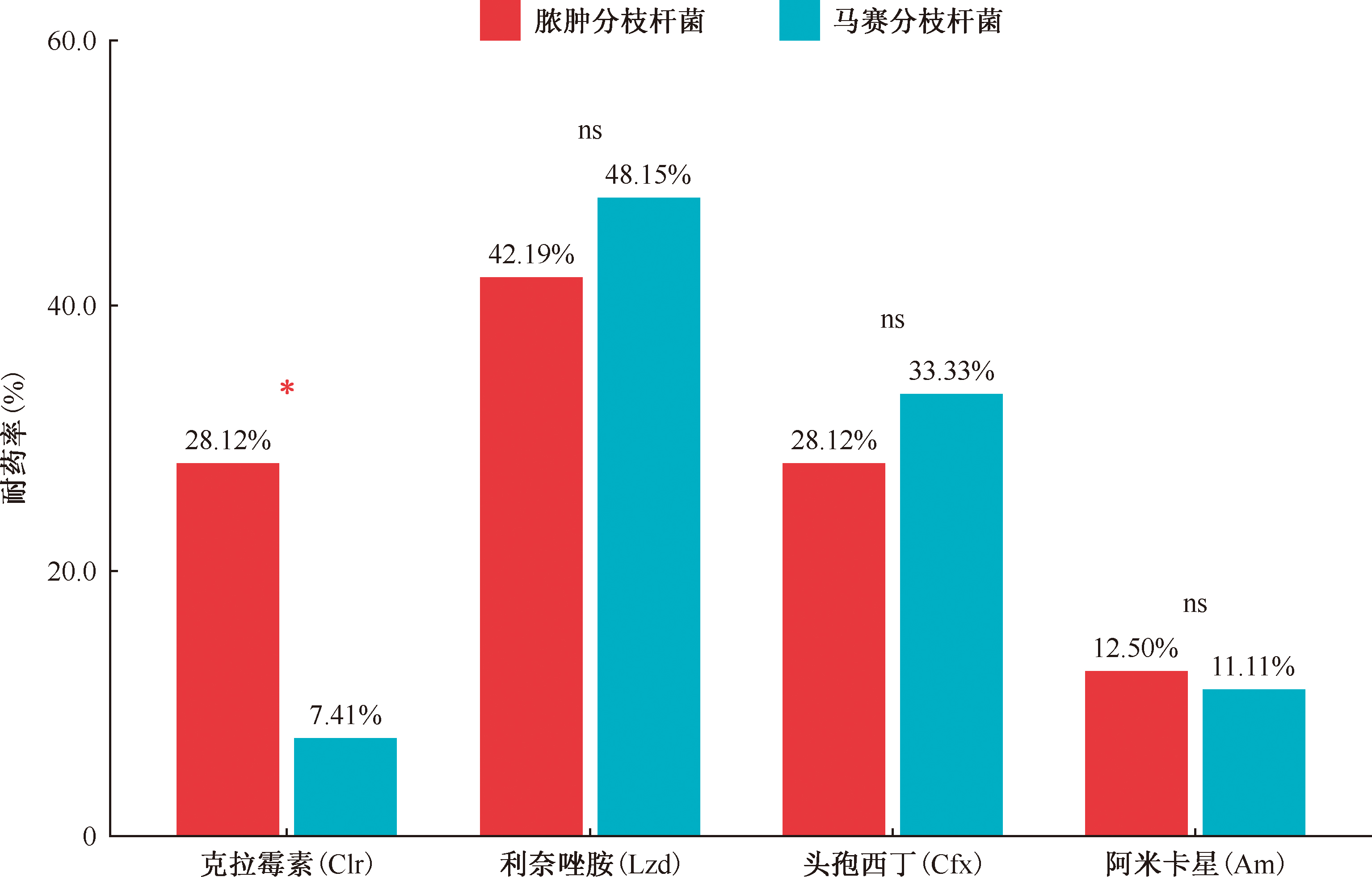
| 临床特征 | 患者例数 (91例) | 联合耐药 (15例) | 非联合耐药 (76例) | χ2值 | P值 |
|---|---|---|---|---|---|
| 菌种亚型 | 4.538 | 0.034 | |||
| 脓肿分枝杆菌 | 64(70.33) | 14(93.33) | 50(65.79) | ||
| 马赛分枝杆菌 | 27(29.67) | 1(6.67) | 26(34.21) | ||
| 治疗分类 | 1.196 | 0.274 | |||
| 初治 | 37(40.66) | 8(53.33) | 29(38.16) | ||
| 复治 | 54(59.34) | 7(46.67) | 47(61.84) | ||
| 年龄组(岁) | 3.156 | 0.206 | |||
| <45 | 46(50.55) | 5(33.33) | 38(50.00) | ||
| 45~59 | 17(18.68) | 5(33.33) | 21(27.63) | ||
| ≥60 | 28(30.77) | 5(33.33) | 17(22.37) | ||
| 性别 | 2.133 | 0.144 | |||
| 女性 | 45(49.45) | 10(66.67) | 35(46.05) | ||
| 男性 | 46(50.55) | 5(33.33) | 41(53.95) | ||
| 慢性阻塞性肺疾病 | -a | 0.584 | |||
| 无 | 85(93.41) | 15(100.00) | 70(92.11) | ||
| 有 | 6(6.59) | 0(0.00) | 6(7.89) | ||
| 支气管扩张症 | 0.344 | 0.557 | |||
| 无 | 61(67.03) | 9(60.00) | 52(68.42) | ||
| 有 | 30(32.97) | 6(40.00) | 24(31.58) |
| [1] | 储美萍, 钱静娟, 程亮, 等. 非结核分枝杆菌病临床特征及临床分离株的菌种分布及耐药性[J]. 中华医院感染学杂志, 2024, 34(1): 41-44. doi:10.11816/cn.ni.2024-230615. |
| [2] |
Ratnatunga C N, Lutzky V P, Kupz A, et al. The rise of non-tuberculosis mycobacterial lung disease[J]. Front Immunol, 2020, 11: 303. doi:10.3389/fimmu.2020.00303.
pmid: 32194556 |
| [3] | 林雪峰, 陈静, 江丹英, 等. 乐清地区308株非结核分枝杆菌菌种鉴定、分布及耐药情况研究[J]. 浙江医学, 2024, 46(3): 317-322. doi:10.12056/j.issn.1006-2785.2024.46.3.2023-2151. |
| [4] | 郭明日, 朱彧, 孙海柏. 脓肿分枝杆菌复合群药敏试验及耐药机制研究进展[J]. 天津医药, 2021, 49(11): 1216-1221. doi:10.11958/20211436. |
| [5] | 郑璐瑶, 陆宇, 陈效友. 非结核分枝杆菌肺病治疗药物研发的现状与挑战[J]. 中国防痨杂志, 2021, 43(7): 729-734. doi:10.3969/j.issn.1000-6621.2021.07.015. |
| [6] | Tortoli E, Kohl T A, Brown-Elliott B A, et al. Emended description of Mycobacterium abscessus, Mycobacterium abscessus subsp. abscessus and Mycobacterium abscessus subsp. bolletii and designation of Mycobacterium abscessus subsp. massiliense comb. nov[J]. Int J Syst Evol Microbiol, 2016, 66(11): 4471-4479. doi:10.1099/ijsem.0.001376. |
| [7] | Yoshida S, Tsuyuguchi K, Suzuki K, et al. Further isolation of Mycobacterium abscessus subsp. abscessus and subsp. bolletii in different regions of Japan and susceptibility of these isolates to antimicrobial agents[J]. Int J Antimicrob Agents, 2013, 42(3): 226-231. doi:10.1016/j.ijantimicag.2013.04.029. |
| [8] | Dedrick R M, Abad L, Storey N, et al. The problem of Mycobacterium abscessus complex: multi-drug resistance, bacteriophage susceptibility and potential healthcare transmission[J]. Clin Microbiol Infect, 2023, 29(10): 1335. e9-1335.e16. doi:10.1016/j.cmi.2023.06.014. |
| [9] | Hou Y, Pi R, Jia J, et al. Limited predictive power of known resistance genes for phenotypic drug resistance in clinical Mycobacterium abscessus complex from Beijing in China[J]. Antimicrob Agents Chemother, 2025, 69(7): e01847-24. doi:10.1128/aac.01847-24. |
| [10] | 中华医学会结核病学分会. 非结核分枝杆菌病诊断与治疗指南(2020年版)[J]. 中华结核和呼吸杂志, 2020, 43(11): 918-946. doi:10.3760/cma.j.cn112147-20200508-00570. |
| [11] | Guo W, Shangguan Y, Ji Z, et al. Clinical characteristics and antimicrobial susceptibility profiles of Mycobacterium abscessus and Mycobacterium massiliense pulmonary infection[J]. J Glob Antimicrob Resist, 2024, 38: 83-89. doi:10.1016/j.jgar.2024.01.006. |
| [12] | 刘婷, 梁颖, 伍仕敏, 等. 荧光熔解曲线法和GeneXpert MTB/RIF技术对结核分枝杆菌复合群和利福平耐药检测结果的比较[J]. 临床血液学杂志, 2022, 35(2): 112-116. doi:10.13201/j.issn.1004-2806.2022.02.007. |
| [13] | 胡晓红, 韩宇, 庄倩, 等. 荧光PCR熔解曲线法分析宜昌地区非结核分枝杆菌感染的流行特征[J]. 中国感染控制杂志, 2023, 22(8): 939-944. doi:10.12138/j.issn.1671-9638.20233435. |
| [14] | Li H, Mulati G, Shang Y, et al. Rapid detection of clarithromycin and amikacin resistance in Mycobacterium abscessus complex by high-resolution melting curve analysis[J]. Microbiol Spectr, 2022, 10(3): e0057422. doi:10.1128/spectrum.00574-22. |
| [15] | Gupta R S, Lo B, Son J. Phylogenomics and comparative genomic studies robustly support division of the genus Mycobacterium into an emended genus Mycobacterium and four novel genera[J]. Front Microbiol, 2018, 9: 67. doi:10.3389/fmicb.2018.00067. |
| [16] |
Jain C, Rodriguez-R L M, Phillippy A M, et al. High throughput ANI analysis of 90K prokaryotic genomes reveals clear species boundaries[J]. Nat Commun, 2018, 9(1): 5114. doi:10.1038/s41467-018-07641-9.
pmid: 30504855 |
| [17] |
Wang X, Dai Y, Wang X, et al. Mycobacteroides abscessus subspecies: a comparative genomic analysis reveals unique metabolic activities and drug resistance patterns[J]. BMC Microbiol, 2025, 25(1): 308. doi:10.1186/s12866-025-04010-7.
pmid: 40389879 |
| [18] | Victoria L, Gupta A, Gómez J L, et al. Mycobacterium abscessus complex: a review of recent developments in an emerging pathogen[J]. Front Cell Infect Microbiol, 2021, 11: 659997. doi:10.3389/fcimb.2021.659997. |
| [19] | Clinical and Laboratory Standards Institute. Susceptibility testing of Mycobacteria, Nocardia spp., and other aerobic Actinomycetes. 2nd ed. CLSI standard M24-A2[M]. Wayne, PA: Clinical and Laboratory Standards Institute, 2011: 24-25, 39. |
| [20] | Clinical and Laboratory Standards Institute. Performance standards for susceptibility testing of Mycobacteria, Nocardia spp., and other aerobic Actinomycetes. 1st ed. CLSI standard M62[M]. Wayne, PA: Clinical and Laboratory Standards Institute, 2018: 5. |
| [21] | Daley C L, Iaccarino J M, Lange C, et al. Treatment of nontuberculous mycobacterial pulmonary disease: an official ATS/ERS/ESCMID/IDSA clinical practice guideline[J]. Eur Respir J, 2020, 56(1): 2000535. doi:10.1183/13993003.00535-2020. |
| [22] | 王少华, 常文静, 郑丹薇, 等. 河南32株脓肿分枝杆菌复合群菌株药敏及基因分型[J]. 中国热带医学, 2025, 25(6): 690-697. doi:10.13604/j.cnki.46-1064/r.2025.06.07. |
| [23] | 芮啸. 非结核分枝杆菌(NTM)肺病病原菌分布特征及药敏试验结果分析[J]. 当代临床医刊, 2025, 37(5): 49-51. doi:10.3969/j.issn.2095-9559.2024.05.016. |
| [24] | Yang J H, Wang P H, Pan S W, et al. Treatment outcome in patients with Mycobacterium abscessus complex lung disease: the impact of tigecycline and amikacin[J]. Antibiotics, 2022, 11(5): 571. doi:10.3390/antibiotics11050571. |
| [25] | Liu Q, Du J, An H, et al. Clinical characteristics of patients with non-tuberculous mycobacterial pulmonary disease: a seven-year follow-up study conducted in a certain tertiary hospital in Beijing[J]. Front Cell Infect Microbiol, 2023, 13: 1205225. doi:10.3389/fcimb.2023.1205225. |
| [26] | 王飞, 华朵, 郭建建, 等. 2021—2023年武汉地区非结核分枝杆菌肺病患者特征分析[J]. 中国防痨杂志, 2024, 46(9): 1069-1076. doi:10.19982/j.issn.1000-6621.20240179. |
| [27] | 张卉, 葛莉, 张煜涵, 等. 34例非结核分枝杆菌病的临床病理特征分析[J]. 中国防痨杂志, 2024, 46(7): 756-762. doi:10.19982/j.issn.1000-6621.20240151. |
| [28] | 马沐泽, 董昭兴. 2019—2023年宁波市非结核分枝杆菌肺病菌种类型和流行病学特征分析[J]. 现代实用医学, 2025, 37(9): 918-920. doi:10.3969/j.issn.1671-0800.2025.09.010. |
| [29] | Moon S M, Park H Y, Kim S Y, et al. Clinical characteristics, treatment outcomes, and resistance mutations associated with macrolide-resistant Mycobacterium avium complex lung disease[J]. Antimicrob Agents Chemother, 2016, 60(11): 6758-6765. doi:10.1128/AAC.01240-16. |
| [30] | Liu C F, Song Y M, He W C, et al. Nontuberculous mycobacteria in China: incidence and antimicrobial resistance spectrum from a nationwide survey[J]. Infect Dis Poverty, 2021, 10(1): 59. doi:10.1186/s40249-021-00844-1. |
| [31] | 梁锋, 刘德情, 陈华, 等. 广州市非结核分枝杆菌病流行病学特征分析[J]. 中国防痨杂志, 2024, 46(11): 1373-1379. doi:10.19982/j.issn.1000-6621.20240185. |
| [32] | 王怡婷, 郑惠文, 赵冰, 等. 脓肿分枝杆菌复合群对克拉霉素耐药基因的初步研究[J]. 中国防痨杂志, 2021, 43(12): 1302-1308. doi:10.3969/j.issn.1000-6621.2021.12.012. |
| [33] | Pasipanodya J G, Ogbonna D, Ferro B E, et al. Systematic review and meta-analyses of the effect of chemotherapy on pulmonary Mycobacterium abscessus outcomes and disease recurrence[J]. Antimicrob Agents Chemother, 2017, 61(11): e01206-17. doi:10.1128/AAC.01206-17. |
| [34] |
Nessar R, Cambau E, Reyrat J M, et al. Mycobacterium abscessus: a new antibiotic nightmare[J]. J Antimicrob Chemother, 2012, 67(4): 810-818. doi:10.1093/jac/dkr578.
pmid: 22290346 |
| [35] |
Chew K L, Octavia S, Go J, et al. In vitro susceptibility of Mycobacterium abscessus complex and feasibility of standardizing treatment regimens[J]. J Antimicrob Chemother, 2021, 76(4): 973-978. doi:10.1093/jac/dkaa537.
pmid: 33338230 |
| [1] | Zhao Yuchuan, Chen Yanmei, Zhang Chenchen, Yu Meiling, Peng Kehao, Xu Liuyue, Liang Hongdi, Chen Xunxun. Research on performance comparison and selection strategies of digital PCR platforms for tuberculosis detection [J]. Chinese Journal of Antituberculosis, 2026, 48(9): 1331-1337. |
| [2] | Li Jing, Zhang Yangyi, Yang Jinghui, Wu Zheyuan, Li Ningdi, Yu Chenlei, Wang Lili, Shen Xuhui, Jiang Yuan, Shen Xin. Study on the characteristics of rpoB gene mutations in Mycobacterium tuberculosis and its correlation with rifampicin resistance level in Shanghai [J]. Chinese Journal of Antituberculosis, 2026, 48(4): 485-494. |
| [3] | Ni Sheng, Sha Wei, Wang Li. Research progress on the mechanisms of lung injury caused by Mycobacterium abscessus [J]. Chinese Journal of Antituberculosis, 2026, 48(3): 419-425. |
| [4] | Lin Weibing, Shi Yiheng, Guo Yanling, Ma Shang, Yang Bin, Long Sibo, Zheng Maike, Sun Yong, Zhao Yan, Wang Guirong. Analysis of drug resistance patterns in 241 patients with lymph node tuberculosis [J]. Chinese Journal of Antituberculosis, 2026, 48(2): 247-255. |
| [5] | Su Dahong, Li Xiaoli, Yang Bin, Shi Yiheng, Lin Weibing, Miao Tiantian, Zhao Jinfeng, Ma Shang, Huo Fengmin, Wang Guirong. Analysis of drug resistance to bedaquiline, delamanid and linezolid in patients with pulmonary tuberculosis [J]. Chinese Journal of Antituberculosis, 2026, 48(10): 1523-1530. |
| [6] | Gu Yuzhen, Chen Siyi, Huang Hairong, Yu Xia. Evaluation of in vitro activity of lefamulin against mycobacteria [J]. Chinese Journal of Antituberculosis, 2025, 47(6): 732-737. |
| [7] | Tuberculosis Basic Professional Branch, Chinese Antituberculosis Association. Expert consensus on the standardization of broth microdilution method for drug susceptibility testing of Mycobacterium tuberculosis in China [J]. Chinese Journal of Antituberculosis, 2025, 47(5): 535-545. |
| [8] | Li Nana, Wang Hong, Tian Peng, Wen Jixiu, Yang Dan, Wu Xia, Lan Yuanbo. Investigation into the impact of Rv2048c gene knockout on the drug susceptibility of Mycobacterium tuberculosis [J]. Chinese Journal of Antituberculosis, 2025, 47(12): 1621-1628. |
| [9] | Chen Shuangshuang, Tian Lili, Wang Nenhan, Yang Xinyu, Zhao Yanfeng, Li Chuanyou, Dai Xiaowei. Analysis of in vitro antibacterial effects of 17 antibiotics against rapidly growing mycobacteria in the Beijing area [J]. Chinese Journal of Antituberculosis, 2024, 46(9): 1056-1062. |
| [10] | Yu Lan, Chen Shuangshuang, Wang Nenhan, Tian Lili, Zhao Yanfeng, Fan Ruifang, Liu Haican, Li Chuanyou, Dai Xiaowei. Consistency between phenotypic resistance to fluoroquinolones and genetic mutations in rifampicin resistant Mycobacterium tuberculosis strains [J]. Chinese Journal of Antituberculosis, 2024, 46(8): 942-950. |
| [11] | Cheng Mengli, Jiang Guanglu, Huo Fengmin, Xue Yi, Yu Xia. Evaluation of in vitro activity of fusidic acid against mycobacteria [J]. Chinese Journal of Antituberculosis, 2024, 46(4): 461-466. |
| [12] | Pei Shaojun, Ou Xichao. Interpretation of the World Health Organization’s Catalogue of mutations in Mycobacterium tuberculosis complex and their association with drug resistance (2nd Edition) [J]. Chinese Journal of Antituberculosis, 2024, 46(3): 260-266. |
| [13] | Ma Shiran, Chen Suting, Huang Hairong, Duan Hongfei. In vitro inhibitory and intracellular bactericidal activity of omadacycline against Mycobacterium abscessus [J]. Chinese Journal of Antituberculosis, 2024, 46(12): 1442-1447. |
| [14] | Li Jing, Jiang Qi, Jiang Yuan, Shen Xin. Evaluation of performance of PCR fluorescent probe method for detecting Mycobacterium tuberculosis complex and rifampicin resistance [J]. Chinese Journal of Antituberculosis, 2024, 46(10): 1250-1258. |
| [15] | Song Yuanyuan, Xia Hui, Zhao Yanlin. Development process of setting of critical concentrations for phenotypic drug susceptibility testing of Mycobacterium tuberculosis [J]. Chinese Journal of Antituberculosis, 2023, 45(7): 631-638. |
| Viewed | ||||||
|
Full text |
|
|||||
|
Abstract |
|
|||||
 京公网安备11010202007215号
Total visitors: Visitors of today: Now online:
京公网安备11010202007215号
Total visitors: Visitors of today: Now online:
 This work is licensed under Creative Commons Attribution 3.0 License.
