
Chinese Journal of Antituberculosis ›› 2026, Vol. 48 ›› Issue (1): 94-105.doi: 10.19982/j.issn.1000-6621.20250311
• Original Articles • Previous Articles Next Articles
Chen Depan1,2, Li Xiang3, Zhang Kaiyi4, Li Min1,2, Xia Jiawei1, Gao ChuYi1, Yang Yatao1, Zhang Le1( )
)
Received:2025-07-31
Online:2026-01-10
Published:2025-12-31
Contact:
Zhang Le,Email: Supported by:CLC Number:
Chen Depan, Li Xiang, Zhang Kaiyi, Li Min, Xia Jiawei, Gao ChuYi, Yang Yatao, Zhang Le. To construct a risk prediction model for adult chronic kidney disease complicated with active tuberculosis based on logistic regression, decision tree, and neural network[J]. Chinese Journal of Antituberculosis, 2026, 48(1): 94-105. doi: 10.19982/j.issn.1000-6621.20250311
Add to citation manager EndNote|Ris|BibTeX
URL: https://www.zgflzz.cn/EN/10.19982/j.issn.1000-6621.20250311

| 不同特征 | 合计(392例) | 观察组(266例) | 对照组(126例) | 统计检验值 | P值 | |||||
|---|---|---|---|---|---|---|---|---|---|---|
| 年龄(岁, | 57.78±16.02 | 56.83±15.96 | 59.76±16.02 | t=-1.694 | 0.091 | |||||
| 性别[例(构成比,%)] | χ2=1.090 | 0.296 | ||||||||
| 男性 | 299(76.28) | 207(77.82) | 92(73.02) | |||||||
| 女性 | 93(23.72) | 59(22.18) | 34(26.98) | |||||||
| 合并症[例(构成比,%)] | ||||||||||
| 高血压 | 210(53.57) | 152(57.14) | 58(46.03) | χ2=4.244 | 0.039 | |||||
| 糖尿病 | 141(35.97) | 105(39.47) | 36(28.57) | χ2=4.412 | 0.036 | |||||
| 个人史[例(构成比,%)] | ||||||||||
| 吸烟 | 110(28.06) | 82(30.83) | 28(22.22) | χ2=3.136 | 0.077 | |||||
| 饮酒 | 123(31.38) | 93(34.96) | 30(23.81) | χ2=4.939 | 0.026 | |||||
| 粉尘接触 | 24(6.12) | 18(6.78) | 6(4.76) | χ2=0.598 | 0.439 | |||||
| 实验室检查 | ||||||||||
| PH值[M(Q1,Q3)] | 7.39(7.35,7.43) | 7.40(7.33,7.43) | 7.38(7.36,7.44) | Z=-1.565 | 0.118 | |||||
| 氧分压[mmHg,M(Q1,Q3)] | 80.50(68.00,95.00) | 80.00(69.00,99.00) | 83.00(66.00,86.26) | Z=-0.982 | 0.326 | |||||
| 血氧饱和度[%,M(Q1,Q3)] | 94.00(93.89,97.00) | 94.00(93.89,97.00) | 94.00(93.00,96.00) | Z=-0.531 | 0.595 | |||||
| 氧合指数[M(Q1,Q3)] | 188.89(155.56,197.22) | 190.16(157.78,202.22) | 184.44(146.67,190.16) | Z=-1.434 | 0.151 | |||||
| Na+[mmol/L,M(Q1,Q3)] | 138.70(135.38,141.50) | 138.80(135.90,141.40) | 138.17(135.00,141.70) | Z=-0.743 | 0.458 | |||||
| K+[mmol/L,M(Q1,Q3)] | 4.30(3.83,4.83) | 4.30(3.84,4.85) | 4.31(3.81,4.76) | Z=-0.256 | 0.798 | |||||
| Cl+[mmol/L,M(Q1,Q3)] | 103.15(98.90,107.28) | 103.40(99.10,107.75) | 102.98(98.40,106.90) | Z=-0.963 | 0.335 | |||||
| 白细胞计数[×109/L,M(Q1,Q3)] | 6.59(5.09,8.85) | 6.40(5.06,8.65) | 6.98(5.19,9.11) | Z=-0.933 | 0.351 | |||||
| 中性粒细胞计数[×109/L, M(Q1,Q3)] | 4.65(3.21,6.66) | 4.51(3.27,6.57) | 4.92(3.15,6.96) | Z=-0.209 | 0.834 | |||||
| 淋巴细胞计数[×109/L,M(Q1,Q3)] | 1.07(0.72,1.45) | 1.04(0.68,1.38) | 1.13(0.74,1.78) | Z=-2.229 | 0.026 | |||||
| 单核细胞计数[×109/L,M(Q1,Q3)] | 0.52(0.37,0.66) | 0.51(0.36,0.65) | 0.53(0.37,0.73) | Z=-0.352 | 0.725 | |||||
| 血小板[×109/L,M(Q1,Q3)] | 223.50(166.25,289.00) | 223.00(164.75,286.50) | 224.00(168.00,298.00) | Z=-0.876 | 0.381 | |||||
| 红细胞压积[%,M(Q1,Q3)] | 31.45(25.20,37.60) | 30.60(24.48,36.60) | 32.70(28.20,39.70) | Z=-3.052 | 0.002 | |||||
| 血红蛋白[g/L,M(Q1,Q3)] | 102.00(82.00,123.75) | 99.50(81.00,118.00) | 105.00(91.00,128.00) | Z=-2.361 | 0.018 | |||||
| 总胆红素[μmol/L,M(Q1,Q3)] | 6.00(4.03,8.98) | 5.70(3.90,8.73) | 6.70(4.30,9.30) | Z=-1.820 | 0.069 | |||||
| 前白蛋白[mg/L,M(Q1,Q3)] | 229.75(179.35,282.20) | 226.55(175.98,278.53) | 233.45(180.20,282.80) | Z=-0.704 | 0.481 | |||||
| 白蛋白[g/L,M(Q1,Q3)] | 32.49(28.00,36.95) | 32.90(28.18,36.85) | 32.20(27.30,37.10) | Z=-1.222 | 0.222 | |||||
| 肌酐[μmol/L,M(Q1,Q3)] | 412.00(159.00,770.75) | 411.50(154.75,768.00) | 460.00(181.00,792.00) | Z=-0.503 | 0.615 | |||||
| 尿素[mmol/L,M(Q1,Q3)] | 15.25(9.18,22.92) | 15.50(9.33,23.53) | 14.50(9.07,22.40) | Z=-0.250 | 0.803 | |||||
| 尿酸[μmol/L,M(Q1,Q3)] | 457.00(364.25,553.75) | 461.00(374.00,567.25) | 432.00(336.00,517.00) | Z=-2.160 | 0.031 | |||||
| PT活动度[%,M(Q1,Q3)] | 91.93(83.53,98.63) | 92.66(84.06,99.01) | 90.86(80.12,97.32) | Z=-1.875 | 0.061 | |||||
| 纤维蛋白原[g/L,M(Q1,Q3)] | 4.12(3.11,5.30) | 4.09(3.01,5.27) | 4.16(3.46,5.55) | Z=-1.713 | 0.087 | |||||
| 纤维蛋白原降解产物[μg/ml, M(Q1,Q3)] | 5.77(3.28,11.29) | 6.87(3.53,13.26) | 4.52(2.55,8.60) | Z=-2.593 | 0.010 | |||||
| D-二聚体[μg/ml,M(Q1,Q3)] | 1.76(0.84,4.03) | 1.75(0.85,3.70) | 1.97(0.82,4.57) | Z=-1.088 | 0.277 | |||||
| C反应蛋白[mg/L,M(Q1,Q3)] | 16.30(5.49,41.88) | 17.64(4.85,40.18) | 15.80(5.60,58.30) | Z=-0.419 | 0.675 | |||||
| 降钙素原[ng/ml,M(Q1,Q3)] | 0.36(0.09,1.15) | 0.35(0.10,1.15) | 0.40(0.08,1.11) | Z=-0.312 | 0.755 | |||||
| IgG[g/L,M(Q1,Q3)] | 11.71(9.07,14.11) | 11.92(9.26,14.14) | 10.89(7.89,14.08) | Z=-1.128 | 0.259 | |||||
| IgM[g/L,M(Q1,Q3)] | 0.79(0.55,1.07) | 0.82(0.56,1.10) | 0.77(0.52,0.97) | Z=-0.972 | 0.331 | |||||
| IgA[g/L,M(Q1,Q3)] | 2.07(1.33,2.69) | 2.00(1.32,2.87) | 2.07(1.33,2.51) | Z=-0.678 | 0.498 | |||||
| IL-2[pg/ml,M(Q1,Q3)] | 2.04(1.32,3.06) | 1.92(1.32,3.10) | 2.13(1.32,2.97) | Z=-1.167 | 0.243 | |||||
| IL-4[pg/ml,M(Q1,Q3)] | 1.36(1.03,1.94) | 1.37(1.07,1.97) | 1.31(0.85,1.80) | Z=-0.354 | 0.723 | |||||
| IL-5[pg/ml,M(Q1,Q3)] | 2.65(1.94,3.79) | 2.62(1.81,3.75) | 2.70(2.17,3.79) | Z=-0.859 | 0.390 | |||||
| IL-6[pg/ml,M(Q1,Q3)] | 12.20(4.44,31.82) | 12.10(4.24,26.21) | 15.84(5.15,39.77) | Z=-3.051 | 0.002 | |||||
| IL-8[pg/ml,M(Q1,Q3)] | 3.81(1.74,16.01) | 4.68(1.74,17.91) | 2.99(1.74,7.89) | Z=-0.613 | 0.540 | |||||
| IL-10[pg/ml,M(Q1,Q3)] | 2.30(1.36,3.34) | 2.07(1.37,3.24) | 2.81(1.35,4.08) | Z=-2.663 | 0.008 | |||||
| 肿瘤坏死因子[pg/ml, M(Q1,Q3)] | 1.89(1.25,3.92) | 1.93(1.25,3.69) | 1.76(1.23,4.88) | Z=-1.576 | 0.115 | |||||
| γ干扰素[pg/ml,M(Q1,Q3)] | 5.40(2.93,16.73) | 6.30(3.44,21.37) | 3.20(1.94,12.35) | Z=-1.163 | 0.245 | |||||
| CD3+ T淋巴细胞[个/μl, M(Q1,Q3)] | 935.32(655.00,1086.00) | 935.32(636.50,1078.50) | 935.32(798.00,1113.00) | Z=-1.408 | 0.159 | |||||
| CD4+ T淋巴细胞[个/μl, M(Q1,Q3)] | 525.40(364.25,638.50) | 525.40(337.75,633.25) | 525.40(454.00,669.00) | Z=-2.290 | 0.022 | |||||
| CD8+ T淋巴细胞[个/μl, M(Q1,Q3)] | 382.60(258.00,431.25) | 379.50(245.75,420.75) | 382.60(273.00,454.00) | Z=-1.554 | 0.120 | |||||
| CD4+/CD8+比值[M(Q1,Q3)] | 1.63(1.20,1.78) | 1.63(1.12,1.91) | 1.63(1.36,1.75) | Z=-1.078 | 0.281 | |||||
| NK细胞[个/μl,M(Q1,Q3)] | 71.00(39.10,129.50) | 67.00(38.00,114.00) | 91.80(43.73,155.75) | Z=-1.772 | 0.076 | |||||
| B淋巴细胞[个/μl,M(Q1,Q3)] | 104.50(50.03,174.50) | 104.50(44.05,192.00) | 89.50(53.03,121.75) | Z=-1.006 | 0.314 | |||||
| CA125[U/ml,M(Q1,Q3)] | 24.02(13.37,47.66) | 24.73(12.40,53.29) | 22.83(14.30,44.47) | Z=-1.020 | 0.308 | |||||
| 症状 | 合计(392例) | 观察组(266例) | 对照组(126例) | χ2值 | P值 |
|---|---|---|---|---|---|
| 咳嗽 | 209(53.32) | 145(54.51) | 64(50.79) | 0.475 | 0.491 |
| 咳痰 | 189(48.21) | 127(47.74) | 62(49.21) | 0.073 | 0.787 |
| 乏力 | 81(20.66) | 61(22.93) | 20(15.80) | 2.599 | 0.107 |
| 发热 | 88(22.45) | 62(23.31) | 26(20.63) | 0.351 | 0.554 |
| 盗汗 | 28(7.14) | 22(8.27) | 6(4.76) | 1.587 | 0.208 |
| 咯血 | 51(13.01) | 45(16.92) | 6(4.76) | 11.162 | 0.001 |
| 胸闷胸痛 | 132(33.67) | 90(33.83) | 42(33.33) | 0.010 | 0.922 |
| 呼吸困难 | 39(9.95) | 25(9.40) | 14(11.11) | 0.280 | 0.597 |
| 体质量减轻 | 61(15.56) | 49(18.42) | 12(9.52) | 5.151 | 0.023 |
| 恶心呕吐 | 40(10.20) | 30(11.28) | 10(7.94) | 1.042 | 0.307 |
| 食欲不振 | 118(30.10) | 90(33.83) | 28(22.22) | 5.480 | 0.019 |
| 贫血 | 220(56.12) | 158(59.40) | 62(49.21) | 3.607 | 0.058 |
| 尿量减少 | 148(37.76) | 104(39.10) | 44(34.92) | 0.635 | 0.426 |
| 变量 | 赋值 | 变量 | 赋值 |
|---|---|---|---|
| 高血压 | 有=1,无=2 | 红细胞压积 | 原值输入 |
| 糖尿病 | 有=1,无=2 | 血红蛋白 | 原值输入 |
| 饮酒 | 是=1,否=2 | 尿酸 | 原值输入 |
| 咯血 | 是=1,否=2 | 纤维蛋白原降解产物 | 原值输入 |
| 体质量减轻 | 是=1,否=2 | IL-6 | 原值输入 |
| 食欲不振 | 是=1,否=2 | IL-10 | 原值输入 |
| 淋巴细胞计数 | 原值输入 | CD4+ T淋巴细胞计数 | 原值输入 |
| 变量 | β值 | s | Wald χ2值 | P值 | OR值 | 95%CI值 |
|---|---|---|---|---|---|---|
| 高血压 | 0.361 | 0.245 | 2.170 | 0.141 | 1.434 | 0.888~2.317 |
| 糖尿病 | 0.312 | 0.261 | 1.422 | 0.233 | 1.366 | 0.818~2.279 |
| 饮酒 | 0.696 | 0.279 | 6.202 | 0.013 | 2.005 | 1.160~3.467 |
| 咯血 | 1.002 | 0.474 | 4.464 | 0.035 | 2.724 | 1.075~6.901 |
| 体质量减轻 | 0.228 | 0.385 | 0.349 | 0.555 | 1.255 | 0.590~2.671 |
| 食欲不振 | 0.419 | 0.293 | 2.044 | 0.153 | 1.520 | 0.856~2.697 |
| 淋巴细胞计数 | -0.657 | 0.247 | 7.065 | 0.008 | 0.518 | 0.319~0.842 |
| 红细胞压积 | -0.083 | 0.040 | 4.265 | 0.039 | 0.920 | 0.851~0.996 |
| 血红蛋白 | 0.016 | 0.013 | 1.507 | 0.220 | 1.016 | 0.991~1.042 |
| 尿酸 | 0.002 | 0.001 | 4.249 | 0.039 | 1.002 | 1.001~1.003 |
| 纤维蛋白原降解产物 | -0.040 | 0.011 | 12.402 | <0.001 | 0.960 | 0.939~0.982 |
| IL-6 | <0.001 | 0.001 | 0.507 | 0.477 | 1.000 | 1.000~1.001 |
| IL-10 | -0.044 | 0.020 | 4.764 | 0.029 | 0.957 | 0.920~0.996 |
| CD4+ T淋巴细胞计数 | <0.001 | 0.001 | 0.519 | 0.471 | 1.000 | 0.999~1.002 |
| 常量 | 1.366 | 0.704 | 3.768 | 0.052 | 3.920 |
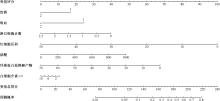

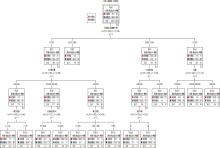

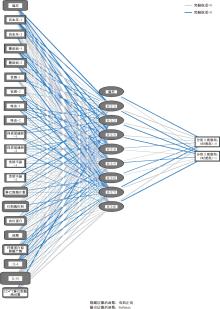

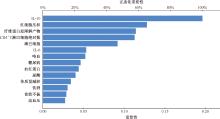
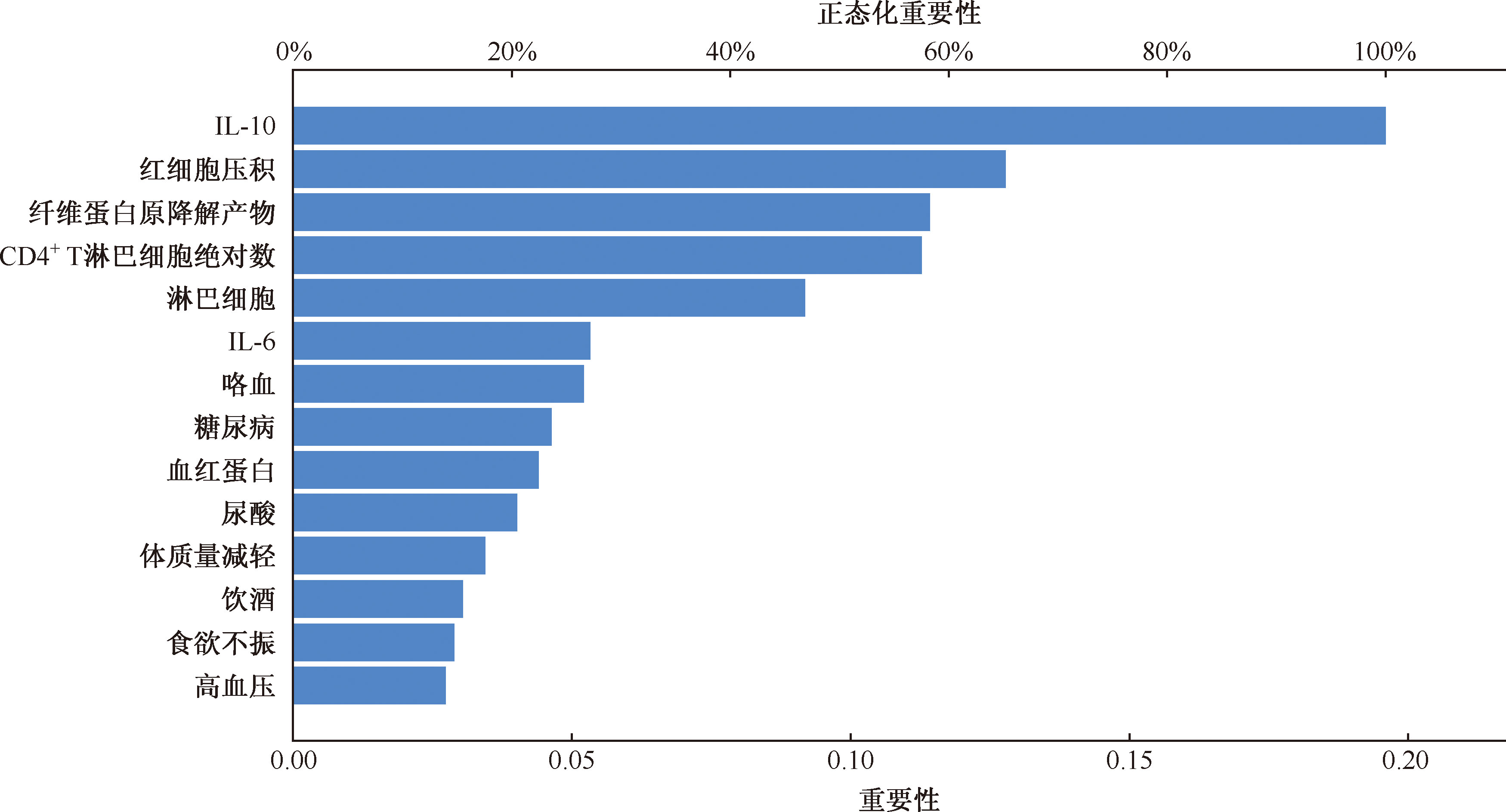
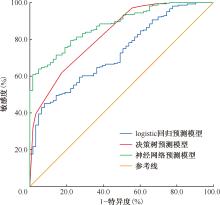

| 模型 | AUC值 | 95%CI值 | 敏感度 (%) | 特异度 (%) | 约登指数 | F1分数 | 马修斯 相关系数 | 标准误 | P值 |
|---|---|---|---|---|---|---|---|---|---|
| logistic回归模型 | 0.726 | 0.676~0.777 | 45.1 | 92.1 | 0.372 | 0.604 | 0.413 | 0.026 | <0.001 |
| 决策树模型 | 0.825 | 0.783~0.868 | 62.0 | 82.5 | 0.445 | 0.707 | 0.450 | 0.022 | <0.001 |
| 神经网络模型 | 0.876 | 0.843~0.909 | 60.9 | 98.4 | 0.593 | 0.753 | 0.654 | 0.017 | <0.001 |
| 模型 | 观察组[例(准确率,%] | 对照组[例(准确率,%] | χ2值 | P值 |
|---|---|---|---|---|
| logistic回归模型 | 240(90.2) | 42(33.3) | ||
| 决策树模型 | 258(96.9) | 44(35.2) | 25.562 | <0.001 |
| 神经网络模型 | 247(92.8) | 97(77.5) |
| [1] | 中华医学会结核病学分会. 慢性肾脏病合并结核病的治疗专家共识(2022版). 中华结核和呼吸杂志, 2022, 45(10):996-1008. doi:10.3760/cma.j.cn112147-20220327-00241. |
| [2] | Lv JC, Zhang LX. Prevalence and Disease Burden of Chronic Kidney Disease. Adv Exp Med Biol, 2019, 1165:3-15. doi:10.1007/978-981-13-8871-2_1. |
| [3] |
Wang L, Xu X, Zhang M, et al. Prevalence of Chronic Kidney Disease in China: Results From the Sixth China Chronic Disease and Risk Factor Surveillance. JAMA Intern Med, 2023, 183(4):298-310. doi:10.1001/jamainternmed.2022.6817.
pmid: 36804760 |
| [4] | 陈德盼, 李翔, 张开义, 等. 慢性肾脏病合并结核感染危险因素及免疫学特征研究进展. 中国预防医学杂志, 2025, 26(4):505-508. doi:10.16506/j.1009-6639.2025.04.020. |
| [5] | Moran E, Baharani J, Dedicoat M, et al. Risk factors associated with the development of active tuberculosis among patients with advanced chronic kidney disease. J Infect, 2018, 77(4): 291295. doi:10.1016/j.jinf.2018.06.003. |
| [6] | 付寒, 王鹏, 张宗华, 等. 标准抗结核治疗方案对耐多药肺结核患者肾功能的影响分析. 新发传染病电子杂志, 2022, 7(3):32-36. doi:10.19871/j.cnki.xfcrbzz.2022.03.007. |
| [7] | 李颖, 熊迪, 邹吉利, 等. 93例药源性肾损伤文献分析. 医药导报, 2021, 40(6):831-834. doi:10.3870/j.issn.1004-0781.2021.06.025. |
| [8] | Sahu N, Rakshit S, Nirala SK, et al. Naringenin protects hepato-renal tissues against antituberculosis drugs induced toxic manifestations by modulating interleukin-6, insulin like growth factor-1, biochemical and ultra-structural integrity. Mol Biol Rep, 2023, 50(2):1019-1031. doi:10.1007/s11033-022-07799-y. |
| [9] | 高艳萍. 肾病综合征合并结核感染患者的临床特征及预后分析. 南昌: 南昌大学, 2023. doi:10.27232/d.cnki.gnchu.2023.001378. |
| [10] | 上海市肾内科临床质量控制中心专家组. 慢性肾脏病早期筛查、诊断及防治指南(2022年版). 中华肾脏病杂志, 2022, 38(5):453-464. doi:10.3760/cma.j.cn441217-20210819-00067. |
| [11] | 中华人民共和国国家卫生和计划生育委员会. WS 288—2017肺结核诊断. 结核与肺部疾病杂志, 2024, 5(4):376-378. doi:10.19983/j.issn.2096-8493.2024022. |
| [12] | 中华人民共和国国家卫生和计划生育委员会. WS 196—2017结核病分类. 结核与肺部疾病杂志, 2024, 5(4):379-380. doi:10.19983/j.issn.2096-8493.2024055. |
| [13] | 中国疾病预防控制中心结核病预防控制中心. 中国结核病防治工作技术指南. 北京: 人民卫生出版社, 2021. |
| [14] | 朱倩莹, 程耀, 唐建, 等. 尿毒症维持性血液透析患者合并结核分枝杆菌感染调查及其影响因素分析. 中国国境卫生检疫杂志, 2021, 44(2):130-132. doi:10.16408/j.1004-9770.2021.02.016. |
| [15] | 胡鑫洋, 高静韬. 世界卫生组织《2024年全球结核病报告》解读. 结核与肺部疾病杂志, 2024, 5(6):500-504. doi:10.19983/j.issn.2096-8493.2024164. |
| [16] | 熊晶, 朱维芳, 梅蕊. 溶栓前血糖、D-二聚体和纤维蛋白降解产物水平与老年急性脑梗死阿替普酶静脉溶栓治疗疗效和预后的相关性分析. 老年医学与保健, 2021, 27(4):772-775. doi:10.3969/j.issn.1008-8296.2021.04.022. |
| [17] | 赵志明, 马诗静, 李莉. 慢性肾脏病患者凝血功能变化及与肾功能指标的相关性. 微循环学杂志, 2022, 32(3):52-56. doi:10.3969/j.issn.1005-1740.2022.03.011. |
| [18] | 贾月, 于洪志. 活动性结核病合并急性肺血栓栓塞症的影响因素分析. 天津医药, 2025, 53(2):165-169. doi:10.11958/20241508. |
| [19] | 张文, 冯晓蓓, 马宏昆. 非典型溶血性尿毒症综合征诊断上海专家共识. 上海医学, 2025, 48(1):1-9. doi:10.19842/j.cnki.issn.0253-9934.2025.01.001. |
| [20] | Palomero J, Panisello C, Lozano-Rabella M, et al. Biomarkers of tumor-reactive CD4+ and CD8+ TILs associate with improved prognosis in endometrial cancer. J Immunother Cancer, 2022, 10(12):e005443. doi:10.1136/jitc-2022-005443. |
| [21] | 李虎, 黄永平, 缪军, 等. 中性粒细胞与淋巴细胞比值联合白蛋白-胆红素评分对不可切除乙型肝炎相关性肝细胞癌患者动脉化疗栓塞治疗转归的评估价值. 传染病信息, 2025, 38(2):109-115. doi:10.3969/j.issn.1007-8134.2025.02.002. |
| [22] | 李继燕, 胡海英, 冷洁, 等. 莫西沙星+利福平+吡嗪酰胺+乙胺丁醇化疗方案与异烟肼+利福平+吡嗪酰胺+乙胺丁醇化疗方案治疗初治肺结核患者的疗效及对CT病灶吸收率、痰菌阴转率的影响. 临床内科杂志, 2024, 41(9):640-642. doi:10.3969/j.issn.1001-9057.2024.09.016. |
| [23] | 肖海浩, 汤春梅, 潘育文, 等. 气管支气管结核患者咯血的临床分析. 广东医学, 2021, 42(4):400-403. doi:10.13820/j.cnki.gdyx.20203722. |
| [1] | Pharmaceutical Professional Branch of Chinese Antituberculosis Association. Expert consensus on therapy and drug monitoring clinical application of anti-tuberculosis drug (updated in 2025) [J]. Chinese Journal of Antituberculosis, 2026, 48(2): 167-187. |
| [2] | Fu Xuwen, He Weiyaozhen, Li Xiang. Imaging manifestations of male reproductive system tuberculosis [J]. Chinese Journal of Antituberculosis, 2026, 48(2): 188-196. |
| [3] | Su Wei, Bai Xinyu, Maiwulajiang Yimamu, Keyoumu Wubulikasimu, Diermulati Tusun, Lai Fuli, Mirenisha Abudurexiti, Xirizhati Mamuti, Zhou Linjun, Huang Fei. Survival status and influencing factors analysis of patients with rifampicin-resistant pulmonary tuberculosis in Kashgar Prefecture, Xinjiang Uygur Autonomous Region, 2013—2022 [J]. Chinese Journal of Antituberculosis, 2026, 48(2): 197-205. |
| [4] | Wu Xiaoying, He Gang, Cai Xiaoting, He Liqian, Deng Hong, He Liyan. Analysis on the prognostic outcome model of elderly pulmonary tuberculosis patients with comorbidities based on the Chinese multimorbidity-weighted index [J]. Chinese Journal of Antituberculosis, 2026, 48(2): 206-216. |
| [5] | Zhu Shiyu, Song Canlei, Zhang Rui, Hao Yanxing, Zhu Weitao, Gao Xia. Research on the construction of social support indicator system for tuberculosis based on Delphi method [J]. Chinese Journal of Antituberculosis, 2026, 48(2): 217-222. |
| [6] | Xu Liangrun, Yang Mingying, Guo Yingwu, Wang Yun, Xu Jingjing, Hou Juyan, Ma Yunhong. A qualitative study on motivational factors and barriers to pulmonary tuberculosis treatment among initial treated smear-positive pulmonary tuberculosis patients and their families based on the Health Belief Model [J]. Chinese Journal of Antituberculosis, 2026, 48(2): 223-229. |
| [7] | Liu Shuya, Zhang Ting, Wang Qingya, Fan Jun, Wang Ni. Analysis of close contacts screening situation and time changing trends of pulmonary tuberculosis patients in Chongqing from 2015 to 2024 [J]. Chinese Journal of Antituberculosis, 2026, 48(2): 230-237. |
| [8] | Cai Liping, Chen Danping, Tang Jing, Jiang Sisi, Wu Ying, Wang Xiaomei. Construction of a discharge preparation service protocol for new drug-susceptible pulmonary tuberculosis patients based on the Timing Theory [J]. Chinese Journal of Antituberculosis, 2026, 48(2): 238-246. |
| [9] | Lin Weibing, Shi Yiheng, Guo Yanling, Ma Shang, Yang Bin, Long Sibo, Zheng Maike, Sun Yong, Zhao Yan, Wang Guirong. Analysis of drug resistance patterns in 241 patients with lymph node tuberculosis [J]. Chinese Journal of Antituberculosis, 2026, 48(2): 247-255. |
| [10] | Su Ben, Qiu Lei, Zhou Rui, Chen Tao, Chen Yuxian, Cui Jie, Xia Liuyuan, Zhang Shaoyan, Lu Zhenhui. Analysis of usage characteristics of traditional Chinese medicine compound prescriptions for treating pulmonary tuberculosis based on the Chinese Patent Publication and Announcement Network [J]. Chinese Journal of Antituberculosis, 2026, 48(2): 274-281. |
| [11] | Wang Xueyu, Chu Naihui, Nie Wenjuan. Research progress on the anti-Mycobacterium tuberculosis activity of sitafloxacin [J]. Chinese Journal of Antituberculosis, 2026, 48(2): 299-303. |
| [12] | Institute of Basic Research in Clinical Medicine, China Academy of Chinese Medical Sciences , Lishui Hospital of Traditional Chinese Medicine Affiliated to Zhejiang Chinese Medical University , Chinese Antituberculosis Association , Editorial Board of the Chinese Journal of Antituberculosis . Expert consensus on TCM syndrome differentiation, treatment principles, formulas, and herbs for latent tuberculosis infection [J]. Chinese Journal of Antituberculosis, 2026, 48(1): 1-8. |
| [13] | Chen Lina, Ding Liqi, He Yan, Chen Danping. Analysis of current status of self-discipline of pulmonary tuberculosis patients and its influencing factors [J]. Chinese Journal of Antituberculosis, 2026, 48(1): 113-120. |
| [14] | Yu Zhou, Chen Lina, Yang Rongjing, Shang Xuan, Xiao Guosu, Zhang Xianming, Huang Niwen. Hirudin ameliorates tuberculous pleural fibrosis in mice by regulating the Nrf2/HO-1 signaling pathway [J]. Chinese Journal of Antituberculosis, 2026, 48(1): 131-138. |
| [15] | Fan Weixiao, Zhou Ke, Liu Jiayun. Identification of efferocytosis-related core genes in active tuberculosis patients based on GEO database [J]. Chinese Journal of Antituberculosis, 2026, 48(1): 139-147. |
| Viewed | ||||||
|
Full text |
|
|||||
|
Abstract |
|
|||||
 京公网安备11010202007215号
Total visitors: Visitors of today: Now online:
京公网安备11010202007215号
Total visitors: Visitors of today: Now online:
 This work is licensed under Creative Commons Attribution 3.0 License.
