
Chinese Journal of Antituberculosis ›› 2026, Vol. 48 ›› Issue (11): 1818-1825.doi: 10.19982/j.issn.1000-6621.20260237
• Original Articles • Previous Articles Next Articles
Li Hai, Sun Lei, Mao Yuxiang, Guo Ting, Qiu Jinxia, He Min( )
Received:2026-04-24
Online:2026-11-10
Published:2026-11-03
Contact:
He Min, Email: Supported by:CLC Number:
Li Hai, Sun Lei, Mao Yuxiang, Guo Ting, Qiu Jinxia, He Min. Preliminary exploration of risk factors for postoperative infectious complications in patients with HIV/AIDS-associated spinal tuberculosis: A single-center retrospective study[J]. Chinese Journal of Antituberculosis, 2026, 48(11): 1818-1825. doi: 10.19982/j.issn.1000-6621.20260237
Add to citation manager EndNote|Ris|BibTeX
URL: https://www.zgflzz.cn/EN/10.19982/j.issn.1000-6621.20260237

| 特征 | 例(构成比,%) | 特征 | 例(构成比,%) |
|---|---|---|---|
| 性别 | 有 | 7(16.7) | |
| 男性 | 33(78.6) | 术前HIV病毒载量(IU/ml) | |
| 女性 | 9(21.4) | <50 | 33(78.6) |
| 糖尿病 | ≥50 | 9(21.4) | |
| 无 | 40(95.2) | 截瘫 | |
| 有 | 2(4.8) | 无 | 26(61.9) |
| 高血压 | 有 | 16(38.1) | |
| 无 | 37(88.1) | 耐药 | |
| 有 | 5(11.9) | 无 | 36(85.7) |
| 肺结核 | 有 | 6(14.3) | |
| 无 | 12(28.6) | 椎体受累节段数 | |
| 有 | 30(71.4) | <3 | 29(69.0) |
| 肺外多部位结核 | ≥3 | 13(31.0) | |
| 无 | 33(78.6) | 椎旁/流注脓肿 | |
| 有 | 9(21.4) | 无 | 21(50.0) |
| 吸烟史 | 有 | 21(50.0) | |
| 无 | 15(35.7) | 椎管侵犯与脊髓受压程度(%) | |
| 有 | 27(64.3) | <30 | 25(59.5) |
| 饮酒史 | ≥30 | 17(40.5) | |
| 无 | 27(64.3) | 手术入路 | |
| 有 | 15(35.7) | 前路 | 27(64.3) |
| 静脉药瘾史 | 后路 | 6(14.3) | |
| 无 | 35(83.3) | 前后路联合 | 9(21.4) |
| 变量/水平 | 合计(42例) | 无并发症(33例) | 有并发症(9例) | 统计检验值 | P值 |
|---|---|---|---|---|---|
| 年龄(岁, | 46.905±13.087 | 47.424±12.872 | 45.000±14.483 | t=-0.488 | 0.628 |
| BMI(kg/m2, | 21.076±2.994 | 20.909±3.069 | 21.689±2.778 | t=0.688 | 0.495 |
| HIV诊断时长[月,M(Q1,Q3)] | 36.000(24.000,72.750) | 36.000(24.000,72.000) | 36.000(24.000,96.000) | Z=0.398 | 0.699 |
| 术前CD4+ T淋巴细胞计数(个/μl, | 284.071±176.394 | 307.545±188.188 | 198.000±84.840 | t=-1.688 | 0.099 |
| 术前抗结核时间[月,M(Q1,Q3)] | 2.000(1.000,4.000) | 2.000(1.000,4.000) | 2.000(1.000,3.000) | Z=-0.169 | 0.878 |
| 术前血红蛋白(g/L, | 121.000±20.492 | 123.455±20.696 | 112.000±17.965 | t=-1.509 | 0.139 |
| 术前血清白蛋白(g/L, | 36.190±4.181 | 35.991±3.956 | 36.922±5.118 | t=0.588 | 0.560 |
| 术前CRP[mg/L,M(Q1,Q3)] | 31.610(7.925,42.223) | 15.590(7.200,41.750) | 38.720(32.000,57.110) | Z=1.487 | 0.141 |
| 术前ESR(mm/1h, | 51.924±33.871 | 46.903±33.324 | 70.333±30.859 | t=1.897 | 0.065 |
| 性别[例(构成比,%)] | χ2=0.004 | 1.000 | |||
| 男性 | 33(78.6) | 26(78.8) | 7(77.8) | ||
| 女性 | 9(21.4) | 7(21.2) | 2(22.2) | ||
| 糖尿病[例(构成比,%)] | χ2=1.018 | 0.387 | |||
| 无 | 40(95.2) | 32(97.0) | 8(88.9) | ||
| 有 | 2(4.8) | 1(3.0) | 1(11.1) | ||
| 高血压[例(构成比,%)] | χ2=1.548 | 0.567 | |||
| 无 | 37(88.1) | 28(84.8) | 9(100.0) | ||
| 有 | 5(11.9) | 5(15.2) | 0(0.0) | ||
| 肺结核[例(构成比,%)] | χ2=1.711 | 0.247 | |||
| 无 | 12(28.6) | 11(33.3) | 1(11.1) | ||
| 有 | 30(71.4) | 22(66.7) | 8(88.9) | ||
| 肺外多部位结核[例(构成比,%)] | χ2=0.964 | 0.375 | |||
| 无 | 33(78.6) | 27(81.8) | 6(66.7) | ||
| 有 | 9(21.4) | 6(18.2) | 3(33.3) | ||
| 吸烟史[例(构成比,%)] | χ2=0.028 | 1.000 | |||
| 无 | 15(35.7) | 12(36.4) | 3(33.3) | ||
| 有 | 27(64.3) | 21(63.6) | 6(66.7) | ||
| 饮酒史[例(构成比,%)] | χ2=0.028 | 1.000 | |||
| 无 | 27(64.3) | 21(63.6) | 6(66.7) | ||
| 有 | 15(35.7) | 12(36.4) | 3(33.3) | ||
| 静脉药瘾史[例(构成比,%)] | χ2=0.255 | 0.631 | |||
| 无 | 35(83.3) | 28(84.8) | 7(77.8) | ||
| 有 | 7(16.7) | 5(15.2) | 2(22.2) | ||
| 术前HIV病毒载量[例(构成比,%)] | χ2=3.604 | 0.080 | |||
| <50IU/ml | 33(78.6) | 28(84.8) | 5(55.6) | ||
| ≥50IU/ml | 9(21.4) | 5(15.2) | 4(44.4) | ||
| 截瘫[例(构成比,%)] | χ2=0.110 | 1.000 | |||
| 无 | 26(61.9) | 20(60.6) | 6(66.7) | ||
| 有 | 16(38.1) | 13(39.4) | 3(33.3) | ||
| 耐药[例(构成比,%)] | χ2=0.094 | 1.000 | |||
| 无 | 36(85.7) | 28(84.8) | 8(88.9) | ||
| 有 | 6(14.3) | 5(15.2) | 1(11.1) | ||
| 椎体受累节段数[例(构成比,%)] | χ2=2.110 | 0.232 | |||
| <3 | 29(69.0) | 21(63.6) | 8(88.9) | ||
| ≥3 | 13(31.0) | 12(36.4) | 1(11.1) | ||
| 椎旁/流注脓肿[例(构成比,%)] | χ2=0.141 | 1.000 | |||
| 无 | 21(50.0) | 16(48.5) | 5(55.6) | ||
| 有 | 21(50.0) | 17(51.5) | 4(44.4) | ||
| 椎管侵犯与脊髓受压程度[例(构成比,%)] | χ2=1.584 | 0.271 | |||
| <30% | 25(59.5) | 18(54.5) | 7(77.8) | ||
| ≥30% | 17(40.5) | 15(45.5) | 2(22.2) | ||
| 手术入路[例(构成比,%)] | χ2=0.094 | 1.000 | |||
| 前路 | 27(64.3) | 21(63.6) | 6(66.7) | ||
| 后路 | 6(14.3) | 5(15.2) | 1(11.1) | ||
| 前后路联合 | 9(21.4) | 7(21.2) | 2(22.2) |
| 变量 | 变量类型 | 赋值方法 |
|---|---|---|
| 术后并发症(因变量) | 二分类 | 无=0,有=1 |
| 术前CD4+ T淋巴细胞计数 | 连续 | 原值代入 |
| 术前ESR | 连续 | 原值代入 |
| 术前HIV病毒载量 | 二分类 | <50IU/ml=0,≥50IU/ml=1 |
| 变量 | β值 | s | Wald χ2值 | OR值 | 90%CI值 | P值 |
|---|---|---|---|---|---|---|
| 术前CD4+ T淋巴细胞计数(个/μl) | -0.005 | 0.004 | 1.442 | 0.995 | 0.988~1.002 | 0.230 |
| 术前ESR(mm/1h) | 0.012 | 0.013 | 0.831 | 1.012 | 0.990~1.034 | 0.362 |
| 术前HIV病毒载量(IU/ml) | ||||||
| <50 | 1.000 | |||||
| ≥50 | 0.977 | 0.915 | 1.141 | 2.657 | 0.590~11.972 | 0.286 |
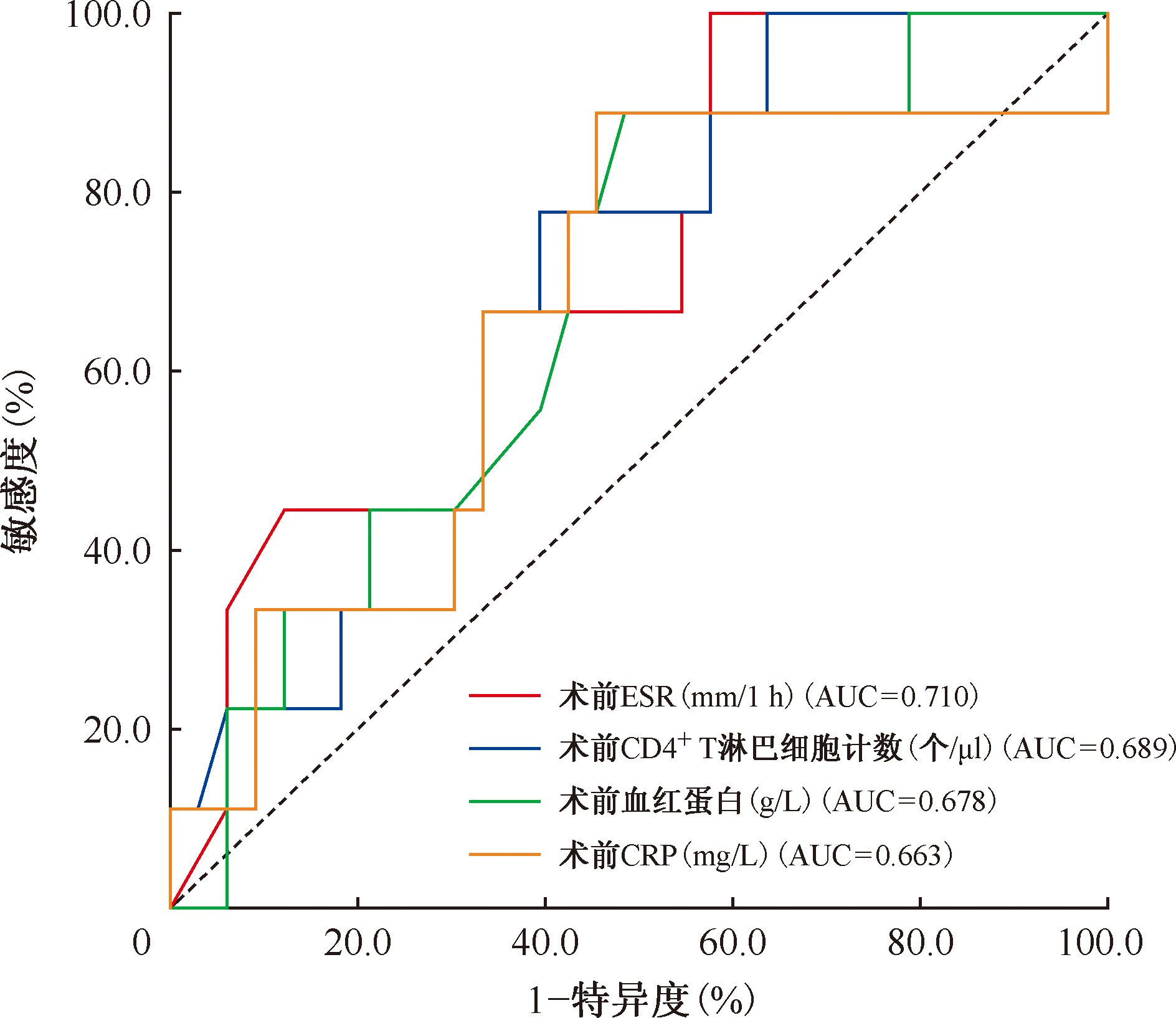
| 指标 | AUC值 | 90%CI值 | 最佳截断值 | 敏感度(%) | 特异度(%) | 约登指数 |
|---|---|---|---|---|---|---|
| 术前ESR(mm/1h) | 0.710 | 0.556~0.865 | 30.500 | 100.0 | 42.4 | 0.424 |
| 术前CD4+ T淋巴细胞计数(个/μl) | 0.689 | 0.539~0.838 | 235.000 | 77.8 | 60.6 | 0.384 |
| 术前血红蛋白(g/L) | 0.678 | 0.521~0.836 | 126.500 | 88.9 | 51.5 | 0.404 |
| 术前CRP(mg/L) | 0.663 | 0.482~0.845 | 18.895 | 88.9 | 54.5 | 0.434 |
| BMI(kg/m2) | 0.591 | 0.417~0.765 | 19.550 | 88.9 | 48.5 | 0.374 |
| 术前血清白蛋白(g/L) | 0.547 | 0.334~0.760 | 41.650 | 33.3 | 97.0 | 0.303 |
| HIV诊断时长(月) | 0.544 | 0.351~0.736 | 90.000 | 33.3 | 84.8 | 0.182 |
| 术前抗结核时间(月) | 0.481 | 0.293~0.670 | 10.000 | 22.2 | 87.9 | 0.101 |
| 年龄(岁) | 0.456 | 0.256~0.657 | 49.000 | 55.6 | 63.6 | 0.192 |
| [1] |
Bagcchi S. WHO’s Global Tuberculosis Report 2022[J]. Lancet Microbe, 2023, 4(1):e20. doi:10.1016/S2666- 5247(22)00359-7.
doi: 10.1016/S2666-5247(22)00359-7 URL |
| [2] | Tian X, Wang C, Hao Z, et al. Global, regional, and national burden of HIV and tuberculosis and predictions by Bayesian age-period-cohort analysis: a systematic analysis for the Global Burden of Disease Study 2021[J]. Front Reprod Health, 2024, 6: 1475498. doi:10.3389/frph.2024.1475498. |
| [3] | Pawlowski A, Jansson M, Sköld M, et al. Tuberculosis and HIV co-infection[J]. PLoS Pathog, 2012, 8(2): e1002464. doi:10.1371/journal.ppat.1002464. |
| [4] |
Corleis B, Bucsan A N, Deruaz M, et al. HIV-1 and SIV infection are associated with early loss of lung interstitial CD4+ T cells and dissemination of pulmonary tuberculosis[J]. Cell Rep, 2019, 26(6): 1409-1418.e5. doi:10.1016/j.celrep.2019.01.021.
pmid: 30726727 |
| [5] |
Kwan C K, Ernst J D. HIV and tuberculosis: a deadly human syndemic[J]. Clin Microbiol Rev, 2011, 24(2): 351-376. doi:10.1128/CMR.00042-10.
pmid: 21482729 |
| [6] | Rajasekaran S, Soundararajan D C R, Shetty A P, et al. Spinal tuberculosis: current concepts[J]. Global Spine J, 2018, 8(4 Suppl): 96S-108S. doi:10.1177/2192568218769053. |
| [7] |
Garg R K, Somvanshi D S. Spinal tuberculosis: a review[J]. J Spinal Cord Med, 2011, 34(5): 440-454. doi:10.1179/2045772311Y.0000000023.
pmid: 22118251 |
| [8] |
Gan J, Zhang C, Tang D, et al. Surgical treatment of spinal tuberculosis: an updated review[J]. Eur J Med Res, 2024, 29(1): 588. doi:10.1186/s40001-024-02198-4.
pmid: 39695719 |
| [9] | Shuvalova E V, Vishnevsky A A. Comorbidity in patients with HIV infection and tuberculous spondylitis as a risk factor for infectious complications[J]. Russ J Spine Surg (Khirurgiya Pozvonochnika), 2020, 17(1): 96-101. doi:10.14531/ss2020.1.96-101. |
| [10] |
Zhang Y, Zhao C S, Chen J M, et al. Efficacy of single-stage posterior surgery for HIV-positive patients with thoracolumular tuberculosis[J]. AIDS Res Ther, 2022, 19(1): 53. doi:10.1186/s12981-022-00478-9.
pmid: 36419079 |
| [11] | 何敏, 蒲育, 蔡玉郭, 等. 23例脊柱结核并发艾滋病患者的手术疗效观察[J]. 中国防痨杂志, 2020, 42(5): 454-458. doi:10.3969/j.issn.1000-6621.2020.05.008. |
| [12] | 赵永杰, 钱南平. 16例脊柱结核并发艾滋病患者的手术治疗效果分析[J]. 中国防痨杂志, 2019, 41(8): 838-842. doi:10.3969/j.issn.1000-6621.2019.08.007. |
| [13] | Scherer J, Castelein S, Locketz M, et al. Evaluation of clinical, laboratory, radiographical and histopathological characteristics in patients with spinal tuberculosis in the context of HIV infection: an analysis of 52 patients from a South African tertiary hospital[J]. S Afr Med J, 2024, 114(11): 38-44. doi:10.7196/SAMJ.2024.v114i11.2065. |
| [14] |
Li K, Liu B, Zhang Q. Recurrent spinal tuberculosis with HIV infection after surgery: a rare case of recurrence and drug resistance[J]. Infect Drug Resist, 2023, 16: 7827-7833. doi:10.2147/IDR.S438184.
pmid: 38162320 |
| [15] | Liu B, Li K, Li S, et al. The association between the CD4/CD8 ratio and surgical site infection risk among HIV-positive adults: insights from a China hospital[J]. Front Immunol, 2023, 14: 1135725. doi:10.3389/fimmu.2023.1135725. |
| [16] | 中华医学会感染病学分会艾滋病学组,中国疾病预防控制中心. 中国艾滋病诊疗指南(2024版)[J]. 中华传染病杂志, 2024, 42(5):257-284. doi:10.3760/cma.j.cn311365-20240328-00081. |
| [17] |
Mok J M, Pekmezci M, Piper S L, et al. Use of C-reactive protein after spinal surgery: comparison with erythrocyte sedimentation rate as predictor of early postoperative infectious complications[J]. Spine, 2008, 33(4): 415-421. doi:10.1097/BRS.0b013e318163f9ee.
pmid: 18277874 |
| [18] |
Berríos-Torres S I, Umscheid C A, Bratzler D W, et al. Centers for Disease Control and Prevention guideline for the prevention of surgical site infection, 2017[J]. JAMA Surg, 2017, 152(8): 784-791. doi:10.1001/jamasurg.2017.0904.
pmid: 28467526 |
| [19] | 张宏其, 李亮, 许建中, 等. 中国脊柱结核外科治疗指南(2022年版)[J]. 中国矫形外科杂志, 2022, 30(17): 1537-1548. doi:10.3977/j.issn.1005-8478.2022.17.01. |
| [20] | Arifin J, Biakto K T, Johan M P, et al. Clinical outcomes and surgical strategy for spine tuberculosis: a systematic review and meta-analysis[J]. Spine Deform, 2024, 12(2): 271-291. doi:10.1007/s43390-023-00785-9. |
| [1] | Liu Aimei, Liu Sang, Feng Lizhen, Wang Qing. Evaluation of surgical outcomes in tuberculosis complicated with HIV/AIDS based on CD4+ T lymphocyte levels [J]. Chinese Journal of Antituberculosis, 2026, 48(7): 1000-1006. |
| [2] | Zhu Qingdong, Zhao Chunyan, Huang Aichun, Zeng Chunmei, Gong Chunming, Xu Chaoyan, Jian Shasha, Li Weiwen, Song Chang. The disease burden and changing trends of HIV/AIDS-associated drug-susceptible tuberculosis in the elderly population aged 60 above of China from 1990 to 2021 [J]. Chinese Journal of Antituberculosis, 2026, 48(1): 34-40. |
| [3] | Tian Xiaomei, Jiang Xuefeng, Yang Xia, Sha Xiaolan, Lei Juan, Wang Xiaowei, Liu Jing. Analysis of case detection and anti-tuberculosis treatment outcomes in Mycobacterium tuberculosis/HIV co-infected patients in Ningxia from 2015 to 2023 [J]. Chinese Journal of Antituberculosis, 2026, 48(1): 57-63. |
| [4] | Li Leilei, Shi Lei, Wang Lin, Li Hongwei, Xu Liran, Pang Yu, Song Yanzheng. Clinical characteristics analysis of HIV-infected cases diagnosed with tuberculosis after surgery due to pulmonary nodules [J]. Chinese Journal of Antituberculosis, 2025, 47(3): 266-273. |
| [5] | Expert Consensus on the Diagnosis and Treatment of Spinal Tuberculosis Combined with HIV/AIDS Patients Group, Combined with HIV/AIDS Patients Group Chinese Antituberculosis Association, Chinese Antituberculosis Association of STD and AIDS Prevention and Control, the Western China Bone Tuberculosis Alliance, the North China Bone the North China Bone. Expert consensus on diagnosis and treatment of spinal tuberculosis with HIV/AIDS (2nd Edition) [J]. Chinese Journal of Antituberculosis, 2025, 47(1): 1-11. |
| [6] | Zhang Guoqin, Qu Ting, Meng Qinglin, Zhou Lin, Liu Eryong. Implementation update of strategy for the control of tuberculosis and HIV/AIDS co-infection in China [J]. Chinese Journal of Antituberculosis, 2025, 47(1): 12-17. |
| [7] | Li Fudong, Ma Xiaoxue, Zhou Jian, Wang Dafu, Zhang Yueying, Gong Tingting, Rao Wen, Hong Feng, Li Shijun, Li Jinlan. Characteristics and treatment outcome analysis of MTB/HIV dual infection patients in Guizhou Province from 2018 to 2023 [J]. Chinese Journal of Antituberculosis, 2025, 47(1): 36-43. |
| [8] | Liu Meijun, Li Feng. Current situation and research progress of co-infection of HIV/AIDS and subclinical tuberculosis [J]. Chinese Journal of Antituberculosis, 2024, 46(5): 596-600. |
| [9] | Huang Jinpeng, Chen Yuanyuan, Gao Dan, Mao Xiaoxiao, Zhang Yue, Gao Jing. The effect of programmed emergency nursing in patients of pulmonary tuberculosis with massive hemoptysis [J]. Chinese Journal of Antituberculosis, 2023, 45(8): 768-774. |
| [10] | Zhang Pei, Zhao Ahui, Gao Min, Zhen Xinan, Yao Yuxia, Jiang Jianguo, Sun Jianwei, Sun Dingyong. Epidemiological characteristics of MTB/HIV co-infection in Henan from 2016 to 2021 [J]. Chinese Journal of Antituberculosis, 2023, 45(4): 377-382. |
| [11] | Yang Zhenggui, Jiang Zeshun, Liu Lan, Han Xue. Effect of Mycobacterium vaccinae on T Lymphocyte subsets in peripheral blood of HIV patients complicated with latent Mycobacterium tuberculosis infection [J]. Chinese Journal of Antituberculosis, 2023, 45(10): 925-931. |
| [12] | XIONG Zi, XIE Ci-fu, SONG Li-xin, WANG Xiao-jun, TIAN Bin, HUANG Zhu-lin, XU Zu-hui, ZHANG Xi-xing, BAI Li-qiong. Epidemiological characteristics of MTB/HIV double infection in Changsha from 2011 to 2020 [J]. Chinese Journal of Antituberculosis, 2022, 44(5): 484-488. |
| [13] | LI Jing, YUAN Feng-shun, LI Ting, LI Yun-kui, GAO Wen-feng, YANG Cheng-bin, HE Jin-ge, YANG Wen. Spatial and temporal distribution characteristics and correlation analysis of HIV/AIDS and tuberculosis in Liangshan Yi Autonomous Prefecture, Sichuan from 2013 to 2019 [J]. Chinese Journal of Antituberculosis, 2021, 43(7): 708-715. |
| [14] | WAN Hai-fang, TAO Fan, ZHAO Jie, CHEN Yuan-hui, HUANG Yan-ming, FU Yun-bin. Analysis of influencing factors of postoperative cognitive dysfunction in elderly patients with spinal tuberculosis [J]. Chinese Journal of Antituberculosis, 2021, 43(5): 441-445. |
| [15] | LI Ting, HE Jin-ge, SU Qian, LI Jing, LI Yun-kui, GAO Wen-feng, GAO Yuan, YANG Wen. Value of tuberculin test in screening tuberculosis infection in HIV infected/AIDS patients in Butuo County, Sichuan Province [J]. Chinese Journal of Antituberculosis, 2020, 42(9): 931-936. |
| Viewed | ||||||
|
Full text |
|
|||||
|
Abstract |
|
|||||
 京公网安备11010202007215号
Total visitors: Visitors of today: Now online:
 This work is licensed under Creative Commons Attribution 3.0 License.
