Email Alert | RSS    帮助

中国防痨杂志 ›› 2026, Vol. 48 ›› Issue (2): 274-281.doi: 10.19982/j.issn.1000-6621.20250307

• 论著 • 上一篇    下一篇

基于中国专利公布公告网探讨治疗肺结核中药复方的用药特点

苏奔, 邱磊, 周睿, 陈涛, 陈玉贤, 崔洁, 夏柳圆, 张少言(), 鹿振辉()   

  1. 上海中医药大学附属龙华医院呼吸疾病研究所, 上海 200032
  • 收稿日期:2025-07-28 出版日期:2026-02-10 发布日期:2026-02-03
  • 通信作者: 张少言,Email:zhangshaoyan000@163.com;鹿振辉,Email:Dr_luzh@shutcm.edu.cn
  • 基金资助:
    国家科技重大专项(2025ZD01908200);国家中医药管理局重大疑难疾病中西医协作项目(ZDYN-2024-B-028);上海市科学技术委员会项目(22XD1423500);上海市科学技术委员会项目(23S21900600);上海市卫生健康委员会项目(2022XD027);上海市卫生健康委员会项目(20234Y0109);上海市卫生健康委员会项目(2022CX010);上海市第六轮公共卫生重点学科(GWVI-11.1-08);上海市申康医院发展中心项目(SHDC12023106);上海市徐汇区院地合作项目(23XHYD-25)

Analysis of usage characteristics of traditional Chinese medicine compound prescriptions for treating pulmonary tuberculosis based on the Chinese Patent Publication and Announcement Network

Su Ben, Qiu Lei, Zhou Rui, Chen Tao, Chen Yuxian, Cui Jie, Xia Liuyuan, Zhang Shaoyan(), Lu Zhenhui()   

  1. Institute of Respiratory Diseases, Longhua Hospital Affiliated to Shanghai University of Traditional Chinese Medicine, Shanghai 200032, China
  • Received:2025-07-28 Online:2026-02-10 Published:2026-02-03
  • Contact: Zhang Shaoyan,Email:zhangshaoyan000@163.com;Lu Zhenhui,Email:Dr_luzh@shutcm.edu.cn
  • Supported by:
    National Major Science and Technology Project(2025ZD01908200);Major Collaborative Project of Traditional Chinese and Western Medicine for Difficult and Complex Diseases of the National Administration of Traditional Chinese Medicine(ZDYN-2024-B-028);Shanghai Science and Technology Commission Project(22XD1423500);Shanghai Science and Technology Commission Project(23S21900600);Shanghai Municipal Health Commission Project(2022XD027);Shanghai Municipal Health Commission Project(20234Y0109);Shanghai Municipal Health Commission Project(2022CX010);Shanghai Sixth Round Key Discipline of Public Health(GWVI-11.1-08);Shanghai Shen Kang Hospital Development Center Project(SHDC12023106);Shanghai Xuhui District Hospital-Local Cooperation Project(23XHYD-25)

摘要:

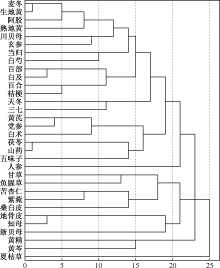
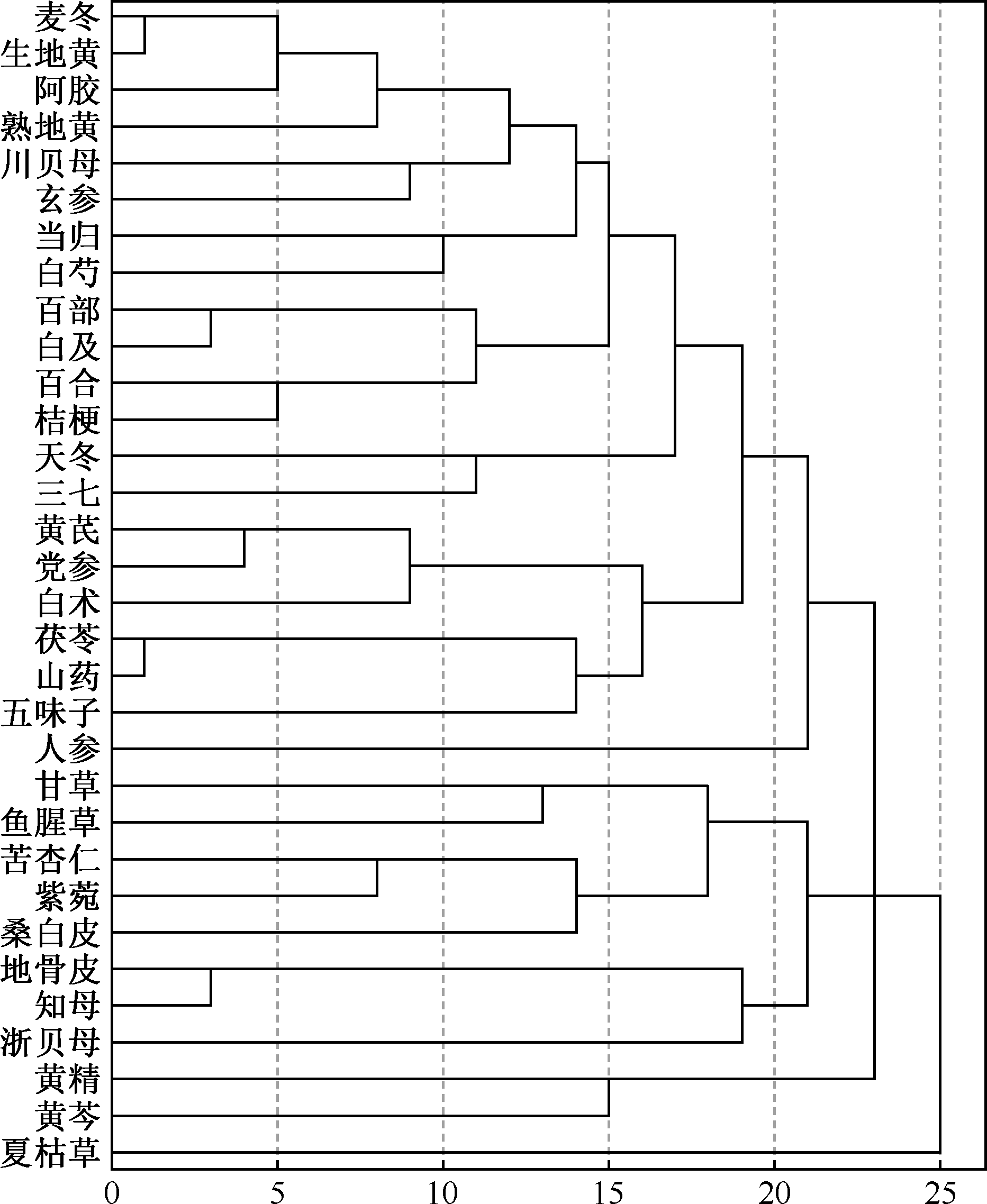
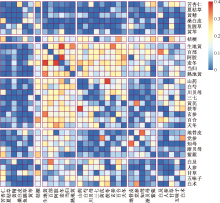
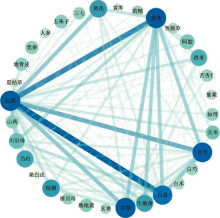
目的: 统计和分析中国专利公布公告网中治疗肺结核中药复方的应用特点,为临床合理用药及新药研发提供参考。方法: 收集中国专利公布公告网治疗肺结核的中药复方专利的药物组成、功效、药性、药味、归经等信息,建立数据库,使用Excel 2019软件进行频次分析,使用R studio软件通过R环境对数据库进行关联规则分析和药物相关性分析。采用SPSS 26.0软件进行高频药物聚类分析,采用Cytoscape 3.10分析构建核心药物共现复杂网络。结果: 共纳入中药复方专利305项,包含905味中药,用药频次前五位分别为百部(135次)、白及(107次)、甘草(107次)、麦冬(103次)、百合(84次),药物功效以补虚药(770次)、化痰止咳平喘药(417次)、清热药(302次)为主,药味以甘(1946次)、苦(1492次)、辛(543次)为主,药性以寒(1363次)、温(788次)、平(633次)为主;多归属肺经(2027次)、肝经(1022次)、心经 (967次)、肾经 (872次)。高频药物关联规则分析得出常用的对药组合有阿胶-麦冬、生地黄-麦冬、天冬-百部等,常用的角药组合有百部-生地黄-麦冬、白及-麦冬-百部、百合-麦冬-百部等。高频药物聚类分析得到9个药物组合,分别为:(1)麦冬,生地黄,阿胶,熟地黄;(2)川贝母,玄参;(3)当归,白芍;(4)百部,白及;(5)百合,桔梗;(6)黄芪,党参,白术:(7)茯苓,山药;(8)苦杏仁,紫菀:(9)地骨皮,知母。药物相关性分析得出茯苓-山药、阿胶-麦冬、麦冬-生地黄、地骨皮-知母等药物之间关系密切。核心药物共现网络表明百部-白及、百部-麦冬、百部-百合、百部-甘草、百部-黄芪可能是治疗肺结核方的核心药物。结论: 中国专利公布公告网中治疗肺结核的中药复方具有重要的临床价值和广泛的应用前景,临床中应在辨证论治的基础上合理使用相关药物组合,以提高临床疗效。

关键词: 结核,肺, 专利, 中药复方, 配伍规律

Abstract:

Objective: To statistically analyze the usage characteristics of traditional Chinese medicine (TCM) compound prescriptions for treating pulmonary tuberculosis from the Chinese Patent Publication and Announcement Network, to provide references for clinical rational drug use and new drug development. Methods: Information on drug composition, effectiveness, nature, taste, and meridian tropism of TCM compound prescriptions for treating pulmonary tuberculosis was collected from the Chinese Patent Publication and Announcement Network, and a database was established. Frequency analysis was conducted using Excel 2019 software, association rule analysis and drug correlation analysis were performed on the database using R studio software through the R environment. Cluster analysis of high-frequency drugs was conducted using SPSS 26.0 software, and a complex network of core drug co-occurrence was constructed using Cytoscape 3.10. Results: A total of 305 TCM compound prescription patents were included, involving 905 TCM drugs. The top five drugs in terms of frequency of use were Baibu (135 times), Baiji (107 times), Gancao (107 times), Maidong (103 times), and Baihe (84 times). Their main drug functions were tonifying (770 times), expectorant and cough/asthma-relieving (417 times), and heat-clearing (302 times). The main tastes were sweet (1946 times), bitter (1492 times), and pungent (543 times), and the main natures were cold (1363 times), warm (788 times), and neutral (633 times). The drugs were mostly attributed to the lung meridian (2027 times), liver meridian (1022 times), heart meridian (967 times), and kidney meridian (872 times). The association rule analysis of high-frequency drugs revealed common drug pairs such as Ejiao-Maidong, Shengdihuang-Maidong, and Tiandong-Baibu, and common drug triplets such as Baibu-Shengdihuang-Maidong, Baiji-Maidong-Baibu, and Baihe-Maidong-Baibu. The cluster analysis of high-frequency drugs identified 9 drug combinations: (1) Maidong, Shengdihuang, Ejiao, and Shudihuang; (2) Chuanbeimu and Xuan Shen; (3) Danggui and Baishao; (4) Baibu and Baiji; (5) Baihe and Jiegeng; (6) Huangqi, Dangshen, and Baizhu; (7) Fuling and Shanyao; (8) Kuxingren and Ziwan; (9) Digupi and Zhimu. The drug correlation analysis indicated that Fuling-Shanyao, Ejiao-Maidong, Maidong-Shengdihuang, and Digupi-Zhimu were closely related. The core drug co-occurrence network suggested that Baibu-Baiji, Baibu-Maidong, Baibu-Baihe, Baibu-Gancao, and Baibu-Huangqi might be the core drugs in the treatment of pulmonary tuberculosis. Conclusion: The TCM compound prescriptions for treating pulmonary tuberculosis on the Chinese Patent Publication and Announcement Network have significant clinical value and broad application prospect. In clinical practice, relevant drug combinations should be used rationally based on syndrome differentiation and treatment to improve clinical effectiveness.

Key words: Tuberculosis,pulmonary, Patent, Chinese herbal compound, Law of concerted application

中图分类号: