
Chinese Journal of Antituberculosis ›› 2026, Vol. 48 ›› Issue (2): 289-298.doi: 10.19982/j.issn.1000-6621.20250300
• Original Articles • Previous Articles Next Articles
Zhou Cang1, Li Guoli1, Jiang Hui2, Shao Yan1, Song Honghuan1, Xue Hao3, Ning Jingxian1,4, Pan Yuchen1,5, Fei Xinru1,2, Sun Zheng1,4, Chen Cheng1, Zhu Limei1, Liu Qiao1( )
)
Received:2025-07-22
Online:2026-02-10
Published:2026-02-03
Contact:
Liu Qiao
E-mail:liuqiaonjmu@163.com
Supported by:CLC Number:
Zhou Cang, Li Guoli, Jiang Hui, Shao Yan, Song Honghuan, Xue Hao, Ning Jingxian, Pan Yuchen, Fei Xinru, Sun Zheng, Chen Cheng, Zhu Limei, Liu Qiao. Evaluation of the diagnostic efficacy of AIMTB-fluorescent immunochromatography for screening latent tuberculosis infection[J]. Chinese Journal of Antituberculosis, 2026, 48(2): 289-298. doi: 10.19982/j.issn.1000-6621.20250300
Add to citation manager EndNote|Ris|BibTeX
URL: https://www.zgflzz.cn/EN/10.19982/j.issn.1000-6621.20250300

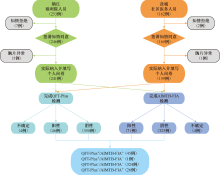
| QFT-Plus | AIMTB-FIA | |||||||
|---|---|---|---|---|---|---|---|---|
| Nil (IU/ml) | TB1-Nil (IU/ml) | TB2-Nil (IU/ml) | Mitogen-Nil (IU/ml) | 结果 | N (IU/ml) | T-N-U (IU/ml) | P-N (IU/ml) | 结果 |
| ≥0.35且≥25%Nil值 | 任何值 | 任何值 | 阳性 | ≥0.4且≥25%N | 任何值 | 阳性 | ||
| ≤8.0 | 任何值 | ≥0.35且≥25%Nil值 | ≤20 | ≥0.4且<25%N | ≥0.5 | 阴性 | ||
| <0.35或≥0.35且 <25%Nil | <0.35或≥0.35且 <25%Nil | ≥0.5 | 阴性 | <0.4 | ≥0.5 | 阴性 | ||

| 特征 | 合计(例) | LTBI组(46例) | 非LTBI组(350名) | 统计检验值 | P值 |
|---|---|---|---|---|---|
| 年龄 | 396 | 55.0(43.5,63.0) | 48.0(30.0,59.0) | Z=-2.665 | 0.008 |
| 性别 | χ2=11.419 | <0.001 | |||
| 男性 | 183 | 32(69.57) | 151(43.14) | ||
| 女性 | 213 | 14(30.43) | 199(56.86) | ||
| 人群来源 | χ2=1.455 | 0.228 | |||
| 福利院人员 | 239 | 24(52.17) | 215(61.43) | ||
| 社区医务工作者 | 157 | 22(47.83) | 135(38.57) | ||
| 体质量指数(kg/m2) | χ2=2.391 | 0.303 | |||
| <18.5 | 66 | 4(8.70) | 62(17.71) | ||
| 18.5~<24.0 | 183 | 23(50.00) | 160(45.71) | ||
| ≥24.0 | 147 | 19(41.30) | 128(36.57) | ||
| 合并高血压 | χ2=0.520 | 0.471 | |||
| 否 | 333 | 37(80.43) | 296(84.57) | ||
| 是 | 63 | 9(19.57) | 54(15.43) | ||
| 合并糖尿病 | - | 0.031 | |||
| 否 | 357 | 37(80.43) | 320(91.43) | ||
| 是 | 39 | 9(19.67) | 30(8.57) | ||
| 合并其他基础疾病 | χ2=0.022 | 0.882 | |||
| 否 | 324 | 38(82.61) | 286(81.71) | ||
| 是 | 72 | 8(17.39) | 64(18.29) | ||
| 吸烟史 | - | <0.001 | |||
| 无吸烟史 | 335 | 33(71.74) | 322(92.00) | ||
| 目前吸烟 | 35 | 10(21.74) | 25(7.14) | ||
| 有吸烟史已戒烟 | 6 | 3(6.52) | 3(0.86) | ||
| 饮酒史 | - | 0.011 | |||
| 无饮酒史 | 375 | 39(84.78) | 336(96.00) | ||
| 目前仍饮酒 | 17 | 6(13.04) | 11(3.14) | ||
| 有饮酒史已戒酒 | 4 | 1(2.17) | 3(0.86) |
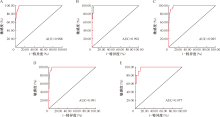
| AIMTB-FIA | QFT-Plus(例) | 合计 (例) | 敏感度 (%) | 特异度 (%) | 阳性预测 值(%) | 阴性预测 值(%) | 一致率 (%) | Kappa值 | |
|---|---|---|---|---|---|---|---|---|---|
| 阳性 | 阴性 | ||||||||
| 所有人员 | 97.80 | 92.60 | 63.38 | 99.69 | 93.20 | 0.731 | |||
| 阳性 | 45 | 26 | 71 | ||||||
| 阴性 | 1 | 324 | 325 | ||||||
| 合计 | 46 | 350 | 396 | ||||||
| 福利院人员 | 95.85 | 90.20 | 52.27 | 99.49 | 90.79 | 0.628 | |||
| 阳性 | 23 | 21 | 44 | ||||||
| 阴性 | 1 | 194 | 195 | ||||||
| 合计 | 24 | 215 | 239 | ||||||
| 社区医务工作者 | 100.00 | 96.30 | 81.48 | 100.00 | 96.82 | 0.879 | |||
| 阳性 | 22 | 5 | 27 | ||||||
| 阴性 | 0 | 130 | 130 | ||||||
| 合计 | 22 | 135 | 157 | ||||||
| 65岁以下 | 100.00 | 92.81 | 62.07 | 100.00 | 93.57 | 0.731 | |||
| 阳性 | 36 | 22 | 58 | ||||||
| 阴性 | 0 | 284 | 284 | ||||||
| 合计 | 36 | 306 | 342 | ||||||
| 65岁及以上 | 90.00 | 90.91 | 69.23 | 97.56 | 90.74 | 0.725 | |||
| 阳性 | 9 | 4 | 13 | ||||||
| 阴性 | 1 | 40 | 41 | ||||||
| 合计 | 10 | 44 | 54 | ||||||

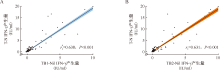
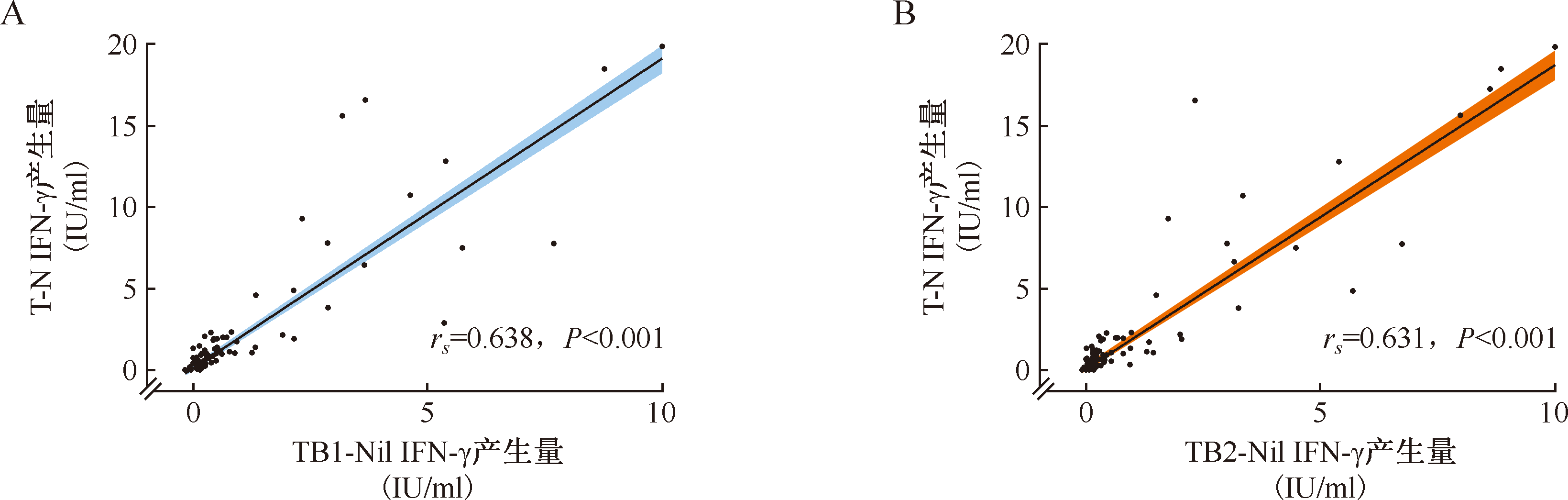
| IFN-γ水平 | 合计 | 非LTBI组 | LTBI组 | Z值 | P值 |
|---|---|---|---|---|---|
| TB1-Nil | 0.00(-0.01,0.03) | 0.00(-0.01,0.01) | 0.88(0.49,3.30) | 121.086 | <0.001 |
| TB2-Nil | 0.00(-0.01,0.02) | 0.00(-0.01,0.01) | 0.96(0.47,3.30) | 121.970 | <0.001 |
| T-N | 0.03(0.00,0.12) | 0.02(0.00,0.06) | 1.99(1.10,7.09) | 120.269 | <0.001 |
| Z值a | 2.671 | 2.903 | -0.622 | ||
| P值 | 1.000 | 1.000 | 1.000 | ||
| Z值b | -238.976 | -268.343 | -24.544 | ||
| P值 | <0.001 | <0.001 | 0.009 | ||
| Z值c | -236.305 | -265.440 | -23.922 | ||
| P值 | <0.001 | <0.001 | 0.011 |
| 组别/指标 | 社区医务工作者 | 福利院人员 | Z值 | P值 | 65岁以下 | 65岁及以上 | Z值 | P值 |
|---|---|---|---|---|---|---|---|---|
| 非LTBI组 | ||||||||
| TB1-Nil | 0.00(-0.01,0.01) | 0.00(-0.01,0.01) | -0.901 | 0.368 | 0.00(-0.01,0.01) | 0.01(0.00,0.05) | -2.980 | 0.003 |
| TB2-Nil | 0.00(-0.01,0.01) | 0.00(-0.01,0.01) | -1.619 | 0.106 | 0.00(-0.01,0.01) | 0.01(0.00,0.04) | -3.032 | 0.002 |
| T-N | 0.11(0.00,0.05) | 0.32(0.00,0.07) | -3.189 | 0.001 | 0.02(0.00,0.06) | 0.06(0.01,0.19) | -3.007 | 0.003 |
| LTBI组 | ||||||||
| TB1-Nil | 1.61(0.71,5.46) | 0.62(0.43,2.86) | -1.794 | 0.073 | 1.09(0.49,3.68) | 0.60(0.38,2.10) | 0.173 | 0.181 |
| TB2-Nil | 1.54(0.72,4.59) | 0.67(0.36,3.01) | -1.737 | 0.082 | 1.31(0.53,4.22) | 0.62(0.35,2.25) | 0.119 | 0.123 |
| T-N | 2.06(1.05,7.58) | 1.99(1.13,6.47) | 0.000 | 1.000 | 2.00(1.19,7.71) | 1.38(0.74,4.23) | 0.112 | 0.116 |
| [1] | 虞浩, 竺丽梅. 江苏省2012—2022年结核病防治进展及展望. 江苏预防医学, 2023, 34(3): 302-304. doi:10.13668/j.issn.1006-9070.2023.03.016. |
| [2] | World Health Organization. WHO consolidated guidelines on tuberculosis: module 1: prevention: tuberculosis preventive treatment. Geneva: World Health Organization, 2020. |
| [3] | 陈诚, 刘炯雅, 孙郑, 等. 结核病防控进展. 中华疾病控制杂志, 2025, 29(4): 373-377. doi:10.16462/j.cnki.zhjbkz.2025.04.001. |
| [4] | 刘巧, 李忠奇, 竺丽梅, 等. 中国结核病防治服务体系运行现状、问题与对策研究. 中国防痨杂志, 2025, 47(5): 559-568. doi:10.19982/j.issn.1000-6621.20240544. |
| [5] | Gong W, Wu X. Differential Diagnosis of Latent Tuberculosis Infection and Active Tuberculosis: A Key to a Successful Tuberculosis Control Strategy. Front Microbiol, 2021, 12:745592. doi:10.3389/fmicb.2021.745592. |
| [6] | Carranza C, Pedraza-Sanchez S, de Oyarzabal-Mendez E, et al. Diagnosis for Latent Tuberculosis Infection: New Alternatives. Front Immunol, 2020, 11:2006. doi:10.3389/fimmu.2020.02006. |
| [7] |
Mwaba P, Chakaya JM, Petersen E, et al. Advancing new diagnostic tests for latent tuberculosis infection due to multidrug-resistant strains of Mycobacterium tuberculosis-End of the road?. Int J Infect Dis, 2020, 92S:S69-S71. doi:10.1016/j.ijid.2020.02.011.
URL pmid: 32119979 |
| [8] | 高妍, 万珈旭, 樊昌林, 等. 结核病γ干扰素释放试验刺激抗原研究进展. 动物医学进展, 2024, 45(9): 88-94. doi:10.3969/j.issn.1007-5038.2024.09.016. |
| [9] | Kadkhoda K, Dee M, Simeone J. Comparison of LIAISON QuantiFERON-TB Gold Plus with QuantiFERON-TB Gold Plus. Microbiol Spectr, 2023, 11(1):e0475422. doi:10.1128/spectrum.04754-22. |
| [10] |
Al Abri S, Kowada A, Yaqoubi F, et al. Cost-effectiveness of IGRA/QFT-Plus for TB screening of migrants in Oman. Int J Infect Dis, 2020, 92S:S72-S77. doi:10.1016/j.ijid.2020.03.010.
URL pmid: 32171953 |
| [11] |
Yoopetch P, Wu O, Jittikoon J, et al. Economic evaluation of diagnosis and treatment for latent tuberculosis infection among contacts of pulmonary tuberculosis patients in Thailand. Sci Rep, 2024, 14(1):17693. doi:10.1038/s41598-024-68452-1.
URL pmid: 39085338 |
| [12] | Cao X, Chen Y, Xin H, et al. The performance of a new rapid interferon gamma release assay based on fluorescence immunochromatography for Mycobacterium tuberculosis infection testing in village doctors in China. Epidemiol Infect, 2024, 152:e155. doi:10.1017/S0950268824001146. |
| [13] | Rudeeaneksin J, Srisungngam S, Klayut W, et al. Quanti-FERON-TB Gold Plus and QuantiFERON-TB Gold In-tube assays for detecting latent tuberculosis infection in Thai healthcare workers. Rev Inst Med Trop Sao Paulo, 2023, 65:e13. doi:10.1590/S1678-9946202365013. |
| [14] | Rickman HM, Phiri MD, Mbale H, et al. Low concordance between QIAreach QuantiFERON-TB, a novel interferon-gamma release assay, and QuantiFERON-TB Gold Plus, in a population-based survey in Blantyre, Malawi. J Clin Microbiol, 2025, 63(1):e0132324. doi:10.1128/jcm.01323-24. |
| [15] | 辛赫男, 高磊. 《世界卫生组织结核病整合指南模块3:诊断——结核感染检测》解读. 中国防痨杂志, 2023, 45(7): 639-643. doi:10.19982/j.issn.1000-6621.20230128. |
| [16] | 张爽, 赵弘, 杨美霞. 结核潜伏感染检测方法的研究进展. 上海预防医学, 2025, 37(1): 94-99. doi:10.19428/j.cnki.sjpm.2025.24611. |
| [17] |
Jonas DE, Riley SR, Lee LC, et al. Screening for Latent Tuberculosis Infection in Adults: Updated Evidence Report and Systematic Review for the US Preventive Services Task Force. JAMA, 2023, 329(17):1495-1509. doi:10.1001/jama.2023.3954.
URL pmid: 37129650 |
| [18] | 许晶晶, 卢鹏, 薛浩, 等. 盐城市大丰区高一新生结核潜伏感染筛查及影响因素分析. 华南预防医学, 2024, 50 (5): 420-423. doi:10.12183/j.scjpm.2024.0420. |
| [19] | 王慧, 李锦成, 陆兴, 等. 重组结核杆菌融合蛋白皮肤试验筛查HIV/AIDS病例结核分枝杆菌潜伏感染的效果分析. 预防医学, 2024, 36(7): 639-643. doi:10.19485/j.cnki.issn2096-5087.2024.07.021. |
| [20] | 高磊, 张慧, 胡茂桂, 等. 基于多中心调查数据和空间统计模型的全国结核分枝杆菌潜伏感染率估算. 中国防痨杂志, 2022, 44 (1): 54-59. doi:10.19982/j.issn.1000-6621.20210661. |
| [21] | 中国医学科学院病原生物学研究所, 中国疾病预防控制中心, 中国科学院地理科学与资源研究所. 全国结核分枝杆菌潜伏感染率估算专家共识. 中国防痨杂志, 2022, 44(1): 4-8. doi:10.19982/j.issn.1000-6621.20210662. |
| [22] |
Banaei N, Gaur RL, Pai M. Interferon Gamma Release Assays for Latent Tuberculosis: What Are the Sources of Variability?. J Clin Microbiol, 2016, 54(4):845-850. doi:10.1128/JCM.02803-15.
URL pmid: 26763969 |
| [23] |
Zellweger JP, Sotgiu G, Corradi M, et al. The diagnosis of latent tuberculosis infection (LTBI): currently available tests, future developments, and perspectives to eliminate tuberculosis (TB). Med Lav, 2020, 111(3):170-183. doi:10.23749/mdl.v111i3.9983.
URL pmid: 32624559 |
| [24] | 吴绣岑, 陈贵华. 2023年美国预防医学服务工作组《成人结核分枝杆菌潜伏感染筛查》解读. 结核与肺部疾病杂志, 2024, 5(5): 398-403. doi:10.19983/j.issn.2096-8493.2024105. |
| [25] | Hopewell P, Hill PC, Brookes RH, et al. Serial testing for tuberculosis can we make sense of T cell assay conversions and reversions. PLoS Med, 2007, 4(6):e208. doi:10.1371/journal.pmed.0040208. |
| [26] | Diel R, Schablon A, Nienhaus A, et al. Occupational Screening for Tuberculosis and the Use of a Borderline Zone for Interpretation of the IGRA in German Healthcare Workers. PLoS One, 2014, 9(12):e115322. doi:10.1371/journal.pone.0142541. |
| [27] | 周崇兴, 梁大斌, 黄彦, 等. 三种结核潜伏感染试验在HIV感染人群中的应用评价. 中国现代医生, 2023, 61(16): 23-26. doi:10.3969/j.issn.1673-9701.2023.16.006. |
| [28] | 刘艳, 张红, 麦美拉·艾赛提, 等. 四种国产试剂盒在结核分枝杆菌感染早期诊断中的应用评价. 中华医院感染学杂志, 2024, 34(24): 3707-3710. doi:10.11816/cn.ni.2024-240387. |
| [29] | 中华医学会结核病学分会, 《中华结核和呼吸杂志》编辑委员会. γ-干扰素释放试验在中国应用的建议. 中华结核和呼吸杂志, 2014, 37(10): 744-747. doi:10.3760/cma.j.issn.1001-0939.2014.10.011. |
| [30] | Liu Z, Liang Q, Ren Y, et al. Immunosenescence: molecular mechanisms and diseases. Signal Transduct Target Ther, 2023, 8(1): 200. doi:10.1038/s41392-023-01451-2. |
| [31] | 姚寒砺, 刘巧, 陈诚, 等. 2005—2023年江苏省≥65岁老年人群结核病发病趋势Joinpoint回归分析. 江苏预防医学, 2025, 36(2): 152-155, 205. doi:10.13668/j.issn.1006-9070.2025.02.005. |
| [1] | Liu Shuya, Zhang Ting, Wang Qingya, Fan Jun, Wang Ni. Analysis of close contacts screening situation and time changing trends of pulmonary tuberculosis patients in Chongqing from 2015 to 2024 [J]. Chinese Journal of Antituberculosis, 2026, 48(2): 230-237. |
| [2] | Shang Yuanyuan, Nie Wenjuan, Chu Naihui. Comparison of clinical characteristics and prognostic factors between elderly and non-elderly patients with Mycobacterium abscessus pulmonary disease [J]. Chinese Journal of Antituberculosis, 2026, 48(1): 106-112. |
| [3] | Tan Xiao, Li Fangping, Zhang Qian, Zhang Meijia. Causal effects of gut microbiota on non-tuberculous mycobacterial lung infection: a bidirectional two-sample mendelian randomization study [J]. Chinese Journal of Antituberculosis, 2026, 48(1): 121-130. |
| [4] | Fan Ruifang, Dai Xiaowei, Yang Xinyu, Chen Shuangshuang, Chen Hao, Yu Lan, Zhao Yanfeng, Li Chuanyou, Wang Nenhan. A study on the identification of Mycobacterium species using fluorescent PCR probe melting curve technique and DNA microarray chip technique [J]. Chinese Journal of Antituberculosis, 2025, 47(8): 1031-1037. |
| [5] | Kong Hanhan, Chen Zijiao, Zeng Jianfeng, Wu Dan, Tang Lin, Wen Min. Development and reliability and validity testing of the Pulmonary Tuberculosis Symptom Cluster Scale [J]. Chinese Journal of Antituberculosis, 2025, 47(8): 1062-1067. |
| [6] | Nontuberculous Mycobacterial Diseases Branch of Chinese Antituberculosis Association. Expert consensus on molecular biology diagnosis of nontuberculous mycobacteria diseases [J]. Chinese Journal of Antituberculosis, 2025, 47(8): 961-975. |
| [7] | Tuberculosis Control Branch of Chinese Antituberculosis Association, Standardization Professional Branch of Chinese Antituberculosis Association, Elderly Tuberculosis Control Branch of Chinese Antituberculosis Association. Expert consensus on the application of Mycobacterium tuberculosis infection detection technologies [J]. Chinese Journal of Antituberculosis, 2025, 47(7): 813-829. |
| [8] | Yang Zeliang, Ma Zichun, Shang Yuanyuan, Shi Jin, Jing Wei, Pang Yu, Qin Lin. The diagnostic value of targeted next generation sequencing in sputum-free pulmonary tuberculosis patients [J]. Chinese Journal of Antituberculosis, 2025, 47(7): 878-883. |
| [9] | Chen Shuangshuang, Wang Nenhan, Zhao Yanfeng, Fan Ruifang, Tian Lili, Chen Hao, Luo Ping, Li Jie, Li Chuanyou, Dai Xiaowei. Application value of MeltPro two-step method in tuberculosis diagnosis and drug resistance screening [J]. Chinese Journal of Antituberculosis, 2025, 47(7): 893-900. |
| [10] | Ou Xichao, Teng Chong, Song Yuanyuan, Zheng Yang, Chen Lei, Zhu Jun, Wang Jianguo, Pan Zhaobao, Kang Haitao, Wang Yan, Yao Hongyan, Huang Fei. Multicenter evaluation study on the application of a novel PCR fluorescence probe technology for early diagnosis of tuberculosis [J]. Chinese Journal of Antituberculosis, 2025, 47(6): 687-693. |
| [11] | Li Longfen, Shi Chunjing, Luo Yun, Zhang Huajie, Liu Jun, Wang Ge, Zhao Yanhong, Yuan Lijuan, Li Shan, Li Wenming, Shen Lingjun. Establishing and validating a prediction model for HIV-associated nontuberculous mycobacterial disease based on machine learning [J]. Chinese Journal of Antituberculosis, 2025, 47(6): 708-718. |
| [12] | Wei Xiaorui, Yu Zeyang, Yang Kun, Zhou Ke, Huang Fang, Liu Hao, Bai Lu, Liu Jiayun. Expression of liver kinase B1 in peripheral blood mononuclear cells of Mycobacterium tuberculosis-infected individuals and its correlation with interferon-γ [J]. Chinese Journal of Antituberculosis, 2025, 47(6): 779-784. |
| [13] | Ying Guangzhi, Cai Qingshan, Ma Xiaoqing, Chen Lingyan, Chen Yuanyuan. Diagnostic value of Nanopore targeted sequencing for detecting nontuberculous mycobacteria in respiratory specimens [J]. Chinese Journal of Antituberculosis, 2025, 47(5): 589-596. |
| [14] | Wang Yingchao, Liu Weiyi, Ji Xiuxiu, Shang Xuetian, Jia Hongyan, Zhang Lanyue, Sun Qi, Du Boping, Zhu Chuanzhi, Pan Liping, Zhang Zongde. Profile analysis of circRNA expression and identification of diagnostic markers in peripheral blood mononuclear cells of tuberculosis patients [J]. Chinese Journal of Antituberculosis, 2025, 47(4): 460-470. |
| [15] | Luo Li, Luo Linzi, Yin Quhua, Zhou Lei, Lu Zhibin, Ding Yan, Xiao Yangbao. Progress in bronchoscopic diagnosis and treatment of lymph node fistula tracheobronchial tuberculosis [J]. Chinese Journal of Antituberculosis, 2025, 47(4): 505-512. |
| Viewed | ||||||
|
Full text |
|
|||||
|
Abstract |
|
|||||
 京公网安备11010202007215号
Total visitors: Visitors of today: Now online:
京公网安备11010202007215号
Total visitors: Visitors of today: Now online:
 This work is licensed under Creative Commons Attribution 3.0 License.
