
Chinese Journal of Antituberculosis ›› 2026, Vol. 48 ›› Issue (11): 1734-1744.doi: 10.19982/j.issn.1000-6621.20260252
• Original Articles • Previous Articles Next Articles
Zheng Yanjun, Tu Yaofen( ), Lin Genfang, Zhang Lili, Lu Zeyi
Received:2026-05-05
Online:2026-11-10
Published:2026-11-03
Contact:
Tu Yaofen,Email: CLC Number:
Zheng Yanjun, Tu Yaofen, Lin Genfang, Zhang Lili, Lu Zeyi. Application effect of digital adherence technologies in medication management of tuberculosis patient: a meta-analysis[J]. Chinese Journal of Antituberculosis, 2026, 48(11): 1734-1744. doi: 10.19982/j.issn.1000-6621.20260252
Add to citation manager EndNote|Ris|BibTeX
URL: https://www.zgflzz.cn/EN/10.19982/j.issn.1000-6621.20260252

| 条目 | 主题 |
|---|---|
| #1 | (((TS=(″Tuberculosis″)) OR TS=(″Antitubercular Agents″))) OR TS=(″Tuberculin Test″) OR TS=(″Interferon-gamma Release Tests″) |
| #2 | ((((((((TS=(″Digital Compliance technology″)) OR TS=(″Mobile Phone″)) OR TS=(″Smart Phone″)) OR TS=(″Mobile APPlication″)) OR TS=(″Electronic medication suPervision″)) OR TS=(″SMS reminder″)) OR TS=(″Video Observation Therapy″)) OR TS=(″Medication Event Reminder Monitor″)) OR TS=(″Biometric Monitoring System″)) OR TS=(″Ingestion Sensor″)) OR TS=(″Digital Pillbox″)) OR TS=(″WeChat″) |
| #3 | ((″Management, Medication Therapy″)) OR TS=(″Medication TheraPy″) OR TS=(″TheraPy Management, Medication″) OR TS=(″Drug TheraPy Management″)) OR TS=(″Self-management″) OR TS=(″Home management″) |
| #4 | #1 AND #2 AND #3 |
| 纳入文献 | 发表 年份 | 国家 | 干预组患者 例数/对照组 患者例数 | 干预组措施 | 对照组 措施 | 干预 时长 (月) | 结局 指标 | ||||||
|---|---|---|---|---|---|---|---|---|---|---|---|---|---|
| 干预形式 | 干预方法 | ||||||||||||
| Acosta等[ | 2022 | 秘鲁 | 49/53 | 电子药盒 | 使用WisePill RT2000电子药盒,实时联网监测开盖;未按时开盖则发送短信提醒;监测员提供依从性指导与临床支持 | DOT | 4 | a、b、c | |||||
| Gashu等[ | 2021 | 埃塞 俄比亚 | 152/154 | 电话 | 基于网络的提醒系统,发送图形+文本消息 | DOT | 4 | a、d、e | |||||
| Wei等[ | 2024 | 中国 | 142/134 | 电子药盒+微信+VOT | 电子药盒:人声提醒服药,实时记录开盒数据并传输至云端;智能手机实现患者、家庭支持者与医护人员的直接沟通(文字/音频/视频);对高风险患者每日实时视频或音频通话监督 | DOT | 6~7 | a、b、c | |||||
| Qin等[ | 2025 | 中国 | 371/370 | 微信 | 通过微信公众号/小程序使用定制化结核病管理APP,每日服药提醒+复诊提醒+结核病健康教育 | DOT | 6 | a、b、c、e | |||||
| Sekandi等[ | 2025 | 乌干达 | 71/71 | VOT | 每日服药视频通过手机上传,短信服药提醒,漏传视频24h电话随访,72h未应答则家访 | DOT | 6 | b、c、e | |||||
| Mohammed 等[ | 2016 | 巴基 斯坦 | 1104/1093 | 短信/电话 | 每日发送1次短信提醒,患者通过回复短信或未接来电确认已服药;如2h内未回应,发送第2次提醒;2h后未回应,发送第3次(最终)提醒;连续7d无回应则电话随访 | DOT | 6 | a、c、e | |||||
| Story等[ | 2019 | 英国 | 112/114 | VOT | 免费提供智能手机,每日拍摄服药视频上传专用APP(异步);督导员通过后台审核视频,鼓励在视频中报告药物不良反应,全程每日督导 | DOT | 6 | b | |||||
| Bediang等[ | 2018 | 非洲 | 137/142 | 短信 | 短信提醒,内容为提醒、激励患者按时服药,每两周更换1次短信内容,持续6个月 | DOT | 6 | a、c | |||||
| Guo等[ | 2020 | 中国 | 203/202 | VOT | 通过智能手机应用程序进行实时视频监督服药,漏服则电话随访,必要时家访 | DOT | 6 | a、c、e | |||||
| Kumwichar 等[ | 2024 | 泰国 | 63/65 | VOT | 患者通过LINE APP接收每日提醒,自行录制服药视频并上传至系统,观察员随后审核视频、确认服药并反馈。若患者未按时上传,观察员电话跟进 | DOT | 2 | c | |||||
| Browne等[ | 2019 | 美国 | 41/20 | 可摄入传感器+短信/电话 | 患者服用传感器嵌合的异烟肼150mg/利福平300mg复合胶囊,贴片检测并记录服药时间,数据通过蓝牙传输至移动设备并上传至安全服务器。若未确认服药,研究人员在24h内通过短信或电话联系患者提供支持 | DOT | 3 | b | |||||
| Liu等[ | 2015 | 中国 | 1008/1104 | 短信 | 每日按约定时间发送最多3条短信(若患者未回复),每月复诊前4天发送提醒 | DOT | 6 | a、b、c | |||||
| Liu等[ | 2015 | 中国 | 997/1104 | 电子药盒 | 药盒在约定时间发出音频提醒,若未打开则最多额外8次提醒;药盒语音提醒复诊 | DOT | 6 | a、b、c | |||||
| Liu等[ | 2015 | 中国 | 1064/1104 | 短信+电子药盒 | 同时接受短信和药盒提醒。医生根据依从性评估(药盒数据+药片计数+短信回复),对不依从患者转为强化管理或DOT | DOT | 6 | a、b、c | |||||
| Charalambous 等[ | 2024 | 南非 | 1306/1278 | 电子药盒 | 药盒提供每日视觉/音频提醒服药及每月复诊提醒;研究人员每周审查依从性数据,根据漏服次数采取分层支持 | DOT | 6 | a、b、c | |||||
| 陈馨仪[ | 2021 | 中国 | 616/624 | 电子药盒 | 药盒提供每日服药提醒和每月复诊提醒,根据漏服药率采取分类管理 | DOT | 6 | b、c、e | |||||
| 杨洋[ | 2023 | 中国 | 300/300 | 微信 | 微信公众号每日推送知识、视频;建立病友微信群:专职管理、答疑、纠正错误认知、经验分享;每月电话随访+指导复查 | DOT | 6 | b | |||||
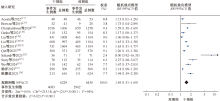

| 亚组分类 (干预方式) | 文献数量 (篇) | RR (95%CI)值 | 异质性检验 | 双尾检验 | |||
|---|---|---|---|---|---|---|---|
| χ2值 | P值 | I2值(%) | Z值 | P值 | |||
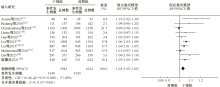
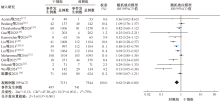
| 电子药盒组 | 4 | 1.48(1.24~1.77) | 39.09 | <0.001 | 92 | 4.33 | <0.001 |
| 短信/电话/微信提醒组 | 4 | 1.14(1.08~1.20) | 7.10 | 0.070 | 58 | 5.02 | <0.001 |
| 视频督导组 | 2 | 4.10(1.11~15.20) | 11.48 | <0.001 | 91 | 2.11 | 0.030 |
| 联合干预组 | 3 | 1.64(1.52~1.76) | 0.10 | 0.950 | 0 | 13.11 | <0.001 |
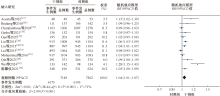



| 亚组分类 (国家/地区) | 文献数量 (篇) | RR (95%CI)值 | 异质性检验 | 双尾检验 | |||
|---|---|---|---|---|---|---|---|
| χ2值 | P值 | I2值(%) | Z值 | P值 | |||
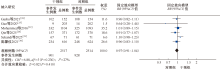
| 中国 | 5 | 0.51(0.37~0.72) | 24.85 | <0.001 | 76 | 3.91 | <0.001 |
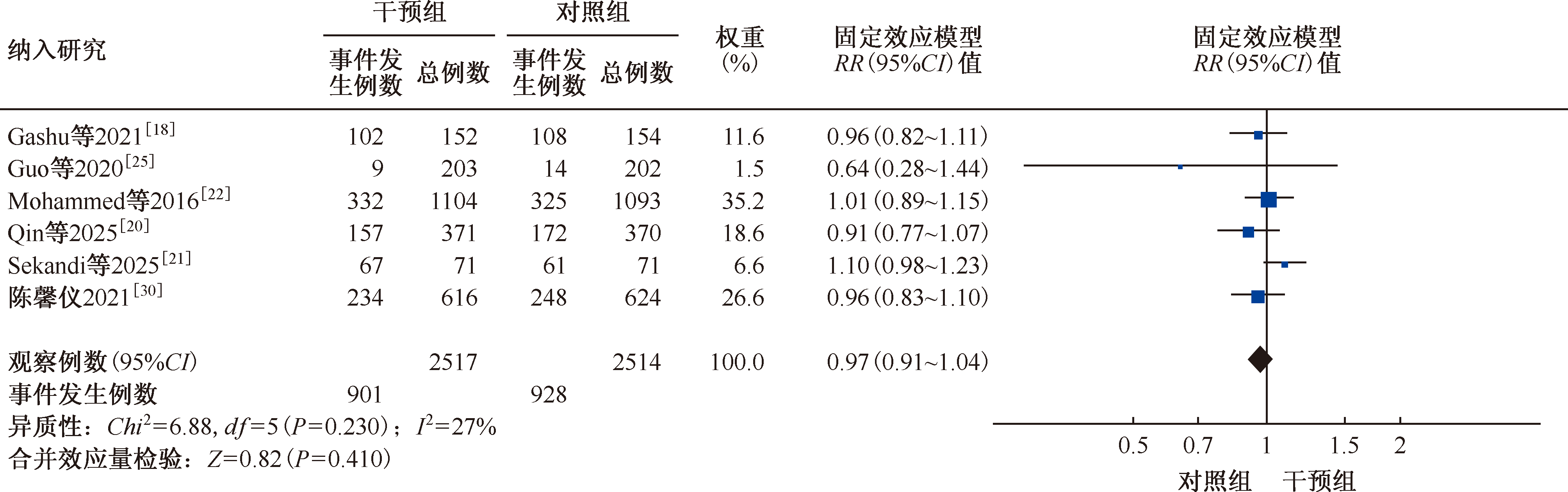
| 其他国家 | 6 | 0.92(0.77~1.08) | 6.89 | 0.230 | 27 | 1.01 | 0.310 |
| [1] | World Health Organization. Global tuberculosis report 2025[R]. Geneva: World Health Organization, 2025. |
| [2] | Dorman S E, Nahid P, Kurbatova E V, et al. Four-Month Rifapentine Regimens with or without Moxifloxacin for Tuberculosis[J]. N Engl J Med, 2021, 384(18):1705-1718. doi:10.1056/NEJMoa2033400. |
| [3] | Hassani S, Mohammadi Shahboulagi F, Foroughan M, et al. Relationship of family caregivers’ associated factors with medication adherence among elderly with tuberculosis in Iran[J]. J Clin Tuberc Other Mycobact Dis, 2024, 37:100488. doi:10.1016/j.jctube.2024.100488. |
| [4] | Vega V, Cabrera-Sanchez J, Rodríguez S, et al. Risk factors for pulmonary tuberculosis recurrence, relapse and reinfection: a systematic review and meta-analysis[J]. BMJ Open Respir Res, 2024, 11(1):e002281. doi:10.1136/bmjresp-2023-002281. |
| [5] | Sazali M F, Rahim S S S A, Mohammad A H, et al. Improving Tuberculosis Medication Adherence: The Potential of Integrating Digital Technology and Health Belief Model[J]. Tuberc Respir Dis (Seoul), 2023, 86(2):82-93. doi:10.4046/trd.2022.0148. |
| [6] |
Fox G J, Dobler C C, Marais B J, et al. Preventive therapy for latent tuberculosis infection-the promise and the challenges[J]. Int J Infect Dis, 2017, 56:68-76. doi:10.1016/j.ijid.2016.11.006.
pmid: 27872018 |
| [7] | Zhang J, Yang Y, Qiao X, et al. Factors Influencing Medication Nonadherence to Pulmonary Tuberculosis Treatment in Tibet, China: A Qualitative Study from the Patient Perspective[J]. Patient Prefer Adherence, 2020, 14:1149-1158. doi:10.2147/PPA.S252448. |
| [8] | World Health Organization. Guidelines for treatment of drug-susceptible tuberculosis and patient care, 2017 update[R]. Geneva: World Health Organization, 2017. |
| [9] |
Marahatta S B, Yadav R K, Baral S, et al. Barriers to Treatment Compliance of Directly Observed Treatment Shortcourse among Pulmunary Tuberculosis Patients[J]. J Nepal Health Res Counc, 2021, 19(3):450-459. doi:10.33314/jnhrc.v19i3.3478.
pmid: 35140414 |
| [10] | World Health Organization, European Respiratory Society. Digital health for the End TB Strategy: an agenda for action[R]. Geneva: World Health Organization, 2015. |
| [11] | Subbaraman R, de Mondesert L, Musiimenta A, et al. Digital adherence technologies for the management of tuberculosis therapy: mapping the landscape and research priorities[J]. BMJ Glob Health, 2018, 3(5):e001018. doi:10.1136/bmjgh-2018-001018. |
| [12] | 中共中央国务院. “健康中国2030”规划纲要[EB/OL]. (2016-10-25) [2026-05-30]. https://www.gov.cn/zhengce/2016-10/25/content_5124174.htm. |
| [13] | Badzi C D, Kotoh A M, Tabong P T, et al. SMS reminders for monitoring tuberculosis treatment among women in Greater Accra region, Ghana[J]. Digit Health, 2024, 10:20552076241297746. doi:10.1177/20552076241297746. |
| [14] | Garfein R S, Liu L, Cepeda J, et al. Asynchronous Video Directly Observed Therapy to Monitor Short-Course Latent Tuberculosis Infection Treatment: Results of a Randomized Controlled Trial[J]. Open Forum Infect Dis, 2024, 11(4):ofae180. doi:10.1093/ofid/ofae180. |
| [15] | Ravenscroft L, Kettle S, Persian R, et al. Video-observed therapy and medication adherence for tuberculosis patients: randomised controlled trial in Moldova[J]. Eur Respir J, 2020, 56(2):2000493. doi:10.1183/13993003.00493-2020. |
| [16] | Cumpston M, Li T, Page M J, et al. Updated guidance for trusted systematic reviews: a new edition of the Cochrane Handbook for Systematic Reviews of Interventions[J]. Cochrane Database Syst Rev, 2019,10:ED000142. doi:10.1002/14651858.ED000142. |
| [17] |
Acosta J, Flores P, Alarcón M, et al. A randomised controlled trial to evaluate a medication monitoring system for TB treatment[J]. Int J Tuberc Lung Dis, 2022, 26(1):44-49. doi:10.5588/ijtld.21.0373.
pmid: 34969428 |
| [18] | Gashu K D, Gelaye K A, Lester R, et al. Effect of a phone reminder system on patient-centered tuberculosis treatment adherence among adults in Northwest Ethiopia: a randomised controlled trial[J]. BMJ Health Care Inform, 2021, 28(1):e100268. doi:10.1136/bmjhci-2020-100268. |
| [19] |
Wei X, Hicks J P, Zhang Z, et al. Effectiveness of a comprehensive package based on electronic medication monitors at improving treatment outcomes among tuberculosis patients in Tibet: a multicentre randomised controlled trial[J]. Lancet, 2024, 403(10430):913-923. doi:10.1016/S0140-6736(23)02270-5.
pmid: 38309280 |
| [20] | Qin N, Chen J, Chen L, et al. Effectiveness of a mobile health application on treatment outcomes among patients with tuberculosis in Shanghai, China: a multicentre randomised controlled trial[J]. BMJ Glob Health, 2025, 10(6):e018022. doi:10.1136/bmjgh-2024-018022. |
| [21] | Sekandi J N, Buregyeya E, Zalwango S, et al. Effectiveness of a Mobile Health Intervention (DOT Selfie) in Increasing Treatment Adherence Monitoring and Support for Patients With Tuberculosis in Uganda: Randomized Controlled Trial[J]. JMIR Mhealth Uhealth, 2025, 13:e57991. doi:10.2196/57991. |
| [22] | Mohammed S, Glennerster R, Khan A J. Impact of a Daily SMS Medication Reminder System on Tuberculosis Treatment Outcomes: A Randomized Controlled Trial[J]. PLoS One, 2016, 11(11):e0162944. doi:10.1371/journal.pone.0162944. |
| [23] |
Story A, Aldridge R W, Smith C M, et al. Smartphone-enabled video-observed versus directly observed treatment for tuberculosis: a multicentre, analyst-blinded, randomised, controlled superiority trial[J]. Lancet, 2019, 393(10177):1216-1224. doi:10.1016/S0140-6736(18)32993-3.
pmid: 30799062 |
| [24] |
Bediang G, Stoll B, Elia N, et al. SMS reminders to improve adherence and cure of tuberculosis patients in Cameroon (TB-SMS Cameroon): a randomised controlled trial[J]. BMC Public Health, 2018, 18(1):583. doi:10.1186/s12889-018-5502-x.
pmid: 29720146 |
| [25] |
Guo P, Qiao W, Sun Y, et al. Telemedicine Technologies and Tuberculosis Management: A Randomized Controlled Trial[J]. Telemed J E Health, 2020, 26(9):1150-1156. doi:10.1089/tmj.2019.0190.
pmid: 31794684 |
| [26] | Kumwichar P, Prappre T, Chongsuvivatwong V. Tuberculosis Treatment Compliance Under Smartphone-Based Video-Observed Therapy Versus Community-Based Directly Observed Therapy: Cluster Randomized Controlled Trial[J]. JMIR Mhealth Uhealth, 2024, 12:e53411. doi:10.2196/53411. |
| [27] | Browne S H, Umlauf A, Tucker A J, et al. Wirelessly observed therapy compared to directly observed therapy to confirm and support tuberculosis treatment adherence: A randomized controlled trial[J]. PLoS Med, 2019, 16(10):e1002891. doi:10.1371/journal.pmed.1002891. |
| [28] | Liu X, Lewis J J, Zhang H, et al. Effectiveness of Electronic Reminders to Improve Medication Adherence in Tuberculosis Patients: A Cluster-Randomised Trial[J]. PLoS Med, 2015, 12(9):e1001876. doi:10.1371/journal.pmed.1001876. |
| [29] | Charalambous S, Maraba N, Jennings L, et al. Treatment adherence and clinical outcomes amongst in people with drug-susceptible tuberculosis using medication monitor and differentiated care approach compared with standard of care in South Africa: a cluster randomized trial[J]. EClinicalMedicine, 2024, 75:102745. doi:10.1016/j.eclinm.2024.102745. |
| [30] | 陈馨仪. 电子药盒辅助服药管理模式对结核病患者服药依从性及疗效影响研究[D]. 宁波: 宁波大学, 2021. doi:10.27256/d.cnki.gnbou.2021.001903. |
| [31] | 杨洋. 微信管理模式应用于肺结核患者治疗管理中的效果分析[J]. 江苏卫生事业管理, 2023, 34(9):1304-1307. doi:10.3969/j.issn.1005-7803.2023.09.035. |
| [32] | Santosa A, Juniarti N, Pahria T, et al. Digital adherence technology to improve medication adherence in tuberculosis patients: a systematic review and meta-analysis randomized control trials[J]. NPJ Prim Care Respir Med, 2025, 35(1):52. doi:10.1038/s41533-025-00457-3. |
| [33] | Ngwatu B K, Nsengiyumva N P, Oxlade O, et al. The impact of digital health technologies on tuberculosis treatment: a systematic review[J]. Eur Respir J, 2018, 51(1):1701596. doi:10.1183/13993003.01596-2017. |
| [34] |
Jerene D, van Kalmthout K, Levy J, et al. Effect of digital adherence technologies on treatment outcomes in people with drug-susceptible tuberculosis: four pragmatic, cluster-randomised trials[J]. Lancet, 2025, 405(10485):1155-1166. doi:10.1016/S0140-6736(24)02847-2.
pmid: 40086457 |
| [35] |
Liu X, Thompson J, Dong H, et al. Digital adherence technologies to improve tuberculosis treatment outcomes in China: a cluster-randomised superiority trial[J]. Lancet Glob Health, 2023, 11(5):e693-e703. doi:10.1016/S2214-109X(23)00068-2.
pmid: 37061308 |
| [1] | Zhong Leping, Qin Shibing, Sha Wei, Deng Guofang, Lin Minggui. Application and prospect of ultrasound-mediated transdermal drug delivery in adjuvant treatment of tuberculosis [J]. Chinese Journal of Antituberculosis, 2026, 48(9): 1245-1249. |
| [2] | Huang Huan, Wang Xiaomin, Song Zhe, Li Xuelin, Ding Feng, Wang Jin, Zeng Jianfeng, Wu Haiwu, Zhong Xinguang, Lu Shuihua. Interpretation of the World Health Organization’s Target Product Profiles for Tuberculosis Screening Test Products [J]. Chinese Journal of Antituberculosis, 2026, 48(9): 1250-1258. |
| [3] | Ren Feilin, Jin Meihua, Tong Zhaowei, Zheng Pingming. Interpretation of the Group Standard Specifications for the Construction of Tuberculosis Preventive Treatment Clinics in Primary Medical Institutions [J]. Chinese Journal of Antituberculosis, 2026, 48(9): 1259-1265. |
| [4] | Bai Yan, Chen Yu, Gao Xusheng, Liang Jianqin, Zeng Yi, Wang Yun, Fan Lin. Analysis of clinical characteristics and factors influencing outcomes in elderly patients with drug-susceptible pulmonary tuberculosis [J]. Chinese Journal of Antituberculosis, 2026, 48(9): 1266-1276. |
| [5] | Li Cheng, Wu Chunli, Xia Fan, Yu Wenduo, Liu Zhenguo, Yi Hengzhong, Wen Xinmin, Tang Zhigang, Huang Sheng, Li Yao, Chen Mengshi, Rong Pengfei. Study on the association between gut microbiota and drug-induced liver injury in patients with drug-resistant pulmonary tuberculosis [J]. Chinese Journal of Antituberculosis, 2026, 48(9): 1277-1289. |
| [6] | Xu Chaoyan, Wei Jiaojiao, Li Shanshan, Yao Lin, Li Ling, Gao Mengqiu. Construction and clinical evaluation of an early diagnostic model for Mycobacterium intracellulare pulmonary disease [J]. Chinese Journal of Antituberculosis, 2026, 48(9): 1290-1299. |
| [7] | Ma Liang, Ilyar Batyr, Gu Fuding, Tang Wei, Zhou Wenzheng, Dilixiati Abulizi, Mierzhati Aisha, Qin Wei. Retrospective analysis of 21 cases of advanced knee tuberculosis treated with one-stage radical debridement and total knee arthroplasty [J]. Chinese Journal of Antituberculosis, 2026, 48(9): 1300-1306. |
| [8] | Zhang Aihua, Xu Meng, Yang Yuying, Su Shuang, Song Lei, Ma Dandan, Wei Suxia, Cheng Junwei, Fu Chaohong. Analysis of the incidence of anemia and related risk factors in 878 AIDS patients with tuberculosis [J]. Chinese Journal of Antituberculosis, 2026, 48(9): 1307-1314. |
| [9] | Xue Yunlian, Li Sijie, Jiang Xue, Liu Guihao, Wu Huizhong, Wang Tingting, Zhou Zhanqi, Ji Lianrong, Wang Jiawen, Wu Xinghua, Wu Yue, Zhou Lin. Global, regional, and national burdens of tuberculosis attributable to smoking from 1990 to 2021 [J]. Chinese Journal of Antituberculosis, 2026, 48(9): 1315-1323. |
| [10] | Huang Liping, Gu Wenju, Bao Peiyu, Shen Jiayi, Song Yanzheng, Zhang Lin. The current status and influencing factors of preoperative anxiety in patients with cervical lymph node tuberculosis [J]. Chinese Journal of Antituberculosis, 2026, 48(9): 1324-1330. |
| [11] | Zhao Yuchuan, Chen Yanmei, Zhang Chenchen, Yu Meiling, Peng Kehao, Xu Liuyue, Liang Hongdi, Chen Xunxun. Research on performance comparison and selection strategies of digital PCR platforms for tuberculosis detection [J]. Chinese Journal of Antituberculosis, 2026, 48(9): 1331-1337. |
| [12] | Gulijiamali Rexiding, Gulina Badeerhan, Wang Mingzhe, Paziliya Aini, Yipar Aihaiti, Wang le, Liu Nianqiang, Dong Xiao, Wang Senlu. Predictive value of ARIMA model and Holt-Winters exponential smoothing method for pulmonary tuberculosis incidence in Xinjiang Uygur Autonomous Region [J]. Chinese Journal of Antituberculosis, 2026, 48(9): 1338-1345. |
| [13] | Yang Qiuping, Wen Haoyu, Yu Ya. Prevalence and influencing factors of latent Mycobacterium tuberculosis infection in patients with pneumoconiosis: a meta-analysis [J]. Chinese Journal of Antituberculosis, 2026, 48(9): 1346-1355. |
| [14] | Xie Cifu, Song Lixin, Yin Pengliang, Xiong Zi. Evaluation of the intervention effect of an online prize-winning quiz on residents’ core knowledge of pulmonary tuberculosis prevention and control [J]. Chinese Journal of Antituberculosis, 2026, 48(9): 1356-1363. |
| [15] | Zhou Ran, Deng Jing, Chen Haiyi, Zhang Ting, Zheng Denghu. Risk prediction of catastrophic household cost among patients with rifampicin-susceptible pulmonary tuberculosis in Chongqing Municipality [J]. Chinese Journal of Antituberculosis, 2026, 48(9): 1364-1374. |
| Viewed | ||||||
|
Full text |
|
|||||
|
Abstract |
|
|||||
 京公网安备11010202007215号
Total visitors: Visitors of today: Now online:
 This work is licensed under Creative Commons Attribution 3.0 License.
