
Chinese Journal of Antituberculosis ›› 2026, Vol. 48 ›› Issue (10): 1604-1611.doi: 10.19982/j.issn.1000-6621.20260334
• Original Articles • Previous Articles Next Articles
Yin Quhua1, Ou Guojian1, Zhou Lei2, Luo Li2, Ling Jie1, Xiao Yangbao2, Liu Zhenguo3, Rong Pengfei4( )
)
Received:2026-06-10
Online:2026-10-10
Published:2026-09-30
Contact:
Rong Pengfei, Email: Supported by:CLC Number:
Yin Quhua, Ou Guojian, Zhou Lei, Luo Li, Ling Jie, Xiao Yangbao, Liu Zhenguo, Rong Pengfei. Risk analysis of post-treatment bronchial stenosis in patients with lymph node fistula-type tracheobronchial tuberculosis[J]. Chinese Journal of Antituberculosis, 2026, 48(10): 1604-1611. doi: 10.19982/j.issn.1000-6621.20260334
Add to citation manager EndNote|Ris|BibTeX
URL: https://www.zgflzz.cn/EN/10.19982/j.issn.1000-6621.20260334

| 特征 | 合计 (914例) | 治疗后支气管狭窄状态 | |||
|---|---|---|---|---|---|
| 无狭窄组(686例) | 狭窄组(228例) | 统计检验值 | P值 | ||
| 年龄(岁, | 54.12±17.70 | 50.74±17.78 | 64.28±12.98 | t=12.361 | <0.001 |
| 血红蛋白(g/L, | 119.23±16.58 | 120.09±17.05 | 116.63±14.81 | t=2.939 | 0.006 |
| 白蛋白(g/L, | 37.86±5.07 | 38.25±5.28 | 36.67±4.19 | t=4.607 | <0.001 |
| 血红细胞沉降率(mm/1h, | 38.20±26.95 | 37.60±27.44 | 40.02±25.41 | t=1.221 | 0.240 |
| 性别[例(构成比,%)] | χ2=32.024 | <0.001 | |||
| 女性 | 441(48.25) | 294(42.86) | 147(64.47) | ||
| 男性 | 473(51.75) | 392(57.14) | 81(35.53) | ||
| 发热[例(发生率,%)] | 109(11.93) | 81(11.81) | 28(12.28) | χ2=0.037 | 0.849 |
| 咳嗽[例(发生率,%)] | 760(83.15) | 553(80.61) | 207(90.79) | χ2=12.652 | <0.001 |
| 咳痰[例(发生率,%)] | 667(72.98) | 470(68.51) | 197(86.40) | χ2=27.776 | <0.001 |
| 咯血[例(发生率,%)] | 59(6.46) | 51(7.43) | 8(3.51) | χ2=4.368 | 0.037 |
| 胸痛[例(发生率,%)] | 93(10.18) | 73(10.64) | 20(8.77) | χ2=0.654 | 0.419 |
| 呼吸困难[例(发生率,%)] | 266(29.10) | 175(25.51) | 91(39.91) | χ2=17.194 | <0.001 |
| 痰涂片镜检阳性[例(阳性率,%)] | 408(44.64) | 268(39.07) | 140(61.40) | χ2=34.548 | <0.001 |
| 支气管肺泡灌洗液检测阳性[例(阳性率,%)] | 551(60.28) | 376(54.81) | 175(76.75) | χ2=34.418 | <0.001 |
| 空洞[例(发生率,%)] | 125(13.68) | 97(14.14) | 28(12.28) | χ2=0.501 | 0.479 |
| 淋巴结钙化[例(发生率,%)] | 396(43.33) | 292(42.57) | 104(45.61) | χ2=0.648 | 0.421 |
| 其他部位淋巴结受累[例(发生率,%)] | 165(18.05) | 131(19.10) | 34(14.91) | χ2=2.025 | 0.155 |
| 多发瘘管[例(发生率,%)] | 178(19.47) | 148(21.57) | 30(13.16) | χ2=7.729 | 0.005 |
| 内镜下可见坏死[例(比例,%)] | 706(77.24) | 506(73.76) | 200(87.72) | χ2=18.967 | <0.001 |
| 内镜下可见肉芽组织[例(比例,%)] | 442(48.36) | 390(56.85) | 52(22.81) | χ2=79.421 | <0.001 |
| 内镜下可见溃疡[例(比例,%)] | 524(57.33) | 333(48.54) | 191(83.77) | χ2=86.815 | <0.001 |
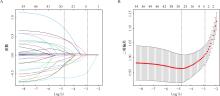

| 变量数(个) | 准确率 | 准确率标准差 | Kappa系数 | Kappa标准差 |
|---|---|---|---|---|
| 2 | 0.774 | 0.036 | 0.317 | 0.109 |
| 3 | 0.764 | 0.027 | 0.163 | 0.134 |
| 4 | 0.801 | 0.045 | 0.475 | 0.121 |
| 5 | 0.817 | 0.040 | 0.496 | 0.106 |
| 6 | 0.809 | 0.042 | 0.459 | 0.118 |
| 7 | 0.797 | 0.043 | 0.403 | 0.126 |
| 8 | 0.800 | 0.046 | 0.395 | 0.139 |
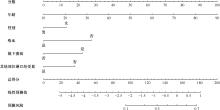
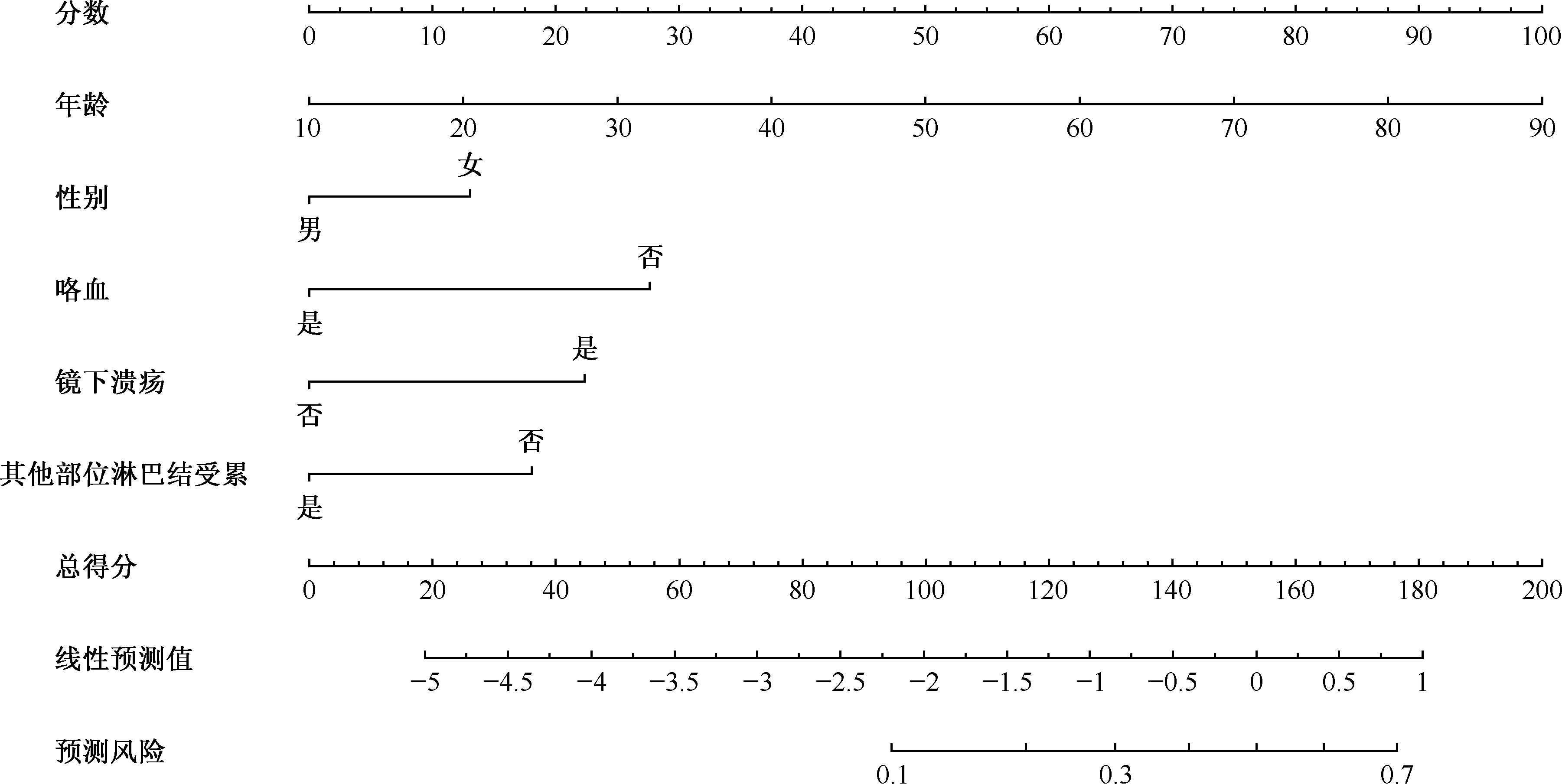
| 因素 | β值 | s | Wald χ2值 | P值 | OR(95%CI)值 |
|---|---|---|---|---|---|
| 年龄(每增加1岁) | 0.056 | 0.008 | 31.905 | <0.001 | 1.06(1.04~1.08) |
| 男性 | -0.572 | 0.180 | 7.635 | 0.007 | 0.56(0.37~0.86) |
| 无咯血 | 1.247 | 0.421 | 7.124 | 0.015 | 3.48(1.28~9.48) |
| 内镜下可见溃疡 | 0.885 | 0.290 | 3.886 | 0.001 | 2.42(1.41~4.17) |
| 无其他部位淋巴结结核 | 0.983 | 0.235 | 6.983 | 0.001 | 2.67(1.52~4.70) |
| [1] | 中华医学会结核病学分会, 《中华结核和呼吸杂志》编辑委员会. 气管支气管结核诊断和治疗指南(试行)[J]. 中华结核和呼吸杂志, 2012, 35(8):581-587. doi:10.3760/cma.j.issn.1001-0939.2012.08.007. |
| [2] | Davis R J, Akst L M, Allen C T, et al. Third Proceedings of The North American Airway Collaborative (NoAAC): Consensus Statement on Trial Design for Airway Stenosis[J]. JAMA Otolaryngol Head Neck Surg, 2025, 151(3):263-267. doi:10.1001/jamaoto.2024.4963. |
| [3] |
Chaddha U, Agrawal A, Murgu S, et al. World Association for Bronchology and Interventional Pulmonology (WABIP) Guidelines on Airway Stenting for Benign Central Airway Obstruction[J]. Respirology, 2025, 30(7):587-604. doi:10.1111/resp.70068.
pmid: 40575842 |
| [4] | Kim H. Rigid Bronchoscopy for Post-tuberculosis Tracheobronchial Stenosis[J]. Tuberc Respir Dis (Seoul), 2023, 86(4):245-250. doi:10.4046/trd.2023.0017. |
| [5] |
Su Z, Cheng Y, Wu Z, et al. Incidence and Predictors of Tracheobronchial Tuberculosis in Pulmonary Tuberculosis: A Multicentre, Large-Scale and Prospective Study in Southern China[J]. Respiration, 2019, 97(2):153-159. doi:10.1159/000492335.
pmid: 30205411 |
| [6] | Chen Q, Huang T, Zou L, et al. Differences in epidemiological and clinical features between adult and pediatric tracheobronchial tuberculosis patients in Southwest China[J]. Front Public Health, 2023, 11:1225267. doi:10.3389/fpubh.2023.1225267. |
| [7] | Zhuang R, Yang M, Xu L, et al. Characteristics analysis of 157 cases of central airway stenosis due to tracheobronchial tuberculosis: A descriptive study[J]. Front Public Health, 2023, 11:1115177. doi:10.3389/fpubh.2023.1115177. |
| [8] | 徐勇, 周腾, 刘俊佳. 结核性气道狭窄介入治疗后再狭窄风险预测模型的构建及验证[J]. 中国防痨杂志, 2026, 48(6):760-768. doi:10.19982/j.issn.1000-6621.20250441. |
| [9] |
Feng Y, Guo J, Luo S, et al. Risk Factors for Pulmonary Tuberculosis with Tracheobronchial Tuberculosis: Propensity Score Matching Analysis[J]. Infect Drug Resist, 2024, 17:3145-3151. doi:10.2147/IDR.S470886.
pmid: 39050839 |
| [10] | 罗莉, 罗林紫, 尹曲华, 等. 淋巴结瘘型气管支气管结核的支气管镜下诊疗进展[J]. 中国防痨杂志, 2025, 47(4):505-512. doi:10.19982/j.issn.1000-6621.20240438. |
| [11] | 中华人民共和国国家卫生和计划生育委员会. WS 288—2017 肺结核诊断[J]. 结核与肺部疾病杂志, 2024, 5(4): 376-378. doi:10.19983/j.issn.2096-8493.2024022. |
| [12] | 中华医学会结核病学分会. 气管支气管结核诊断和治疗指南(2025年版)[J]. 中华结核和呼吸杂志, 2026, 49(5):503-524. doi:10.3760/cma.j.cn112147-20250826-00518. |
| [13] | 王洪武. 重视气管支气管结核的介入诊疗:基于2025年版指南的诊疗范式革新与临床实践升维[J]. 中华结核和呼吸杂志, 2026, 49(5):496-499. doi:10.3760/cma.j.cn112147-20250901-00532. |
| [14] | Tian Y, Su T, Shen L, et al. Efficacy and prognostic analysis of bronchoscopic intervention in elderly patients with tracheobronchial tuberculosis[J]. Front Med (Lausanne), 2025, 12:1624985. doi:10.3389/fmed.2025.1624985. |
| [15] | 陈晴, 吴桂辉, 黄涛, 等. 成人气管支气管结核发生肺不张的危险因素分析[J]. 中华结核和呼吸杂志, 2023, 46(7):674-679. doi:10.3760/cma.j.cn112147-20230120-00032. |
| [16] | Bhardwaj S, Gautam R K, Kushwaha S. From senescence to scarring: Exploring TGF-β signaling in cellular aging, fibrotic remodeling, and pulmonary fibrosis[J]. Cytokine Growth Factor Rev, 2025, 86:29-39. doi:10.1016/j.cytogfr.2025.08.003. |
| [17] | Ren L L, Miao H, Wang Y N, et al. TGF-β as A Master Regulator of Aging-Associated Tissue Fibrosis[J]. Aging Dis, 2023, 14(5):1633-1650. doi:10.14336/AD.2023.0222. |
| [18] | Liu Y, Fan M, Li Y, et al. Patient Delay in the Diagnosis of Pulmonary Tuberculosis in the Elderly-China, 2015—2023[J]. China CDC Weekly, 2024, 6(42):1075-1079. doi:10.46234/ccdcw2024.221. |
| [19] |
Fu J, Li J, Liu Z, et al. Sex-Specific Differences in the Clinical Profile Among Patients with Tracheobronchial Tuberculosis: A Hospital-Based Cross-Sectional Study in Shenzhen, China[J]. Int J Gen Med, 2022, 15:5741-5750. doi:10.2147/IJGM.S367070.
pmid: 35761894 |
| [20] | Li J, Li X, Qiu L, et al. Analysis of clinical and bronchoscopic features of multidrug-resistant tracheobronchial tuberculosis[J]. BMC Infect Dis, 2025, 25(1):1246. doi:10.1186/s12879-025-11689-6. |
| [21] | Qiu Q, Li S, Chen Y, et al. Development, assessment and validation of a novel prediction nomogram model for risk identification of tracheobronchial tuberculosis in patients with pulmonary tuberculosis[J]. BMJ Open Respir Res, 2023, 10(1):e001781. doi:10.1136/bmjresp-2023-001781. |
| [22] | Dominelli P B, Ripoll J G, Cross T J, et al. Sex differences in large conducting airway anatomy[J]. J Appl Physiol(1985), 2018, 125(3):960-965. doi:10.1152/japplphysiol.00440.2018. |
| [23] | 杨诚, 黄娟, 张伟强. 肺结核患者气管支气管结核的发生率与临床预测因素分析[J]. 中国医药科学, 2024, 14(3):165-168,190. doi:10.20116/j.issn2095-0616.2024.03.39. |
| [24] | Gebrie E, Baynes H W, Mulugeta B, et al. Sex hormones and tuberculosis: Implications for immune regulation, susceptibility, and disease pathogenesis[J]. Tuberculosis(Edinb), 2026, 157:102740. doi:10.1016/j.tube.2026.102740. |
| [25] | 甘易玲. 雌激素调控气管支气管结核发生发展的作用及机制研究[D]. 重庆: 重庆医科大学, 2023. |
| [26] | 肖海浩, 汤春梅, 潘育文, 等. 气管支气管结核患者咯血的临床分析[J]. 广东医学, 2021, 42(4):400-403. doi:10.13820/j.cnki.gdyx.20203722. |
| [27] | Ganchua S, White A G, Klein E C, et al. Lymph nodes-The neglected battlefield in tuberculosis[J]. PLoS Pathog, 2020, 16(8):e1008632. doi:10.1371/journal.ppat.1008632. |
| [28] | Auld S C, Barczak A K, Bishai W, et al. Pathogenesis of Post-Tuberculosis Lung Disease: Defining Knowledge Gaps and Research Priorities at the Second International Post-Tuberculosis Symposium[J]. Am J Respir Crit Care Med, 2024, 210(8): 979-993. doi:10.1164/rccm.202402-0374SO. |
| [29] | Barroso P, Juste R, Sañudo B, et al. Differences in local immune response of bait Mycobacterium bovis heat-inactivated vaccinated badgers showing exacerbated tuberculous lesions after challenge[J]. Sci Rep, 2025, 15(1):36329. doi:10.1038/s41598-025-20278-1. |
| [1] | Zhong Leping, Qin Shibing, Sha Wei, Deng Guofang, Lin Minggui. Application and prospect of ultrasound-mediated transdermal drug delivery in adjuvant treatment of tuberculosis [J]. Chinese Journal of Antituberculosis, 2026, 48(9): 1245-1249. |
| [2] | Huang Huan, Wang Xiaomin, Song Zhe, Li Xuelin, Ding Feng, Wang Jin, Zeng Jianfeng, Wu Haiwu, Zhong Xinguang, Lu Shuihua. Interpretation of the World Health Organization’s Target Product Profiles for Tuberculosis Screening Test Products [J]. Chinese Journal of Antituberculosis, 2026, 48(9): 1250-1258. |
| [3] | Ren Feilin, Jin Meihua, Tong Zhaowei, Zheng Pingming. Interpretation of the Group Standard Specifications for the Construction of Tuberculosis Preventive Treatment Clinics in Primary Medical Institutions [J]. Chinese Journal of Antituberculosis, 2026, 48(9): 1259-1265. |
| [4] | Bai Yan, Chen Yu, Gao Xusheng, Liang Jianqin, Zeng Yi, Wang Yun, Fan Lin. Analysis of clinical characteristics and factors influencing outcomes in elderly patients with drug-susceptible pulmonary tuberculosis [J]. Chinese Journal of Antituberculosis, 2026, 48(9): 1266-1276. |
| [5] | Li Cheng, Wu Chunli, Xia Fan, Yu Wenduo, Liu Zhenguo, Yi Hengzhong, Wen Xinmin, Tang Zhigang, Huang Sheng, Li Yao, Chen Mengshi, Rong Pengfei. Study on the association between gut microbiota and drug-induced liver injury in patients with drug-resistant pulmonary tuberculosis [J]. Chinese Journal of Antituberculosis, 2026, 48(9): 1277-1289. |
| [6] | Xu Chaoyan, Wei Jiaojiao, Li Shanshan, Yao Lin, Li Ling, Gao Mengqiu. Construction and clinical evaluation of an early diagnostic model for Mycobacterium intracellulare pulmonary disease [J]. Chinese Journal of Antituberculosis, 2026, 48(9): 1290-1299. |
| [7] | Ma Liang, Ilyar Batyr, Gu Fuding, Tang Wei, Zhou Wenzheng, Dilixiati Abulizi, Mierzhati Aisha, Qin Wei. Retrospective analysis of 21 cases of advanced knee tuberculosis treated with one-stage radical debridement and total knee arthroplasty [J]. Chinese Journal of Antituberculosis, 2026, 48(9): 1300-1306. |
| [8] | Zhang Aihua, Xu Meng, Yang Yuying, Su Shuang, Song Lei, Ma Dandan, Wei Suxia, Cheng Junwei, Fu Chaohong. Analysis of the incidence of anemia and related risk factors in 878 AIDS patients with tuberculosis [J]. Chinese Journal of Antituberculosis, 2026, 48(9): 1307-1314. |
| [9] | Xue Yunlian, Li Sijie, Jiang Xue, Liu Guihao, Wu Huizhong, Wang Tingting, Zhou Zhanqi, Ji Lianrong, Wang Jiawen, Wu Xinghua, Wu Yue, Zhou Lin. Global, regional, and national burdens of tuberculosis attributable to smoking from 1990 to 2021 [J]. Chinese Journal of Antituberculosis, 2026, 48(9): 1315-1323. |
| [10] | Huang Liping, Gu Wenju, Bao Peiyu, Shen Jiayi, Song Yanzheng, Zhang Lin. The current status and influencing factors of preoperative anxiety in patients with cervical lymph node tuberculosis [J]. Chinese Journal of Antituberculosis, 2026, 48(9): 1324-1330. |
| [11] | Zhao Yuchuan, Chen Yanmei, Zhang Chenchen, Yu Meiling, Peng Kehao, Xu Liuyue, Liang Hongdi, Chen Xunxun. Research on performance comparison and selection strategies of digital PCR platforms for tuberculosis detection [J]. Chinese Journal of Antituberculosis, 2026, 48(9): 1331-1337. |
| [12] | Gulijiamali Rexiding, Gulina Badeerhan, Wang Mingzhe, Paziliya Aini, Yipar Aihaiti, Wang le, Liu Nianqiang, Dong Xiao, Wang Senlu. Predictive value of ARIMA model and Holt-Winters exponential smoothing method for pulmonary tuberculosis incidence in Xinjiang Uygur Autonomous Region [J]. Chinese Journal of Antituberculosis, 2026, 48(9): 1338-1345. |
| [13] | Xie Cifu, Song Lixin, Yin Pengliang, Xiong Zi. Evaluation of the intervention effect of an online prize-winning quiz on residents’ core knowledge of pulmonary tuberculosis prevention and control [J]. Chinese Journal of Antituberculosis, 2026, 48(9): 1356-1363. |
| [14] | Zhou Ran, Deng Jing, Chen Haiyi, Zhang Ting, Zheng Denghu. Risk prediction of catastrophic household cost among patients with rifampicin-susceptible pulmonary tuberculosis in Chongqing Municipality [J]. Chinese Journal of Antituberculosis, 2026, 48(9): 1364-1374. |
| [15] | Huang Quanjiang, Huang Minying, Cui Zhezhe. Quality evaluation of tuberculosis prevention and control work in Guangxi based on Entropy Weight-TOPSIS and RSR method [J]. Chinese Journal of Antituberculosis, 2026, 48(9): 1375-1385. |
| Viewed | ||||||
|
Full text |
|
|||||
|
Abstract |
|
|||||
 京公网安备11010202007215号
Total visitors: Visitors of today: Now online:
京公网安备11010202007215号
Total visitors: Visitors of today: Now online:
 This work is licensed under Creative Commons Attribution 3.0 License.
