
Chinese Journal of Antituberculosis ›› 2026, Vol. 48 ›› Issue (5): 641-650.doi: 10.19982/j.issn.1000-6621.20250462
• Original Articles • Previous Articles Next Articles
Zhang Shanshan1, Han Yaxuan1, Zhang Xiaoyan1, Li Jianying2, Ren Fei3, Zhang Yaohui4, Yang Haixia1( )
)
Received:2025-11-25
Online:2026-05-10
Published:2026-04-27
Contact:
Yang Haixia
E-mail:yhx2015111@163.com
Supported by:CLC Number:
Zhang Shanshan, Han Yaxuan, Zhang Xiaoyan, Li Jianying, Ren Fei, Zhang Yaohui, Yang Haixia. Clinical characteristics and survival analysis of patients with lung cancer concurrent with drug-resistant pulmonary tuberculosis[J]. Chinese Journal of Antituberculosis, 2026, 48(5): 641-650. doi: 10.19982/j.issn.1000-6621.20250462
Add to citation manager EndNote|Ris|BibTeX
URL: https://www.zgflzz.cn/EN/10.19982/j.issn.1000-6621.20250462

| 特征 | LC组 (126例) | LC+DS-PTB组 (82例) | LC+DR-PTB组 (15例) | 统计检验值 | P值 |
|---|---|---|---|---|---|
| 平均年龄(岁, | 63.71±9.94 | 64.61±9.39 | 67.40±13.29 | F=0.984 | 0.376 |
| 男性[例(构成比,%)] | 74(58.7) | 72(87.8)a | 12(80.0) | χ2=20.980 | <0.001 |
| 吸烟史[例(构成比,%)] | 37(29.4) | 29(35.4) | 7(46.7) | χ2=2.230 | 0.328 |
| ECOG评分[分,M(Q1,Q3)] | 1(1,1) | 1(1,1) | 1(1,2)bc | H=13.950 | 0.001 |
| BMI(kg/m2, | 22.40±3.54 | 21.80±3.61 | 19.84±4.23b | F=3.616 | 0.029 |
| 合并肺外基础疾病[例(比例,%)]d | 52(41.3) | 43(52.4) | 5(33.3) | χ2=3.367 | 0.186 |
| 合并肺部基础疾病[例(比例,%)]e | 10(7.9) | 13(15.9) | 5(33.3)b | χ2=9.159 | 0.010 |
| 病理类型(非小细胞肺癌)[例(比例,%)] | 107(82.5) | 74(90.2) | 14(93.3) | χ2=1.790 | 0.409 |
| 肿瘤分期(Ⅲ/Ⅳ期)[例(比例,%)] | 93(73.8) | 70(85.4) | 12(80.0) | χ2=3.949 | 0.139 |
| 治疗方式[例(比例,%)] | |||||
| 手术 | 28(22.2) | 16(19.5) | 4(26.7) | χ2=0.468 | 0.792 |
| 化疗 | 86(68.3) | 61(74.4) | 9(60.0) | χ2=1.648 | 0.439 |
| 胸部放疗 | 46(36.5) | 28(34.1) | 2(13.3) | χ2=3.205 | 0.201 |
| 靶向治疗 | 54(42.9) | 34(41.5) | 8(53.3) | χ2=0.733 | 0.693 |
| 免疫治疗f | 42(33.3) | 27(32.9) | 2(13.3) | χ2=2.541 | 0.281 |
| 特征 | LC组 (54例) | LC+DS-PTB组 (51例) | LC+DR-PTB组 (15例) | 统计检验值 | P值 |
|---|---|---|---|---|---|
| 平均年龄(岁, | 67.52±9.35 | 67.39±9.01 | 67.40±13.29 | F=0.002 | 0.998 |
| 男性[例(构成比,%)] | 45(83.3) | 43(84.3) | 11(73.3) | χ2=1.015 | 0.602 |
| ECOG评分[分,M(Q1,Q3)] | 1(1,1) | 1(1,1) | 1(1,2) | H=3.885 | 0.143 |
| BMI(kg/m2, | 21.76±3.27 | 20.95±3.20 | 19.84±4.23 | F=2.100 | 0.127 |
| 病理类型(非小细胞肺癌)[例(比例,%)] | 50(92.6) | 48(94.1) | 14(93.3) | χ2=0.098 | 0.952 |
| 肿瘤分期(Ⅲ/Ⅳ期)[例(比例,%)] | 43(79.6) | 41(80.4) | 11(73.3) | χ2=0.362 | 0.834 |
| 吸烟史[例(构成比,%)] | 22(40.7) | 18(35.3) | 7(46.7) | χ2=0.731 | 0.694 |
| 合并肺外基础疾病[例(比例,%)]a | 26(48.1) | 31(60.8) | 5(33.3) | χ2=4.288 | 0.117 |
| 合并肺部基础疾病[例(比例,%)]b | 6(11.1) | 10(19.6) | 5(33.3) | χ2=3.984 | 0.136 |
| 治疗方式[例(比例,%)] | |||||
| 手术 | 10(18.5) | 12(23.5) | 4(26.7) | χ2=0.641 | 0.726 |
| 化疗 | 39(72.2) | 35(68.6) | 9(60.0) | χ2=1.111 | 0.574 |
| 胸部放疗 | 21(38.9) | 11(21.6) | 2(13.3) | χ2=5.775 | 0.056 |
| 靶向治疗 | 17(31.5) | 25(49.0) | 8(53.3) | χ2=4.279 | 0.118 |
| 免疫治疗c | 23(42.6) | 15(29.4) | 2(13.3) | χ2=5.566 | 0.062 |
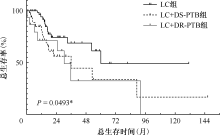
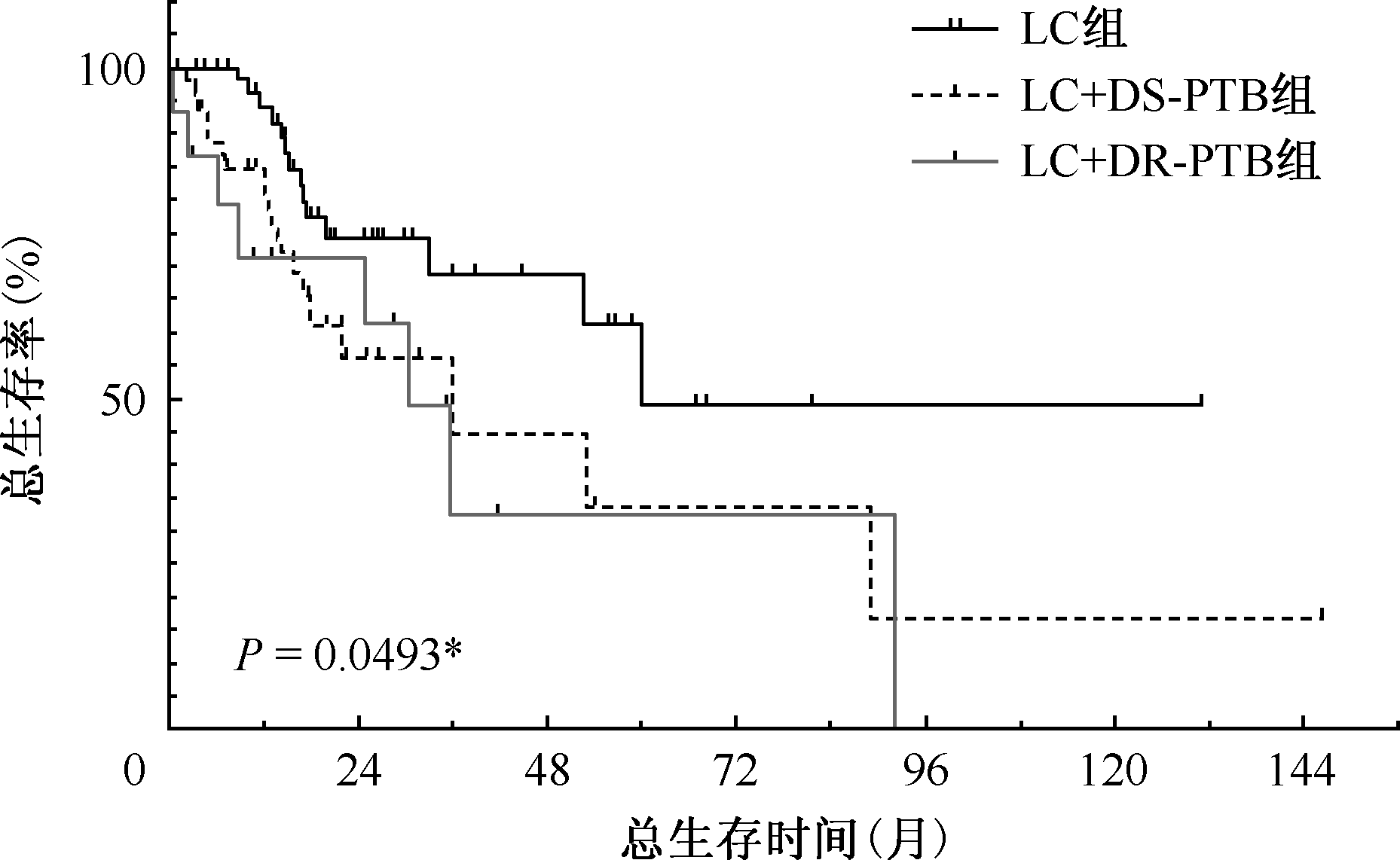
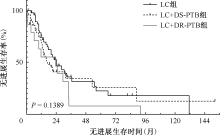
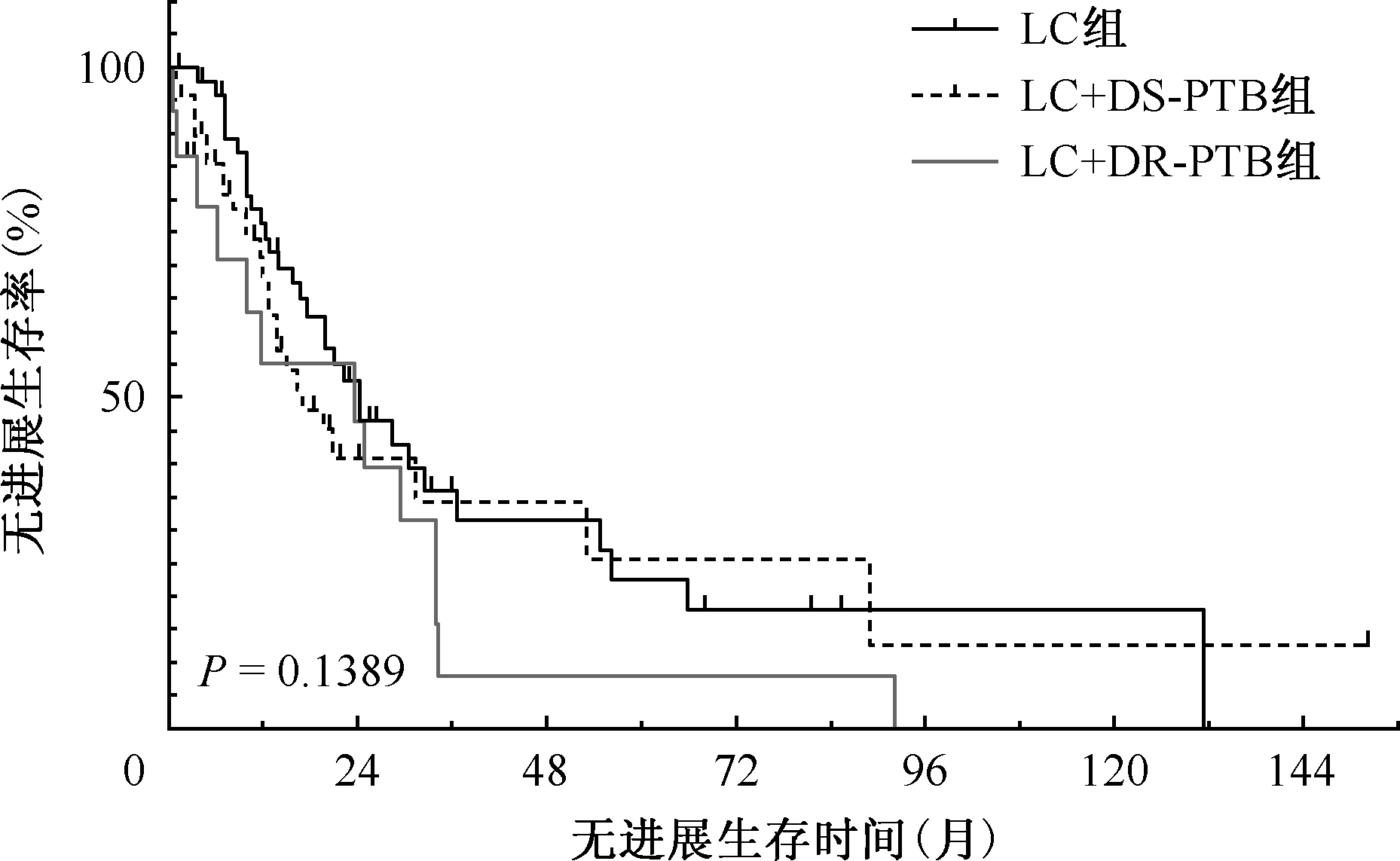
| 变量 | 单因素分析 | 多因素分析 | ||
|---|---|---|---|---|
| HR(95%CI)值 | P值 | HR(95%CI)值 | P值 | |
| 结核病状态 | ||||
| 无结核病(参照) | 1.000 | 1.000 | ||
| 共病药物敏感肺结核 | 2.075(1.027~4.195) | 0.042 | 3.288(1.448~7.466) | 0.004 |
| 共病耐药肺结核 | 2.818(1.209~6.571) | 0.016 | 4.446(1.500~13.176) | 0.007 |
| 人口学特征 | ||||
| 年龄(≥65岁对比<65岁) | 2.350(1.036~5.331) | 0.041 | 2.957(1.100~7.946) | 0.032 |
| 性别(男性对比女性) | 1.253(0.566~2.775) | 0.579 | ||
| 吸烟(是对比否) | 1.001(0.527~1.905) | 0.997 | ||
| BMI(<18.5kg/m2对比≥18.5kg/m2) | 1.968(0.989~3.915) | 0.054 | 1.458(0.657~3.237) | 0.354 |
| ECOG评分(>2分对比≤2分) | 2.937(1.091~7.905) | 0.033 | 2.062(0.580~7.331) | 0.264 |
| 合并肺外基础疾病(有对比无) | 1.968(0.989~3.915) | 0.054 | 2.428(1.107~5.326) | 0.027 |
| 合并肺部基础疾病(有对比无) | 1.098(0.523~2.306) | 0.805 | ||
| 疾病特征 | ||||
| 肿瘤分期(Ⅲ/Ⅳ期对比Ⅰ/Ⅱ期) | 2.773(1.086~7.079) | 0.033 | 2.242(0.553~9.091) | 0.258 |
| 病理类型(小细胞肺癌对比非小细胞肺癌) | 1.821(0.557~5.947) | 0.321 | ||
| 治疗方式 | ||||
| 手术(有对比无) | 0.272(0.097~0.765) | 0.014 | 0.162(0.034~0.762) | 0.021 |
| 化疗(有对比无) | 0.623(0.323~1.203) | 0.159 | 0.844(0.349~2.038) | 0.706 |
| 胸部放疗(有对比无) | 0.850(0.425~1.701) | 0.646 | 0.832(0.356~1.944) | 0.670 |
| 靶向治疗(有对比无) | 1.370(0.741~2.533) | 0.315 | 0.512(0.238~1.105) | 0.088 |
| 免疫治疗(有对比无) | 0.593(0.297~1.185) | 0.139 | 0.694(0.289~1.669) | 0.415 |
| 特征 | LC+DS-PTB组(51例) | LC+DR-PTB组(15例) | 统计检验值 | P值 | ||||
|---|---|---|---|---|---|---|---|---|
| 主要诊断方式[例(构成比,%)] | χ2=5.525 | 0.063 | ||||||
| 结核分枝杆菌痰培养 | 17(33.3) | 10(66.7) | ||||||
| 结核分枝杆菌分子生物学检测a | 32(62.7) | 5(33.3) | ||||||
| 病理学诊断 | 2(4.0) | 0(0.0) | ||||||
| 复治[例(比例,%)] | 7(13.7) | 7(46.7) | - | 0.011 | ||||
| 诊断时序[例(构成比,%)]b | χ2=0.316 | 0.975 | ||||||
| 先肺结核后肺癌 | 7(13.7) | 2(13.3) | ||||||
| 同期诊断(间隔≤6个月) | 29(56.9) | 9(60.0) | ||||||
| 先肺癌后肺结核 | 15(29.4) | 4(26.7) | ||||||
| 诊断延迟[d,M(Q1,Q3)]c | 6(4,16) | 23(6,33) | U=212.500 | 0.046 | ||||
| 治疗延迟[d,M(Q1,Q3)]d | 1(0,5) | 6(3,12) | U=152.500 | 0.006 | ||||
| 影像学表现[例(比例,%)] | ||||||||
| 结节影 | 32(62.7) | 8(53.3) | - | 0.144 | ||||
| 斑片影 | 25(49.0) | 6(40.0) | - | 0.405 | ||||
| 空洞 | 5(9.8) | 2(13.3) | - | 0.653 | ||||
| 肺结核部位[例(构成比,%)] | χ2=1.133 | 0.567 | ||||||
| 双肺 | 31(60.8) | 8(53.3) | ||||||
| 单独右肺 | 15(29.4) | 4(26.7) | ||||||
| 单独左肺 | 5(9.8) | 3(20.0) | ||||||
| 合并肺外结核[例(比例,%)] | 3(5.9) | 1(6.7) | - | 1.000 | ||||
| 抗结核药物[例(比例,%)] | ||||||||
| 异烟肼 | 51(100.0) | 3(20.0) | - | <0.01 | ||||
| 利福平/利福喷丁 | 50(98.0) | 6(40.0) | - | <0.01 | ||||
| 吡嗪酰胺 | 35(68.6) | 7(46.7) | - | 0.138 | ||||
| 乙胺丁醇 | 42(77.8) | 7(46.7) | - | 0.015 | ||||
| 氟喹诺酮类 | 18(33.3) | 12(80.0) | - | 0.003 | ||||
| 利奈唑胺 | 0(0.0) | 9(60.0) | - | <0.01 | ||||
| 环丝氨酸 | 0(0.0) | 7(46.7) | - | <0.01 | ||||
| 氯法齐明 | 0(0.0) | 5(33.3) | - | <0.01 | ||||
| 结核疗效评价[例(构成比,%)] | - | 0.140 | ||||||
| 治疗成功e | 30(58.8) | 5(33.3) | ||||||
| 治疗失败 | 2(3.9) | 0(0.0) | ||||||
| 失访 | 6(11.8) | 5(33.3) | ||||||
| 死亡 | 13(25.4) | 5(33.3) | ||||||
| [1] | Ho JC, Leung CC. Management of co-existent tuberculosis and lung cancer. Lung Cancer, 2018, 122: 83-87. doi:10.1016/j.lungcan.2018.05.030. |
| [2] | Zhou W, Lu H, Lin J, et al. Coexisting Lung Cancer and Pulmonary Tuberculosis: A Comprehensive Review From Incidence to Management. Cancer Rep (Hoboken), 2025, 8(5): e70213. doi:10.1002/cnr2.70213. |
| [3] | Cabrera-Sanchez J, Cuba V, Vega V, et al. Lung cancer occurrence after an episode of tuberculosis: a systematic review and meta-analysis. Eur Respir Rev, 2022, 31(165): 220025. doi:10.1183/16000617.0025-2022. |
| [4] | Qi F, Yang H, Han Y, et al. Coexistent Pulmonary Tuberculosis and Lung Cancer: An Analysis of Incidence Trends, Financial Burdens and Influencing Factors. Cancer Innov, 2025, 4(3): e70009. doi:10.1002/cai2.70009. |
| [5] |
Evman S, Baysungur V, Alpay L, et al. Management and Surgical Outcomes of Concurrent Tuberculosis and Lung Cancer. Thorac Cardiovasc Surg, 2017, 65(7): 542-545. doi:10.1055/s-0036-1583167.
URL pmid: 27111500 |
| [6] |
Zhou Y, Cui Z, Zhou X, et al. The presence of old pulmonary tuberculosis is an independent prognostic factor for squamous cell lung cancer survival. J Cardiothorac Surg, 2013, 8: 123. doi:10.1186/1749-8090-8-123.
URL pmid: 23647947 |
| [7] | 李智炜, 赖铿, 李铁钢, 等. 2016—2020年广州市耐药结核病患者不良治疗结局状况及其影响因素分析. 中国防痨杂志, 2022, 44(6): 600-607. doi:10.19982/j.issn.1000-6621.20220020. |
| [8] | Zhou ZJ, Xie HY, Bertolaccini L, et al. Research progress on lung cancer complicated with pulmonary tuberculosis: a narrative review. Transl Lung Cancer Res, 2025, 14(6): 2272-2280. doi:10.21037/tlcr-2025-450. |
| [9] | Chopra KK, Matta S, Arora VK. Drug resistant tuberculosis among elderly: Challenges. Indian J Tuberc, 2022, 69 Suppl 2: S202-S204. doi:10.1016/j.ijtb.2022.10.022. |
| [10] | Jeon H, Wang S, Song J, et al. Update 2025: Management of Non-Small-Cell Lung Cancer. Lung, 2025, 203(1): 53. doi:10.1007/s00408-025-00801-x. |
| [11] | 中华人民共和国国家卫生和计划生育委员会. WS 288—2017 肺结核诊断. 结核与肺部疾病杂志, 2024, 5(4): 376-378. doi:10.19983/j.issn.2096-8493.2024022. |
| [12] | 中国防痨协会. 耐药结核病化学治疗指南(2019年简版). 中国防痨杂志, 2019, 41(10): 1025-1073. doi:10.3969/j.issn.1000-6621.2019.10.001. |
| [13] | 中华人民共和国国家卫生和计划生育委员会. WS 196—2017结核病分类. 结核与肺部疾病杂志, 2024, 5(4): 379-380. doi:10.19983/j.issn.2096-8493.2024055. |
| [14] | 首都医科大学附属北京胸科医院/北京市结核病胸部肿瘤研究所, 中国防痨协会, 《中国防痨杂志》编辑委员会. 耐药肺结核全口服化学治疗方案中国专家共识(2021年版). 中国防痨杂志, 2021, 43(9): 859-866. doi:10.3969/j.issn.1000-6621.2021.09.002. |
| [15] | Teo AKJ, Singh SR, Prem K, et al. Duration and determinants of delayed tuberculosis diagnosis and treatment in high-burden countries: a mixed-methods systematic review and meta-analysis. Respir Res, 2021, 22(1): 251. doi:10.1186/s12931-021-01841-6. |
| [16] |
Storla DG, Yimer S, Bjune GA. A systematic review of delay in the diagnosis and treatment of tuberculosis. BMC Public Health, 2008, 8: 15. doi:10.1186/1471-2458-8-15.
URL pmid: 18194573 |
| [17] | 中国疾病预防控制中心专家组. 中国结核病预防控制工作技术规范(2020年版). 北京: 人民卫生出版社, 2021. |
| [18] | 谭守勇. 不容忽视耐多药结核病患者营养支持治疗的作用. 中国防痨杂志, 2019, 41(2): 121-123. doi:10.3969/j.issn.1000-6621.2019.02.001. |
| [19] | Park HY, Kang D, Shin SH, et al. Pulmonary Tuberculosis and the Incidence of Lung Cancer among Patients with Chronic Obstructive Pulmonary Disease. Ann Am Thorac Soc, 2022, 19(4): 640-648. doi:10.1513/AnnalsATS.202010-1240OC. |
| [20] | Farhat M, Cox H, Ghanem M, et al. Drug-resistant tuberculosis: a persistent global health concern. Nat Rev Microbiol, 2024, 22(10): 617-635. doi:10.1038/s41579-024-01025-1. |
| [21] | 古丽娜·巴德尔汗, 刘年强, 伊帕尔·艾海提, 等. GeneXpert MTB/RIF检测技术在新疆结核病防治规划中的应用效果. 中国防痨杂志, 2024, 46(2): 173-177. doi:10.19982/j.issn.1000-6621.20230321. |
| [22] | World Health Organization. Global Tuberculosis Report 2025. Geneva:World Health Organization, 2025. |
| [23] |
Akalu TY, Clements ACA, Xu Z, et al. Determinants of drug-resistant tuberculosis in Hunan province, China: a case-control study. BMC Infect Dis, 2024, 24(1): 198. doi:10.1186/s12879-024-09106-5.
URL pmid: 38350860 |
| [24] | Liebenberg D, Gordhan BG, Kana BD. Drug resistant tuberculosis: Implications for transmission, diagnosis, and disease management. Front Cell Infect Microbiol, 2022, 12: 943545. doi:10.3389/fcimb.2022.943545. |
| [25] | 杨海霞, 张小燕, 黄毅, 等. 活动性肺结核合并胸部肿瘤调强放射治疗的安全性及疗效分析. 中国防痨杂志, 2025, 47(3): 312-321. doi:10.19982/j.issn.1000-6621.20240450. |
| [26] |
Chai M, Shi Q. The effect of anti-cancer and anti-tuberculosis treatments in lung cancer patients with active tuberculosis: a retrospective analysis. BMC Cancer, 2020, 20(1): 1121. doi:10.1186/s12885-020-07622-6.
URL pmid: 33213414 |
| [27] | 阮淑金, 陈敬芳, 王秀芬, 等. 肺结核患者治疗不依从影响因素分析及风险预测模型的构建研究. 结核与肺部疾病杂志, 2025, 6(2): 183-190. doi:10.19983/j.issn.2096-8493.20250021. |
| [28] | Tiberi S, Utjesanovic N, Galvin J, et al. Drug resistant TB-latest developments in epidemiology, diagnostics and management. Int J Infect Dis, 2022, 124 Suppl 1: S20-S25. doi:10.1016/j.ijid.2022.03.026. |
| [29] |
Seo W, Kim HW, Kim JS, et al. Long term management of people with post-tuberculosis lung disease. Korean J Intern Med, 2024, 39(1): 7-24. doi:10.3904/kjim.2023.395.
URL pmid: 38225822 |
| [30] | Tang S, Qin C, Hu H, et al. Immune Checkpoint Inhibitors in Non-Small Cell Lung Cancer: Progress, Challenges, and Prospects. Cells, 2022, 11(3): 320. doi:10.3390/cells11030320. |
| [31] |
Fujita K, Terashima T, Mio T. Anti-PD 1 Antibody Treatment and the Development of Acute Pulmonary Tuberculosis. J Thorac Oncol, 2016, 11(12): 2238-2240. doi:10.1016/j.jtho.2016.07.006.
URL pmid: 27423391 |
| [32] | 中国防痨协会多学科诊疗分会, 深圳市第三人民医院(国家感染性疾病临床医学研究中心), 首都医科大学附属北京朝阳医院, 等. 肺结核与肺癌共病诊疗专家共识. 中国防痨杂志, 2025, 47(9): 1105-1125. doi:10.19982/j.issn.1000-6621.20250276. |
| [33] |
Zhu J, He Z, Liang D, et al. Pulmonary tuberculosis associated with immune checkpoint inhibitors: a pharmacovigilance study. Thorax, 2022, 77(7): 721-723. doi:10.1136/thoraxjnl-2021-217575.
URL pmid: 35277447 |
| [34] | Wang Z, Xu K, Sun H, et al. Impact of pneumonitis from radiotherapy combined with immune checkpoint inhibitors therapy on tumor progression and survival in patients with non-small cell lung cancer. Front Immunol, 2025, 16: 1578057. doi:10.3389/fimmu.2025.1578057. |
| [35] | Edwards DM, Sankar K, Alseri A, et al. Pneumonitis After Chemoradiotherapy and Adjuvant Durvalumab in Stage Ⅲ Non-Small Cell Lung Cancer. Int J Radiat Oncol Biol Phys, 2024, 118(4): 963-970. doi:10.1016/j.ijrobp.2023.09.050. |
| [36] | Sheikhpour M, Mirbahari SN, Sadr M, et al. A Comprehensive Study on the Correlation of Treatment, Diagnosis and Epidemiology of Tuberculosis and Lung Cancer. Tanaffos, 2023, 22(1): 7-18. |
| [37] | 中国抗癌协会肺部肿瘤整合康复专业委员会, 中国抗癌协会中西整合肺癌专业委员会, 中华医学会结核病学分会. 中国肺癌合并肺结核临床诊疗指南(2025版). 中国胸心血管外科临床杂志, 2025, 32(11): 1521-1539. doi:10.7507/1007-4848.202509088. |
| [38] |
Xiong M, Xie S, Wang Y, et al. The diagnosis interval influences risk factors of mortality in patients with co-existent active tuberculosis and lung cancer: a retrospective study. BMC Pulm Med, 2023, 23(1): 382. doi:10.1186/s12890-023-02674-3.
URL pmid: 37817103 |
| [1] | Reyhangul·Aken , Muratjan·Amat , Gao Xusheng, Ding Caihong, Zeng Yi, Chen Yu, Bai Yan, Fan Lin. Analysis of influencing factors of malnutrition and treatment outcomes among elderly patients with pulmonary tuberculosis aged 60 years and above [J]. Chinese Journal of Antituberculosis, 2026, 48(6): 751-759. |
| [2] | Xu Yong, Zhou Teng, Liu Junjia. Construction and validation of a risk prediction model for restenosis after interventional treatment of tuberculous airway stenosis [J]. Chinese Journal of Antituberculosis, 2026, 48(6): 760-768. |
| [3] | Fan Jiahua, Yan Liang, Chen Hua, Lu Chunli, Wang Min, Huang Yaling, Li Yan. Association between nutritional risk, inflammatory indicators, and glycemic control in patients with tuberculosis complicated by diabetes mellitus [J]. Chinese Journal of Antituberculosis, 2026, 48(6): 769-778. |
| [4] | Jiang Xuefeng, Zhou Linjun, Sun Yan, Jiang Mingxia, Ma Ling, Mei Li, Liu Dongxin. Analysis of drug resistance gene mutation characteristics in Mycobacterium tuberculosis strains from five northwestern provinces of China [J]. Chinese Journal of Antituberculosis, 2026, 48(6): 856-864. |
| [5] | Zhang Wenya, Zhang Yanqiu, Wang Weidong, Xu Xiaowan, He Mengya, Sun Dingyong. Research progress of serological markers for the prognostic evaluation of pulmonary tuberculosis [J]. Chinese Journal of Antituberculosis, 2026, 48(6): 892-902. |
| [6] | Che Yang, Zhang Dongliang, Li Xiangchen, Lu Yewei, Liu Zhengwei. Molecular characterization and risk factors of cross-resistance between isoniazid and prothionamide in multidrug-resistant Mycobacterium tuberculosis in Ningbo, China [J]. Chinese Journal of Antituberculosis, 2026, 48(5): 576-585. |
| [7] | Xie Cifu, Yin Pengliang, Song Lixin, Xiong Zi. Analysis of out-of-pocket medical expenses and influencing factors of multidrug-resistant/rifampicin-resistant pulmonary tuberculosis patients in Changsha City [J]. Chinese Journal of Antituberculosis, 2026, 48(5): 594-602. |
| [8] | Wu Yaning, Huang Misun, Guo Yi, Bo Xianglong, Wang Ruihuan, Xing Jianliang, Fan Xueting, Xu Da, Zhao Lili, Zhao Xiuqin, Li Guilian, Liu Haican, Li Machao. Analysis of genetic mutation characteristics associated with linezolid resistance in Mycobacterium tuberculosis [J]. Chinese Journal of Antituberculosis, 2026, 48(5): 603-615. |
| [9] | Zhao Xiaoting, Han Jing, Hou Zhili, Ding Wenlong, Zhang Yuyang, Zhang Shuo, Xing Zhiheng. Predictive value of baseline chest CT features for anti-tuberculosis treatment outcomes in patients with non-drug-resistant pulmonary tuberculosis [J]. Chinese Journal of Antituberculosis, 2026, 48(5): 670-676. |
| [10] | Li Qin, Li Linhong, Liu Jiao, Feng Mei, Xie Qi, Zhang Guixian, Yang Qiong, Yang Dandan. A case of AIDS with rifampicin-resistant tuberculous breast abscess and literature review [J]. Chinese Journal of Antituberculosis, 2026, 48(5): 687-693. |
| [11] | Hu Xinyang, Liu Yang, Gao Jingtao. Research progress on latent tuberculosis infection in patients with hematological malignancies [J]. Chinese Journal of Antituberculosis, 2026, 48(5): 694-699. |
| [12] | Ji Lianrong, Xue Yunlian, Jiang Xue, Yuan Shasha, Liu Guihao, Wang Xiaowan, Zou Xia, Wang Tingting, Zhou Zhanqi, Zhou Lin. Spatio-temporal distribution and clustering characteristics of comorbidities among tuberculosis inpatients in Guangdong Province from 2016 to 2024 [J]. Chinese Journal of Antituberculosis, 2026, 48(4): 448-458. |
| [13] | Su Wei, Bai Xinyu, Maiwulajiang Yimamu, Keyoumu Wubulikasimu, Diermulati Tusun, Lai Fuli, Mirenisha Abudurexiti, Xirizhati Mamuti, Zhou Linjun, Huang Fei. Survival status and influencing factors analysis of patients with rifampicin-resistant pulmonary tuberculosis in Kashgar Prefecture, Xinjiang Uygur Autonomous Region, 2013—2022 [J]. Chinese Journal of Antituberculosis, 2026, 48(2): 197-205. |
| [14] | Wu Xiaoying, He Gang, Cai Xiaoting, He Liqian, Deng Hong, He Liyan. Analysis on the prognostic outcome model of elderly pulmonary tuberculosis patients with comorbidities based on the Chinese multimorbidity-weighted index [J]. Chinese Journal of Antituberculosis, 2026, 48(2): 206-216. |
| [15] | Shang Yuanyuan, Wang Xueyu, Wang Yujin, Yu Xia, Huang Hairong, Nie Wenjuan. Functional annotation of single nucleotide polymorphisms and analysis of drug resistance-related pathways in Mycobacterium abscessus strains resistant to Sudapyridine [J]. Chinese Journal of Antituberculosis, 2026, 48(2): 264-273. |
| Viewed | ||||||
|
Full text |
|
|||||
|
Abstract |
|
|||||
 京公网安备11010202007215号
Total visitors: Visitors of today: Now online:
京公网安备11010202007215号
Total visitors: Visitors of today: Now online:
 This work is licensed under Creative Commons Attribution 3.0 License.
