
Chinese Journal of Antituberculosis ›› 2026, Vol. 48 ›› Issue (4): 525-533.doi: 10.19982/j.issn.1000-6621.20250365
• Original Articles • Previous Articles Next Articles
Yang Jie1, Dong Ning1( ), Wei Xiaowen1, Wu Yan2, Dong Wenfang1, Wu Yuanhao1, Zhang Lin3
Received:2025-09-09
Online:2026-04-10
Published:2026-04-02
Contact:
Dong Ning,Email:dongning@shaphc.org
Supported by:CLC Number:
Yang Jie, Dong Ning, Wei Xiaowen, Wu Yan, Dong Wenfang, Wu Yuanhao, Zhang Lin. Effects of family participatory intervention on medication adherence and lung function based on health action process approach in elderly patients with pulmonary tuberculosis[J]. Chinese Journal of Antituberculosis, 2026, 48(4): 525-533. doi: 10.19982/j.issn.1000-6621.20250365
Add to citation manager EndNote|Ris|BibTeX
URL: https://www.zgflzz.cn/EN/10.19982/j.issn.1000-6621.20250365

| 临床特征 | 研究组(58例) | 对照组(59例) | 统计检验值 | P值 | ||
|---|---|---|---|---|---|---|
| 患者 | ||||||
| 年龄[岁,M(Q1,Q3)] | 71.00(64.75,78.00) | 73.00(68.00,77.00) | Z=-0.243 | 0.808 | ||
| 性别[例(构成比,%)] | χ2=0.838 | 0.360 | ||||
| 男性 | 41(70.69) | 37(62.71) | ||||
| 女性 | 17(29.31) | 22(37.29) | ||||
| 文化程度[例(构成比,%)] | χ2=2.772 | 0.250 | ||||
| 小学及以下 | 13(22.41) | 16(27.12) | ||||
| 初中 | 23(39.66) | 29(49.15) | ||||
| 高中/中专及以上 | 22(37.93) | 14(23.73) | ||||
| 体质量指数[kg/m2,M(Q1,Q3)] | 18.31(16.31,19.65) | 18.05(17.01,21.03) | Z=-0.079 | 0.937 | ||
| 基础疾病[例(构成比,%)] | χ2=0.572 | 0.751 | ||||
| 0种 | 7(12.07) | 6(10.17) | ||||
| 1种 | 35(60.34) | 33(55.93) | ||||
| ≥2种 | 16(27.59) | 20(33.90) | ||||
| 合并用药情况[例(构成比,%)] | χ2=0.244 | 0.885 | ||||
| ≤2种 | 12(20.69) | 14(23.73) | ||||
| 3~5种 | 32(55.17) | 30(50.85) | ||||
| ≥6种 | 14(24.14) | 15(25.42) | ||||
| 居住地[例(构成比,%)] | χ2=1.991 | 0.158 | ||||
| 城市 | 12(20.69) | 19(32.20) | ||||
| 郊区/乡镇/农村 | 46(79.31) | 40(67.80) | ||||
| 家庭经济情况[例(构成比,%)] | χ2=2.708 | 0.258 | ||||
| 贫困 | 13(22.41) | 8(9.32) | ||||
| 一般 | 34(58.62) | 43(81.36) | ||||
| 良好 | 11(18.97) | 8(9.32) | ||||
| 家属 | ||||||
| 年龄(岁, | 47.67±9.22 | 45.92±9.93 | t=0.992 | 0.324 | ||
| 性别[例(构成比,%)] | χ2=0.444 | 0.505 | ||||
| 男性 | 19(32.76) | 16(27.12) | ||||
| 女性 | 39(67.24) | 43(72.88) | ||||
| 工作状态[例(构成比,%)] | χ2=0.704 | 0.401 | ||||
| 在职 | 25(43.10) | 30(50.85) | ||||
| 退休/无工作 | 33(56.90) | 29(49.15) | ||||
| 与患者关系[例(构成比,%)] | χ2=1.155 | 0.561 | ||||
| 配偶 | 13(22.41) | 10(16.95) | ||||
| 子女 | 38(65.52) | 44(74.58) | ||||
| 其他亲属 | 7(12.07) | 5(8.47) | ||||
| 文化程度[例(构成比,%)] | χ2=3.470 | 0.325 | ||||
| 小学及以下 | 8(13.79) | 5(8.48) | ||||
| 初中 | 21(36.21) | 15(25.42) | ||||
| 高中/中专 | 23(39.66) | 33(55.93) | ||||
| 大专及以上 | 6(10.34) | 6(10.17) | ||||
| 居住情况[例(构成比,%)] | χ2=0.002 | 0.963 | ||||
| 与患者同住 | 46(79.31) | 47(79.66) | ||||
| 不与患者同住,定期见面 | 12(20.69) | 12(20.34) | ||||
| 干预阶段/ 理论依据 | 干预目标 | 干预内容和要求 | ||
|---|---|---|---|---|
| 责任护士 | 家属 | 患者 | ||
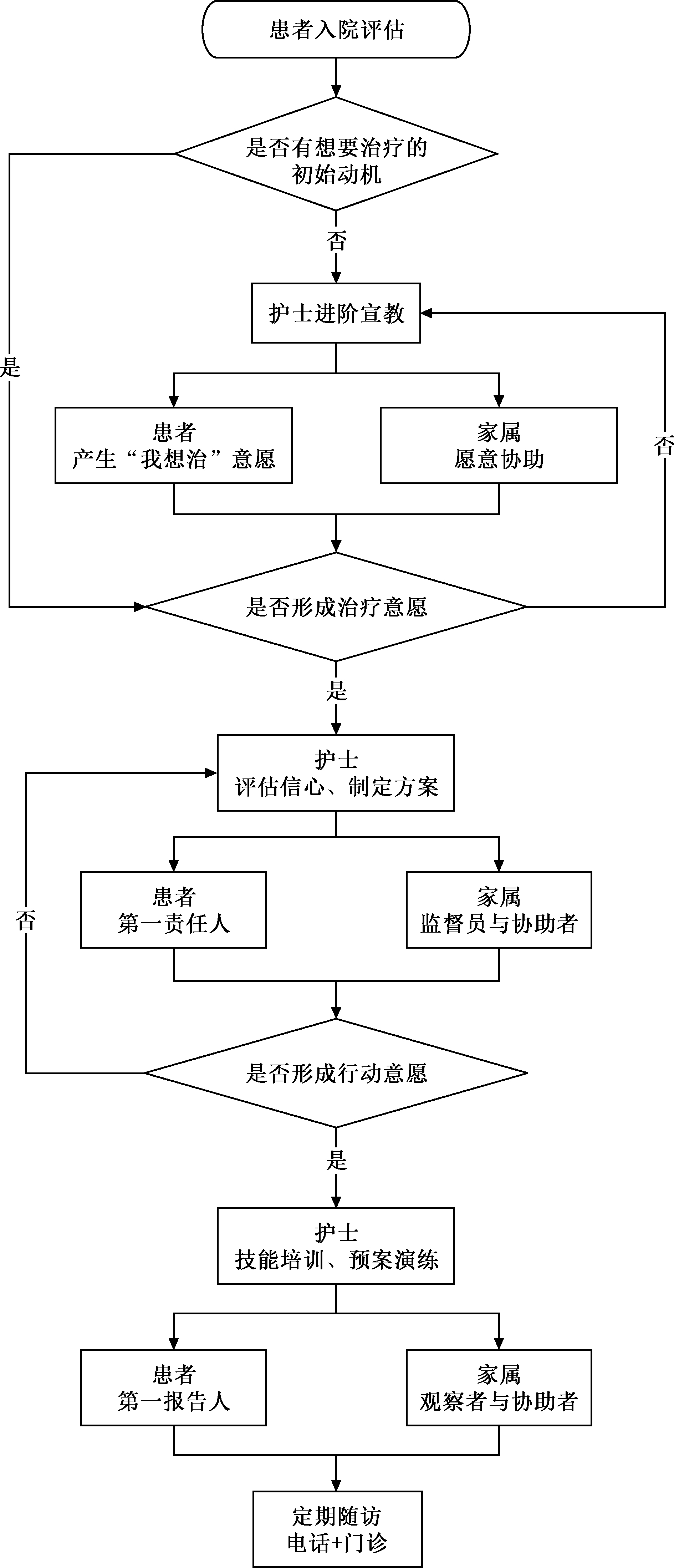
| 动机阶段 (风险感知、 结果预期) | 通过提供信息与情感支持,提升患者及家属对疾病严重性和规范治疗益处的认知,建立起“我想要治疗”的初始动机 | 1.评估认知:了解患者及家属对结核病传播、治疗难度的认知水平 2.建立信任:鼓励表达担忧,以专业、耐心的态度回应,消除信息壁垒 3.进阶宣教:第一次(入院24h内):聚焦“是什么”(病因、传播)与“为什么必须立即治”(控制病情、传播);第二次(入院48h内):聚焦“为什么坚持治”(长期危害)与“如何治好”(治疗目标与角色) 4.干预方法与频次:入院第1~2天,面对面讲解+视频播放+图文手册,10~15min/次,共3次 | 1.知晓疾病对患者的渐进性损害及对家庭(照顾负担、经济压力)的影响 2.认识到协助患者服药既是治愈的保障,也是降低家庭感染风险的措施,愿意主动提供支持 | 1.明确肺结核对自身(肺功能衰竭)和家人(传染风险)的严重危害 2.理解规范治疗是避免恶化、预防耐药的关键,从内心产生“我想治疗”的意愿 |
| 意向阶段 (自我效能、 行动计划) | 通过共同制定行动计划和明确分工,解决“我能否坚持”和“具体怎么做”的问题,形成“我决定且能够坚持治疗”的坚定意向 | 1.澄清矛盾:化解“担忧不良反应”与“渴望康复”的冲突,识别并强化“我可以试试”等积极语句 2.促进分工:引导家庭根据时间与能力进行合理分工 3.制定方案:共同制定涵盖药物、饮食、呼吸康复、消毒隔离的个性化管理方案,并预判障碍 4.提供工具:发放并指导使用《用药记录本》 5.评估信心:使用“信心尺/准备尺”量化并提升信心与准备度 6.干预方法与频次:入院第3~5天,面对面讲解+视频播放+示范指导+案例分享,10~15min/次,共6次 | 1.监督员与协助者:对提醒和服药环境负责 2.备药与提醒:每日将单次剂量的药物备好,放在固定、醒目位置,并进行口头提醒 3.执行“看服到口”:亲眼看着患者将药物放入口中、咽下,并确认口腔无残留,完成后在《用药记录本》上记录 4.明确权责边界:知晓责任是“提醒与确认”,若患者拒绝,应在《用药记录本》上记录并与医护人员联系,避免冲突 | 1.第一责任人:承诺对自身服药行为负最终责任 2.主动行动:在约定时间,主动向家属示意服药 3.确认剂量:服药前,自行核对药物种类和数量,形成“双重保险” 4.及时沟通:若感觉家属提醒方式不当或产生依赖心理,应主动、平和地沟通,共同优化监督流程 |
| 行动阶段 (行为执行、 应对障碍) | 通过技能培训保障行动执行能力,通过预案演练和建立支持系统帮助患者与家属在面对副作用、突发状况等障碍时,能有效应对,防止行动中断 | 1.技能培训:(1)药物知识:通过提问、演示等方式,确认患者及家属掌握抗结核药物的名称、用法、常见不良反应及应对策略;(2)呼吸训练:示范并指导家属协助患者进行缩唇呼吸、腹式呼吸,起始1~2次/天,渐增至3~4次/天,5~10min/次。①缩唇呼吸:患者先闭口,用鼻深吸气,同时在心里默念“1”“2”或家属在旁数“1”“2”;接着,嘴噘起如同吹蜡烛一般,慢慢吐气,发出“噗”的声音,并在心里默念“1”“2”“3”“4”或家属在旁数(尽量使呼气时间保持为吸气时间的两倍);家属指导患者呼气时身体前倾20~45°,以帮助横膈肌上升,将肺中的空气排出;②腹式呼吸:患者将一只手放于上腹部,另一只手放于胸部正中间;以鼻子吸气,同时使上腹部向外突起;呼气时,利用上腹部肌肉的收缩,放于上腹部的手向下压并向上推,同时进行呼气动作;(3)营养计算:结合患者的身高、体质量、血清白蛋白、血红蛋白等指标,指导制定个性化膳食计划,明确能量、蛋白质、维生素等营养素的合理摄入标准(如每日蛋白质摄入量按1.2~1.5g/kg体质量计算);(4)消毒隔离:指导患者痰液正确处理方式,患者餐具、衣物、被褥的日常消毒方法,家具、地面、日常接触表面的消毒方法,指导照顾者接触患者或其分泌物时佩戴医用防护口罩,正确执行手卫生 2.预案演练:采用“回授法”评估掌握度,通过情景模拟(如咯血处理)指导应对策略 3.持续支持:定期沟通,了解患者居家管理中的困难(如药物不良反应导致食欲下降),及时提供解决方案。耐心倾听患者及家属的感受,解答疑问,强化其坚持管理的动力 4.干预方法与频次:出院前3天至出院当日,视频播放+示范指导+情景模拟,15~20min/次,共6次 | 1.观察者与协调者:系统观察患者食欲、皮肤巩膜(黄疸),定期测量体质量 2.触发预警:一旦发现患者体质量持续下降、皮肤巩膜黄染、严重恶心呕吐或患者自诉视力明显下降,立即陪同就医 3.协助与保障:(1)协助呼吸康复训练:训练中密切观察其脸色、言语反应,出现不适应立即协助调整或终止;(2)做好消毒:保持患者居所通风,指导患者及时增减衣服预防感冒,做好餐具、被服等的消毒处理;(3)提供情感支持:关注患者情绪状态,通过倾听、陪伴缓解其心理压力 4.自身压力调适:必要时向医护人员或亲友寻求支持 | 1.第一报告人:主动报告任何身体异常,如:“我恶心吃不下饭”“我眼睛看东西有点模糊”“我关节疼” 2.配合与执行:配合家属进行体质量测量、皮肤观察、执行呼吸康复训练、保持良好生活习惯与呼吸道隔离 3.及时反馈:意识到任何不适都可能与药物有关,做到不隐瞒、不拖延,立即告知家属 4.主动求助:主动向家人或医护人员倾诉需求和困惑(如药物不良反应导致的焦虑) |
| 组别 | 出院后1个月 | 出院后2个月 | 出院后3个月 |
|---|---|---|---|
| 研究组(58例) | 7.79±0.41 | 7.62±0.49 | 7.64±0.49 |
| 对照组(59例) | 7.58±0.50 | 7.37±0.76 | 7.37±0.49 |
| t值 | 2.575 | 2.094 | 2.948 |
| P值 | 0.011 | 0.039 | 0.004 |
| 项目 | 研究组(58例) | 对照组(59例) | 检验统计值 | P值 |
|---|---|---|---|---|
| 胃肠道不适(恶心、厌食、反酸、嗳气等) | 10(17.24) | 11(18.64) | χ2=0.039 | 0.843 |
| 皮肤症状(瘙痒、皮疹等) | 5(8.62) | 4(6.78) | - | 0.743a |
| 肝胆系统(肝区不适、肝功能异常) | 4(6.90) | 1(1.70) | - | 0.207a |
| 运动系统(关节疼痛、肌肉酸痛) | 2(3.45) | 3(5.08) | - | 1.000a |
| 组别 | 适应度 | 合作度 | 成长度 | 情感度 | 亲密度 | ||||||||||
|---|---|---|---|---|---|---|---|---|---|---|---|---|---|---|---|
| 干预前 | 干预后 | Z值 (P值) | 干预前 | 干预后 | Z值 (P值) | 干预前 | 干预后 | Z值 (P值) | 干预前 | 干预后 | Z值 (P值) | 干预前 | 干预后 | Z值 (P值) | |
| 研究组 (58例) | 1.00 (1.00, 1.00) | 2.00 (2.00, 2.00) | -7.394 (<0.001) | 1.00 (0.00, 1.25) | 2.00 (2.00, 2.00) | -6.552 (<0.001) | 1.00 (0.00, 2.00) | 2.00 (2.00, 2.00) | -5.487 (<0.001) | 2.00 (1.00, 2.00) | 2.00 (2.00, 2.00) | -4.107 (<0.001) | 1.00 (1.00, 2.00) | 2.00 (2.00, 2.00) | -5.948 (<0.001) |
| 对照组 (59例) | 1.00 (1.00, 2.00) | 1.00 (1.00, 2.00) | -3.258 (0.001) | 1.00 (0.00, 2.00) | 1.00 (1.00, 2.00) | -1.935 (0.053) | 1.00 (1.00, 2.00) | 2.00 (1.00, 2.00) | -3.975 (<0.001) | 2.00 (1.00, 2.00) | 2.00 (1.00, 2.00) | -1.187 (0.235) | 1.00 (1.00, 1.00) | 1.00 (1.00, 2.00) | -1.418 (0.156) |
| Z值 | -1.421 | -2.708 | -0.249 | -5.430 | -0.296 | -2.977 | -0.084 | -3.212 | -1.460 | -5.702 | |||||
| P值 | 0.155 | 0.007 | 0.803 | <0.001 | 0.767 | 0.003 | 0.933 | 0.001 | 0.144 | <0.001 | |||||
| 组别 | FVC(L) | FEV1(L) | FEV1/FVC(%) | ||||||
|---|---|---|---|---|---|---|---|---|---|
| 干预前 | 干预后 | Z值(P值) | 干预前 | 干预后 | Z值(P值) | 干预前 | 干预后 | Z值(P值) | |
| 研究组 (58例) | 2.77 (2.41,3.54) | 3.59 (3.14,4.23) | -4.535 (<0.001) | 2.08 (1.73,2.80) | 2.85 (2.41,3.25) | -5.027 (<0.001) | 76.72 (75.39,80.93) | 80.89 (75.37,90.19) | -2.627 (0.009) |
| 对照组 (59例) | 2.64 (2.41,3.52) | 3.14 (2.47,4.18) | -2.333 (0.020) | 2.08 (1.73,2.79) | 2.23 (1.89,2.80) | -1.694 (0.090) | 76.83 (74.07,80.93) | 78.42 (67.73,81.85) | -0.479 (0.632) |
| Z值 | -0.527 | -2.604 | -0.573 | -4.328 | -0.011 | -2.767 | |||
| P值 | 0.598 | 0.009 | 0.567 | <0.001 | 0.991 | 0.006 | |||
| [1] | 张曼晖, 张梦迪, 卢征, 等. 2005—2020年中国老年人群肺结核疾病负担趋势分析. 中国防痨杂志, 2025, 47(6):753-759. doi:10.19982/j.issn.1000-6621.20250055. |
| [2] | 中华医学会结核病学分会. 老年肺结核诊断与治疗专家共识(2023版). 中华结核和呼吸杂志, 2023, 46(11):1068-1084. doi:10.3760/cma.j.cn112147-20230921-00182. |
| [3] |
Schwarzer R, Lippke S, Luszczynska A. Mechanisms of health behavior change in persons with chronic illness or disability:the Health Action Process Approach (HAPA). Rehabil Psychol, 2011, 56(3): 161-170. doi:10.1037/a0024509.
pmid: 21767036 |
| [4] | 张向京, 岳建华, 林锐. 健康行为HAPA模型为指导提高老年高血压患者自我效能、心理健康和服药依从性的影响. 中国健康心理学杂志, 2021, 29(8):1199-1204. doi:10.13342/j.cnki.cjhp.2021.08.019. |
| [5] | 柏乐, 颜琬华. 基于健康行动过程取向模型的健康行为干预策略对支气管哮喘患者用药依从性的影响. 中国实用护理杂志, 2020, 36(12): 895-900. doi:10.3760/cma.j.cn211501-20190927-02747. |
| [6] | 布麦日叶木·吐尔洪. 家庭关怀度对肺结核病患者服药依从性的影响:污名知觉的中介作用及其干预研究. 石河子: 石河子大学, 2023. |
| [7] | 中华人民共和国国家卫生和计划生育委员会. WS 288—2017肺结核诊断. 结核与肺部疾病杂志, 2024, 5(4): 376-378. doi:10.19983/j.issn.2096-8493.2024022. |
| [8] | 王家良. 临床流行病学:临床科研设计、测量与评价. 5版. 上海: 上海科学技术出版社, 2021. |
| [9] | 徐良润, 杨明莹, 郭映武, 等. 健康信念模式下家属协同护理模式在初治涂阳肺结核患者自我管理中的应用效果. 中国防痨杂志, 2025, 47(2): 210-217. doi:10.19982/j.issn.1000-6621.20240401. |
| [10] |
Chen Y, Tan D, Xu Y, et al. Effects of a HAPA-based multicomponent intervention to improve self-management precursors of older adults with tuberculosis: A community-based randomised controlled trial. Patient Educ Couns, 2020, 103(2): 328-335. doi:10.1016/j.pec.2019.09.007.
pmid: 31543353 |
| [11] | 彭华, 崔俊伟, 尚秋白, 等. 跨理论模型联合健康信念模型护理干预在肺结核合并慢性阻塞性肺疾病患者中的应用效果. 中国防痨杂志, 2025, 47(6):727-731. doi:10.19982/j.issn.1000-6621.20250037. |
| [12] | Bao Y, Wang C, Xu H, et al. Effects of an mHealth intervention for pulmonary tuberculosis self-management based on the integrated theory of health behavior change:randomized controlled trial. JMIR Public Health Surveill, 2022, 8(7): e34277-e34293. doi:10.2196/34277. |
| [13] |
Morisky DE, Green LW, Levine DM. Concurrent and predictive validity of a self-reported measure of medication adherence. Med Care, 1986, 24(1): 67-74. doi:10.1097/00005650-198601000-00007.
pmid: 3945130 |
| [14] | 杨婷婷, 童叶青, 殷晓旭, 等. Morisky服药依从性量表、家庭APGAR问卷在结核病患者中的应用评价. 中国社会医学杂志, 2016, 33(6):580-582. doi:10.3969/j.issn.1673-5625.2016.06.024. |
| [15] | Smilkstein G, Ashworth C, Montano D. Validity and reliability of the family APGAR as a test of family function. J Fam Pract, 1982, 15(2): 303-311. |
| [16] | 朱蕾, 陈荣昌. 成人常规肺功能测定规范中国专家共识. 临床肺科杂志, 2022, 27(11):1621-1633. doi:10.3969/j.issn.1009-6663.2022.11.001. |
| [17] | 谢琼华. 慢性阻塞性肺疾病患者家属参与式呼吸康复方案的构建和应用评价. 北京: 中国医学科学院, 2023. |
| [18] | 陈晗. 基于健康信念模式的健康教育对初复治肺结核患者心理困扰和服药依从行为的影响. 新疆: 新疆医科大学, 2022. |
| [19] | 王佳, 王秀华, 矫晓克, 等. 结核病患者居家化疗相关症状管理体验的质性研究. 中华现代护理杂志, 2025, 31(12):1574-1581. doi:10.3760/cma.j.cn115682-20250127-00443. |
| [1] | . Guidelines for the diagnosis and treatment of superficial lymph node tuberculosis with integrated traditional Chinese and Western medicine [J]. Chinese Journal of Antituberculosis, 2026, 48(4): 429-447. |
| [2] | Ji Lianrong, Xue Yunlian, Jiang Xue, Yuan Shasha, Liu Guihao, Wang Xiaowan, Zou Xia, Wang Tingting, Zhou Zhanqi, Zhou Lin. Spatio-temporal distribution and clustering characteristics of comorbidities among tuberculosis inpatients in Guangdong Province from 2016 to 2024 [J]. Chinese Journal of Antituberculosis, 2026, 48(4): 448-458. |
| [3] | Liu Xi, Liu Yuze, Hua Weiyu, Li Jie, Zhang Ying, Dong Bin. Epidemiological characteristics of pulmonary tuberculosis among residents in Haidian District,Beijing from 2012 to 2022 and its correlation with population density [J]. Chinese Journal of Antituberculosis, 2026, 48(4): 459-467. |
| [4] | Wang Yongbing, Zhong Yuexiang, Fu Xiuying, Zhang Ying, Weng Wenpei, Zhou Fangjing, Yang Yingzhou, Luo Jilun. Survey of Mycobacterium tuberculosis infection rate and analysis of associated factors among three priority populations in Yingde’s zero-TB community pilot areas,Guangdong Province [J]. Chinese Journal of Antituberculosis, 2026, 48(4): 468-476. |
| [5] | Miao Honghao, Zhang Jie, Pang Mengdi, Ren Yixuan, Deng Yang, Yi Junli, Fan Ruifang, Chen Shuangshuang, Chen Hao, Yu Lan, Li Jie, Li Chuanyou, Yang Xinyu. Genotypic and drug resistance of Mycobacterium tuberculosis in Beijing,2024 [J]. Chinese Journal of Antituberculosis, 2026, 48(4): 477-484. |
| [6] | Li Jing, Zhang Yangyi, Yang Jinghui, Wu Zheyuan, Li Ningdi, Yu Chenlei, Wang Lili, Shen Xuhui, Jiang Yuan, Shen Xin. Study on the characteristics of rpoB gene mutations in Mycobacterium tuberculosis and its correlation with rifampicin resistance level in Shanghai [J]. Chinese Journal of Antituberculosis, 2026, 48(4): 485-494. |
| [7] | Zhong Guowei, Zhang Shaoyi, Fan Huiling. Expression and clinical value of serum LncRNA LINC00707 and miR-382-5p in patients with pulmonary tuberculosis [J]. Chinese Journal of Antituberculosis, 2026, 48(4): 495-503. |
| [8] | Jiang Lina, Dai Wenxi, Ju Hanfang, Meng Sukai, Wang Chunhua. Clinical value of auramine O fluorescence staining automatic microscopic scanning and recognition system for detecting tuberculosis [J]. Chinese Journal of Antituberculosis, 2026, 48(4): 504-509. |
| [9] | Han Yanzhuo, Lu Zhenhui, Su Ben, Zhou Rui, Chen Jiajun, Wu Xianwei, Wu Dingzhong, Zhang Shaoyan, Qiu Lei. Analysis of the clinical characteristics of post-tuberculosis bronchiectasis [J]. Chinese Journal of Antituberculosis, 2026, 48(4): 510-517. |
| [10] | Gao Xianru, Cui Wenjuan, Zhang Mengran, Yang Kefan, Hao Huiyuan, Yang Lu, Sun Wenwen. Study on the health management journey map of 15 initially treated pulmonary tuberculosis patients [J]. Chinese Journal of Antituberculosis, 2026, 48(4): 518-524. |
| [11] | Du Fangfang, Cao Xuefang, Wang Jin, Jin Qi, Liu Jianjun, Gao Lei, Cheng Shiming. Analysis of current developing situation of group standards of Chinese Antituberculosis Association [J]. Chinese Journal of Antituberculosis, 2026, 48(4): 534-540. |
| [12] | Zhou Wensi, Guo Meng, Chen Qingbo, Wang Quan, Li Wei. Comparative analysis of published literature in Chinese and English on multidrug-resistant tuberculosis from 2004 to 2025 [J]. Chinese Journal of Antituberculosis, 2026, 48(4): 541-549. |
| [13] | Qiu Yuxian, Huang Fang, Yang Xiaoyi, Yang Feng, Lu Hua, Zhang Tianyi, Zhang Yang, Yao Rong, Li Yuanyuan. Research progress in digital twin technology for tuberculosis patient management [J]. Chinese Journal of Antituberculosis, 2026, 48(4): 550-555. |
| [14] | Shu Wei, Liu Yuhong. Interpretation of research and innovation part of the WHO Global Tuberculosis Report 2025 [J]. Chinese Journal of Antituberculosis, 2026, 48(3): 307-312. |
| [15] | Wang Jing, Jing Wei, Li Weiwen, Zhu Qingdong, Pang Yu, Chu Naihui, Nie Wenjuan. Clinical cohort analysis of the efficacy and safety of extended-course bedaquiline in patients with multidrug-resistant/rifampicin-resistant pulmonary tuberculosis [J]. Chinese Journal of Antituberculosis, 2026, 48(3): 313-319. |
| Viewed | ||||||
|
Full text |
|
|||||
|
Abstract |
|
|||||
 京公网安备11010202007215号
Total visitors: Visitors of today: Now online:
京公网安备11010202007215号
Total visitors: Visitors of today: Now online:
 This work is licensed under Creative Commons Attribution 3.0 License.
