
Chinese Journal of Antituberculosis ›› 2026, Vol. 48 ›› Issue (6): 787-794.doi: 10.19982/j.issn.1000-6621.20260021
• Original Articles • Previous Articles Next Articles
Li Jing1, Chen Shuangshuang2,3, Chen Chunhua1, Yang Guoxiang1, Yang Chengnao1, Zheng Luyun1, Tan Chengjian1, Li Chuanyou2,3, Li Jie2,3, Zhou Peifu1( ), Dai Xiaowei2,3()
Received:2026-01-12
Online:2026-06-10
Published:2026-05-25
Contact:
Zhou Peifu,Dai Xiaowei
E-mail:zhoupeifu@sina.com;happydaixw@126.com
Supported by:CLC Number:
Li Jing, Chen Shuangshuang, Chen Chunhua, Yang Guoxiang, Yang Chengnao, Zheng Luyun, Tan Chengjian, Li Chuanyou, Li Jie, Zhou Peifu, Dai Xiaowei. Screening of anti-tuberculosis activity and analysis of chemical constituents of the Ethnomedicine Botrychium ternatum[J]. Chinese Journal of Antituberculosis, 2026, 48(6): 787-794. doi: 10.19982/j.issn.1000-6621.20260021
Add to citation manager EndNote|Ris|BibTeX
URL: https://www.zgflzz.cn/EN/10.19982/j.issn.1000-6621.20260021

| 药物 | 民族药专著 | 应用记载 | 药用部位 | 使用民族 |
|---|---|---|---|---|
| 果上叶 | 《水族医药》[ | 单方治疗肺结核 | 全草 | 彝、水、土家 |
| 《楚雄彝州本草》[ | 单方治疗肺结核 | |||
| 《苗族医学》[ | 肺结核(方剂:文殊兰、麦冬、岩豇豆、果上叶) | |||
| 夏枯草 | 《苗族药物集》[ | 复方治疗颈淋巴结结核(方剂:夏枯草、鱼腥草、一把伞、麦冬、八角枫、茜草) | 全草 | 苗、壮 |
| 兔耳草 | 《苗族药物学》[ | 单方治疗肺痨咯血 | 根 | 彝 |
| 何首乌 | 《土家族医药》[ | 复方治疗淋巴结结核(方剂:马桑树皮,当归,何首乌) | 块根 | 土家 |
| 金挖耳 | 《怒江流域民族医药》[ | 单方治疗淋巴结结核 | 全草及根 | 苗 |
| 万寿竹 | 《苗族药物学》[ | 单方治疗肺痨咳嗽 | 根或全草 | 苗 |
| 算盘子根 | 《苗族医学》[ | 复方治疗颈淋巴结核(方剂:算盘子、岩豇豆、夏枯草、百部) | 根或果实 | 苗 |
| 漆姑草 | 《苗族医学》[ | 复方治疗肺结核(方剂:漆姑草、白及、岩豇豆、夏枯草) | 全草 | 苗 |
| 侧柏叶 | 《德昂族药集》[ | 复方治疗肺结核咯血(方剂:鲜仙鹤草、鲜旱莲草、侧柏叶) | 干燥枝梢及叶 | 壮、德昂 |
| 《简明壮医药学》[ | 复方治疗肺结核(方剂:侧梢叶、生地、元参、百合、川贝、甘草) | |||
| 桔梗 | 《中国苗族药物彩色图集》[ | 复方治疗肺结核(方剂:桔梗、白及) | 根 | 侗 |
| 商陆 | 《侗族药物方剂学》[ | 单方治疗颈淋巴结结核 | 根 | 侗 |
| 小蓟 | 《苗族药物学》[ | 肺痨咳嗽(煨水服或烧灰存性研粉吞服) | 全草 | 侗 |
| 《侗族药物方剂学》[ | 单方对人型结核分枝杆菌有抑制作用 | |||
| 田基黄 | 《侗族医学》[ | 治疗牛型结核分枝杆菌 | 全草 | 苗 |
| 射干 | 《侗族药物方剂学》[ | 治疗结核病 | 根茎 | 侗、苗 |
| 阴地蕨 | 《苗族医学》[ | (1)复方治疗血虚痨病(方剂1:穿破石、鹿衔草、地骨皮、鳖甲、阴地蕨;方剂2:棉花根、黄芪、黄精、山楂、薏米、阴地蕨); | 全草 | 彝、水、土家、 苗、壮、侗、毛南 |
| (2)复方治疗小儿肺结核(方剂1:鱼腥草(白折耳)、凉粉柴、阴地蕨、猫爪草;方剂2:沙参、百合、小芝麻、麦冬、阴地蕨) | ||||
| 《土家族医药》[ | 复方治疗肺结核(方剂:百部、白及、白蔹、白贝七、白气参、三七、阴地蕨、百合、藕节、葎草花、肺心草、鱼鳅串、白奶参、阎王七) |
| 药物 | 抑菌圈直径 (mm, | 药物 | 抑菌圈直径 (mm, |
|---|---|---|---|
| 果上叶 | 9±1.32 | 侧柏叶 | 9.25±1.00 |
| 夏枯草 | 9.3±0.76 | 田基黄 | 14.16±1.26 |
| 兔耳草 | 8.5±0.87 | 桔梗 | - |
| 何首乌 | 9.1±0.30 | 商陆 | - |
| 金挖耳 | 9.25±1.00 | 小蓟 | - |
| 万寿竹 | - | 射干 | 13.16±0.76 |
| 算盘子根 | - | 漆姑草 | 8.5±0.87 |
| 阴地蕨 | 18.33±4.04 |
| 提取物 | M.sm | BCG |
|---|---|---|
| 阴地蕨总浸膏 | 1875 | 2 |
| 石油醚相分离物 | 1875 | 1 |
| 二氯甲烷相分离物 | 1875 | 8 |
| 正丁醇相分离物 | 7500 | 16 |
| 利福平 | 0.5 | 0.015 |
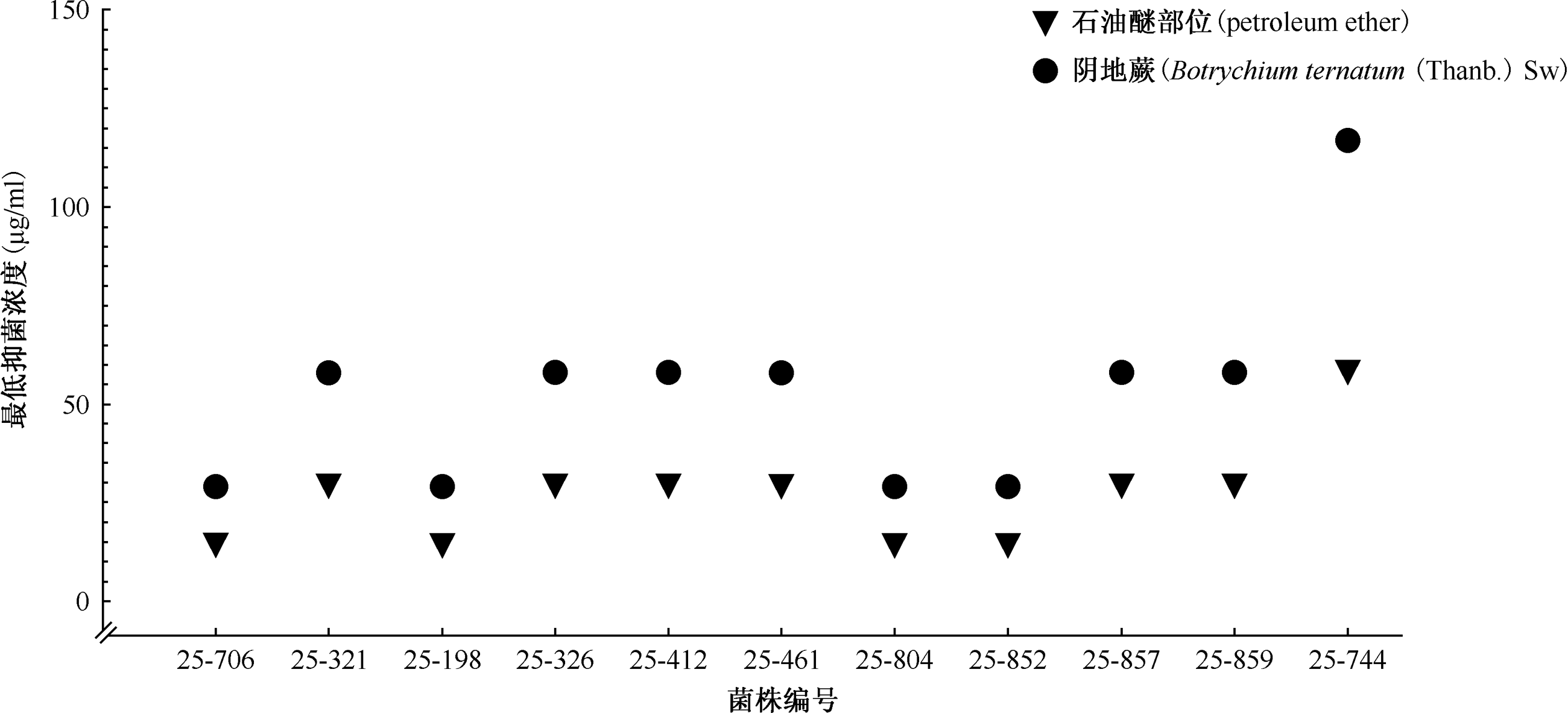
| 药物 | MDR-TB | RR-TB | Hr-TB | pre-XDR-TB | 敏感菌株 | ||||||
|---|---|---|---|---|---|---|---|---|---|---|---|
| 25-706 | 25-804 | 25-321 | 25-461 | 25-198 | 25-412 | 25-326 | 25-744 | 25-852 | 25-857 | 25-859 | |
| 阴地蕨总浸膏 | 29 | 29 | 58 | 58 | 29 | 58 | 58 | 117 | 29 | 58 | 58 |
| 石油醚相分离物 | 14 | 14 | 29 | 29 | 14 | 29 | 29 | 58 | 14 | 29 | 29 |
| 利福平 | ≥64 | ≥64 | ≥64 | ≥64 | 1 | ≥64 | 0.25 | ≥64 | 0.06 | 0.03 | 0.03 |
| [1] | 屈燕, 李涛, 马文斌, 等. 世界卫生组织《2025年全球结核病报告》解读. 结核与肺部疾病杂志, 2025, 6(6): 613-623. doi:10.19983/j.issn.2096-8493.20250178. |
| [2] | Alghamdi S, Rehman SU, Shesha NT, et al. Promising Lead Compounds in the Development of Potential Clinical Drug Candidate for Drug-Resistant Tuberculosis. Molecules (Basel), 2020, 25(23):5685. doi:10.3390/molecules25235685. |
| [3] | Gopie FA, Commiesie E, Baldi S, et al. Should treatment of low-level rifampicin mono-resistant tuberculosis be different?. J Clin Tuberc Other Mycobact Dis, 2021, 23:100241. doi:10.1016/j.jctube.2021.100241. |
| [4] | Dhochak ND, Ramjat K M, Sankar JM, et al. Hypersensitivity Myocarditis Due to Antitubercular Drugs in Children. Pediatr Infect Dis J, 2020, 39(12): 1088-1091. doi:10.1097/inf.0000000000002844. |
| [5] | 李维, 周志超, 郑洁, 等. 1995—2023年中国耐多药结核病研究的态势和热点分析. 中国防痨杂志, 2025, 47(6): 785-791. doi:10.19982/j.issn.1000-6621.20250112. |
| [6] | 徐玉辉, 孙照刚. 抗结核药用植物的种类特点及其国内外比较. 中华中医药杂志, 2021, 36(3): 1582-1585. |
| [7] | Xu Y, Liang B, Kong C, et al. Traditional Medicinal Plants as a Source of Antituberculosis Drugs: A System Review. Biomed Res Int, 2021, 2021:9910365. doi:10.1155/2021/9910365. |
| [8] | Gautam S, Qureshi KA, Pasha SBJ, et al. Medicinal Plants as Therapeutic Alternatives to Combat Mycobacterium tuberculosis: A Comprehensive Review. Antibiotics (Basel), 2023, 12(3):541. doi:10.3390/antibiotics12030541. |
| [9] | Chen M, Liu J, Zou S, et al. A review on the ethnopharmacology, metabolites, pharmacological uses, and toxicology of Ficus hirta (Moraceae) Vahl. Front Pharmacol, 2025, 16:1545348. doi:10.3389/fphar.2025.1545348. |
| [10] | 娄华勇, 傅建, 潘卫东. 基于UGM靶标的贵州药用植物抗结核分枝杆菌化合物构建及类似物研究. 贵州医科大学学报, 2023, 48(6):621-626,633. doi:10.19367/j.cnki.2096-8388.2023.06.001. |
| [11] | 付宝慧, 张静. 冬虫夏草菌联合抗结核治疗肺结核的效果观察. 中国防痨杂志, 2024, (S2): 52-54. |
| [12] | Duan LY, Liang Y, Gong WP, et al. Comparative study on the antituberculous effect and mechanism of the traditional Chinese medicines NiuBeiXiaoHe extract and JieHeWan. Mil Med Res, 2021, 8(1): 34. doi:10.1186/s40779-021-00324-5. |
| [13] | Zhang X, Chen W, Du Y, et al. Phytochemistry and pharmacological activities of Arundina graminifolia (D.Don) Hochr. and other common Orchidaceae medicinal plants. J Ethnopharmacol, 2021, 276:114143. doi:10.1016/j.jep.2021.114143. |
| [14] | Fan Y, Wang M, Zhang Q, et al. Traditional uses, phytochemistry, pharmacology, toxicity and clinical application of traditional Chinese medicine Cynoglossum amabile: a review. Front Pharmacol, 2024, 15:1325283. doi:10.3389/fphar.2024.1325283. |
| [15] | Khan SA, Rather MA, Jia Z, et al. Discovery of antitubercular potential of trans-3-indoleacrylic acid and its derivatives targeting Mycobacterium tuberculosis: A combined in vitro and in silico investigation. Bioorg Chem, 2025, 163:108668. doi:10.1016/j.bioorg.2025.108668. |
| [16] | 于兰, 陈双双, 王嫩寒, 等. 利福平耐药结核分枝杆菌对氟喹诺酮类药物表型耐药与其基因突变的一致性研究. 中国防痨杂志, 2024, 46(8): 942-950. doi:10.19982/j.issn.1000-6621.20240133. |
| [17] | 刘瑞霞, 李翔辉, 冯青松. 乙醇回流法提取大别山产青钱柳总黄酮的工艺研究. 现代食品, 2022, 28(15): 77-79,83. doi:10.16736/j.cnki.cn41-1434/ts.2022.15.017. |
| [18] | 王思雨, 张国玉, 张永祥, 等. 迷迭香粗提物提取工艺优化及其抑菌活性. 食品研究与开发, 2024, 45(9): 118-126. doi:10.12161/j.issn.1005-6521.2024.09.017. |
| [19] | CLSl. Performance standards for Antimicrobial susceptibility Testing. 36th ed. CLSl supplement M100. Clinical and Laboratory Standards Institute, 2026. |
| [20] | CLSl. Methods for Dilution Antimicrobial susceptibility Tests for Bacteria That Grow Aerobically 12th ed. CLSl standard M07 Clinical and Laboratory Standards Institute, 2024. |
| [21] | CLSI. Performance Standards for Susceptibility Testing of Mycobacteria, Nocardia spp., and Other Aerobic Actinomycetes. 2nd edition. CLSI supplement M24S. Clinical and Laboratory Standards Institute, 2023. |
| [22] | 郭鸿, 么蕊, 范晶. 中草药寡糖的提取分离、结构鉴定及分析方法研究进展. 药物分析杂志, 2025, 45(3): 361-391. doi:10.16155/j.0254-1793.2024-1061. |
| [23] | 何可群. HPLC-MS/MS法测定阴地蕨中山奈酚和槲皮素含量. 医药导报, 2015, (10): 1360-63. doi:10.3870/j.iss.1004-0781.2015.10.026. |
| [24] | 王厚安. 水族医药. 贵阳: 贵州民族出版社, 1997. |
| [25] | 王敏, 朱琚元. 楚雄彝州本草. 昆明: 云南人民出版社, 1998. |
| [26] | 陆科闵, 王福荣. 苗族医学. 贵阳: 贵州科技出版社, 2006 |
| [27] | 陆科闵. 苗族药物集. 贵阳: 贵州人民出版社, 1988. |
| [28] | 唐海华. 苗族药物学. 贵阳: 贵州民族出版社, 2006. |
| [29] | 朱国豪. 土家族医药. 北京: 中医古籍出版社, 2006. |
| [30] | 周元川, 郑进. 怒江流域民族医药. 昆明: 云南科技出版社, 2010. |
| [31] | 方茂琴. 德昂族药集. 德宏: 德宏民族出版社, 2014. |
| [32] | 钟鸣. 简明壮医药学. 南宁: 广西民族出版社, 2009. |
| [33] | 汪毅. 中国苗族药物彩色图集. 贵阳: 贵州科技出版社, 2002. |
| [34] | 龙运光, 袁涛忠. 侗族药物方剂学. 贵阳: 贵州科技出版社, 2009. |
| [35] | 陆科闵. 侗族医学. 贵阳: 贵州科技出版社, 1992. |
| [36] | World Health Organization. Meeting report of the WHO expert consultaion on the definition of extensively drug-resistant tuberculosis, 27-29 October 2020. Geneva: World Health Organization, 2021. |
| [37] | Krishnaprasad VH, Nayak V, Kumar S. World Health Organisation’s Bacterial Pathogen Priority List (BPPL) 2017 and BPPL 2024 to combat global antimicrobial resistance crisis: ‘challenges and opportunities’. J Antimicrob Chemother, 2025, 80(8):2061-2069. doi:10.1093/jac/dkaf167. |
| [38] | Dvorakova M, Soudek P, Pavicic A, et al. The traditional utilization, biological activity and chemical composition of edible fern species. J Ethnopharmacol, 2024, 324:117818. doi:10.1016/j.jep.2024.117818. |
| [39] | Baran M, Grimes KD, Sibbald PA, et al. Development of small-molecule inhibitors of fatty acyl-AMP and fatty acyl-CoA ligases in Mycobacterium tuberculosis. Eur J Med Chem, 2020, 201: 112408. doi:10.1016/j.ejmech.2020.112408. |
| [40] | Niveditha N, Begum M, Prathibha D, et al. Design, Synthesis and Pharmacological Evaluation of Some C 3 Heterocyclic-Substituted Ciprofloxacin Derivatives as Chimeric Antitubercular Agents. Chem Pharm Bull (Tokyo), 2020, 68(12): 1170-1177. doi:10.1248/cpb.c20-00525. |
| [41] | Suryawanshi AG, Pathak C, Khona P, et al. Synthesis and biological evaluation of furan-1,3,4-oxadiazole as antitubercular, antibacterial, and antioxidant agents. Future Med Chem, 2025, 17(21): 1-16. doi:10.1080/17568919.2025.2570972. |
| [42] | Preez D Charné, Legoabe, et al. Arylnitro monocarbonyl curcumin analogues: Synthesis and in vitro antitubercular evaluation. Chem Biol Drug Des, 2023, 101(3): 717-726. doi:10.1111/cbdd.14174. |
| [43] | Montana M, Montero V, Khoumeri O, et al. Quinoxaline moiety: A potential scaffold against mycobacterium tuberculosis. Molecules, 2021, 26(16): 4742. doi:10.3390/molecules26164742. |
| [44] | Sonwane PN, Kumbhare MR. Molecular docking and pharmacokinetics of benzimidazole-based FtsZ inhibitors for tuberculosis. Sci Rep, 2025, 15(1): 35270. doi:10.1038/s41598-025-18084-w. |
| [45] | Chowdhury A, Bandyopanhyay A. Compelling cyclic peptide scaffolds for antitubercular action: An account (2011-21) of the natural source. Curr Protein Pept Sci, 2022, 23(12): 823-836. doi:10.2174/1389203723666220930111259. |
| [46] | Johansen MD Shalini, Sumit K, et al. Biological and biochemical evaluation of isatin-isoniazid hybrids as bactericidal candidates against Mycobacterium tuberculosis. Antimicrob Agents Chemother, 2021, 65(8): e0001121. doi:10.1128/aac.00011-21. |
| [47] | Barua Nilakshi, Buragohain, et al. Therapeutic Potential of Curcumin as an Antimycobacterial Agent. Biomolecules, 2021, 11(9):1278. doi:10.3390/biom11091278. |
| [48] | Sasikumar K, Ghosh AR, Dusthackeer A. Antimycobacterial potentials of quercetin and rutin against Mycobacterium tuberculosis H37Rv. Biotech, 2018, 8(10): 427. doi:10.1007/s13205-018-1450-5. |
| [1] | Jiang Xuefeng, Zhou Linjun, Sun Yan, Jiang Mingxia, Ma Ling, Mei Li, Liu Dongxin. Analysis of drug resistance gene mutation characteristics in Mycobacterium tuberculosis strains from five northwestern provinces of China [J]. Chinese Journal of Antituberculosis, 2026, 48(6): 856-864. |
| [2] | Qiao Xiaobo, Li Jing, Wang Baoqian, Zhou Weidong, Wang Fei, Zhang Qibo, Li Tongxia. Study on the diagnostic value of GeneXpert MTB/RIF and BACTEC MGIT 960 in bronchoalveolar lavage fluid combined with peripheral blood IGRA testing for etiologically negative pulmonary tuberculosis diagnosis [J]. Chinese Journal of Antituberculosis, 2026, 48(6): 874-881. |
| [3] | Che Yang, Zhang Dongliang, Li Xiangchen, Lu Yewei, Liu Zhengwei. Molecular characterization and risk factors of cross-resistance between isoniazid and prothionamide in multidrug-resistant Mycobacterium tuberculosis in Ningbo, China [J]. Chinese Journal of Antituberculosis, 2026, 48(5): 576-585. |
| [4] | Wu Yaning, Huang Misun, Guo Yi, Bo Xianglong, Wang Ruihuan, Xing Jianliang, Fan Xueting, Xu Da, Zhao Lili, Zhao Xiuqin, Li Guilian, Liu Haican, Li Machao. Analysis of genetic mutation characteristics associated with linezolid resistance in Mycobacterium tuberculosis [J]. Chinese Journal of Antituberculosis, 2026, 48(5): 603-615. |
| [5] | Hu Xinyang, Liu Yang, Gao Jingtao. Research progress on latent tuberculosis infection in patients with hematological malignancies [J]. Chinese Journal of Antituberculosis, 2026, 48(5): 694-699. |
| [6] | Huang Zhenyang, Li Wenjun, Sun Yansong, Li Hao. Advances in CRISPR-Cas system-based detection of Mycobacterium tuberculosis [J]. Chinese Journal of Antituberculosis, 2026, 48(5): 707-715. |
| [7] | Miao Honghao, Zhang Jie, Pang Mengdi, Ren Yixuan, Deng Yang, Yi Junli, Fan Ruifang, Chen Shuangshuang, Chen Hao, Yu Lan, Li Jie, Li Chuanyou, Yang Xinyu. Genotypic and drug resistance of Mycobacterium tuberculosis in Beijing,2024 [J]. Chinese Journal of Antituberculosis, 2026, 48(4): 477-484. |
| [8] | Li Jing, Zhang Yangyi, Yang Jinghui, Wu Zheyuan, Li Ningdi, Yu Chenlei, Wang Lili, Shen Xuhui, Jiang Yuan, Shen Xin. Study on the characteristics of rpoB gene mutations in Mycobacterium tuberculosis and its correlation with rifampicin resistance level in Shanghai [J]. Chinese Journal of Antituberculosis, 2026, 48(4): 485-494. |
| [9] | Jiang Lina, Dai Wenxi, Ju Hanfang, Meng Sukai, Wang Chunhua. Clinical value of auramine O fluorescence staining automatic microscopic scanning and recognition system for detecting tuberculosis [J]. Chinese Journal of Antituberculosis, 2026, 48(4): 504-509. |
| [10] | Hou Tianyong, Ren Liping, Li Jingying, Wang Jianwei, Fan Shuhui, Wu Yuanming, Wang Quanhong, Ding Weimin. Clinical application value of combined molecular biology testing with bronchoalveolar lavage fluid (BALF) for diagnosing smear-negative pulmonary tuberculosis [J]. Chinese Journal of Antituberculosis, 2026, 48(3): 329-334. |
| [11] | Zhang Jian, Chen Bin, Zhang Mingwu, Qin Jiasheng, Song Yufang, Li Xuejing, Wang Wei. Analysis of the dynamics and influencing factors of latent tuberculosis infection in a rural elderly population in Changxing County [J]. Chinese Journal of Antituberculosis, 2026, 48(3): 405-412. |
| [12] | Tian Xiaomei, Jiang Xuefeng, Yang Xia, Sha Xiaolan, Lei Juan, Wang Xiaowei, Liu Jing. Analysis of case detection and anti-tuberculosis treatment outcomes in Mycobacterium tuberculosis/HIV co-infected patients in Ningxia from 2015 to 2023 [J]. Chinese Journal of Antituberculosis, 2026, 48(1): 57-63. |
| [13] | Jiangxi Chest Hospital/Jiangxi Provincial Key Laboratory of Tuberculosis , Guangzhou National Laboratory , Chinese Antituberculosis Association . Expert consensus on the application of host biomarkers for tuberculosis [J]. Chinese Journal of Antituberculosis, 2026, 48(1): 9-20. |
| [14] | Yan Yueming, Chen Meng, Li Xuekui, Wang Zhongdong, Sun Haiyan, Dai Xiaoqi, Song Song, Xu Honghong, Zhang Menghan, Wang Zhi, Lyu Kunzheng. Prevalence and influencing factors of latent tuberculosis infection among elderly residents in nursing homes in Qingdao [J]. Chinese Journal of Antituberculosis, 2025, 47(9): 1148-1153. |
| [15] | Zhu Tingting, Wang Mingzhe, Zulikatiayi Abudula, Gulina Badeerhan, Kaideliyan Abuduwaili, Wang Le. Preliminary analysis of the construction of mouse models infected with Xinjiang Uygur Autonomous Region Mycobacterium tuberculosis CAS lineage and H37Rv standard strain [J]. Chinese Journal of Antituberculosis, 2025, 47(9): 1187-1195. |
| Viewed | ||||||
|
Full text |
|
|||||
|
Abstract |
|
|||||
 京公网安备11010202007215号
Total visitors: Visitors of today: Now online:
京公网安备11010202007215号
Total visitors: Visitors of today: Now online:
 This work is licensed under Creative Commons Attribution 3.0 License.
