
Chinese Journal of Antituberculosis ›› 2026, Vol. 48 ›› Issue (5): 603-615.doi: 10.19982/j.issn.1000-6621.20250467
• Original Articles • Previous Articles Next Articles
Wu Yaning, Huang Misun, Guo Yi, Bo Xianglong, Wang Ruihuan, Xing Jianliang, Fan Xueting, Xu Da, Zhao Lili, Zhao Xiuqin, Li Guilian( ), Liu Haican(), Li Machao()
Received:2025-11-27
Online:2026-05-10
Published:2026-04-27
Contact:
Li Guilian,Liu Haican,Li Machao
E-mail:liguilian@icdc.cn;liuhaican@icdc.cn;limachao@icdc.cn
Supported by:CLC Number:
Wu Yaning, Huang Misun, Guo Yi, Bo Xianglong, Wang Ruihuan, Xing Jianliang, Fan Xueting, Xu Da, Zhao Lili, Zhao Xiuqin, Li Guilian, Liu Haican, Li Machao. Analysis of genetic mutation characteristics associated with linezolid resistance in Mycobacterium tuberculosis[J]. Chinese Journal of Antituberculosis, 2026, 48(5): 603-615. doi: 10.19982/j.issn.1000-6621.20250467
Add to citation manager EndNote|Ris|BibTeX
URL: https://www.zgflzz.cn/EN/10.19982/j.issn.1000-6621.20250467
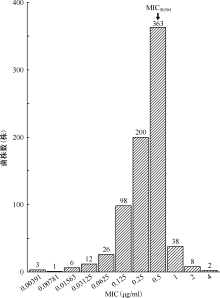
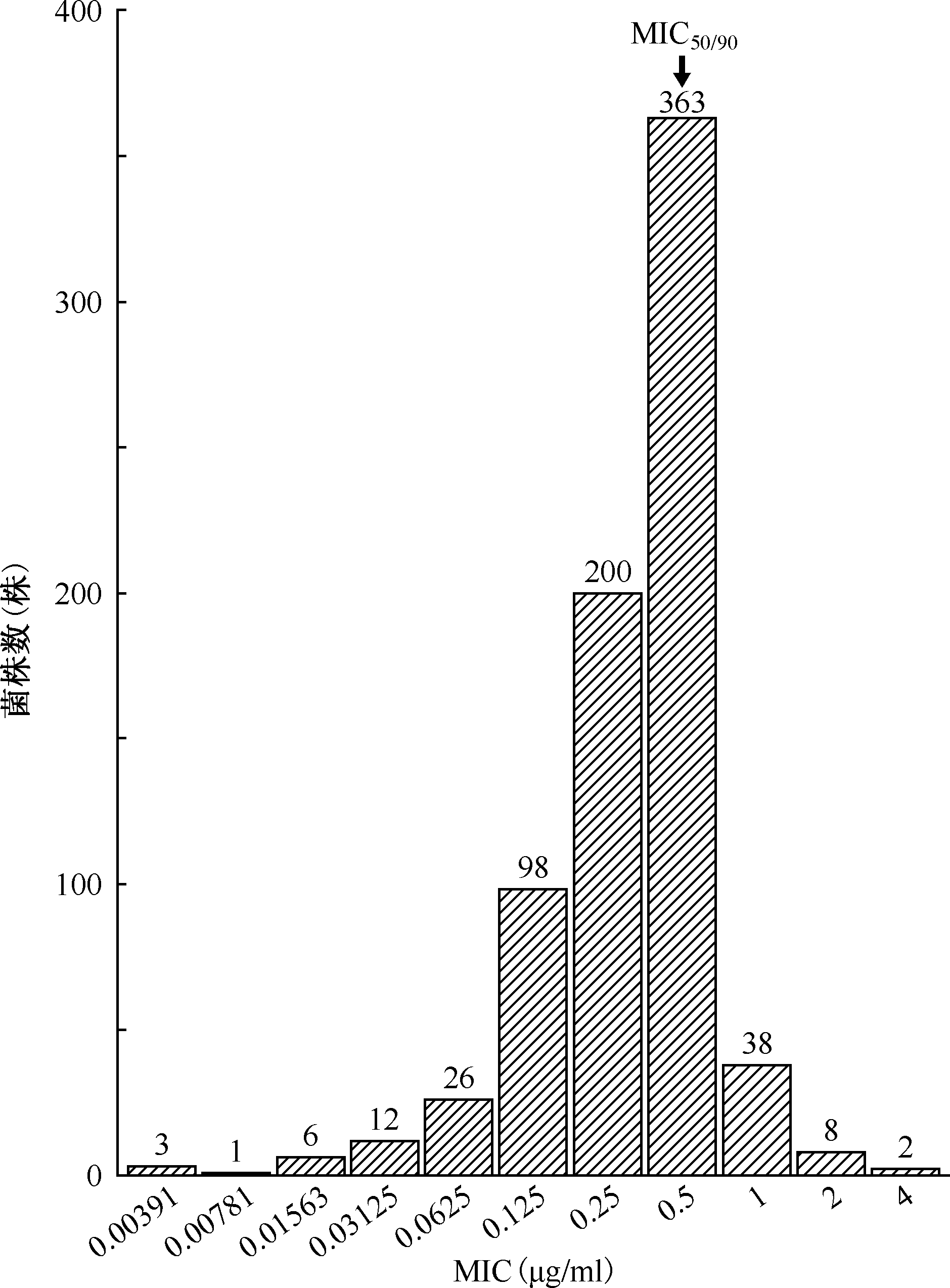
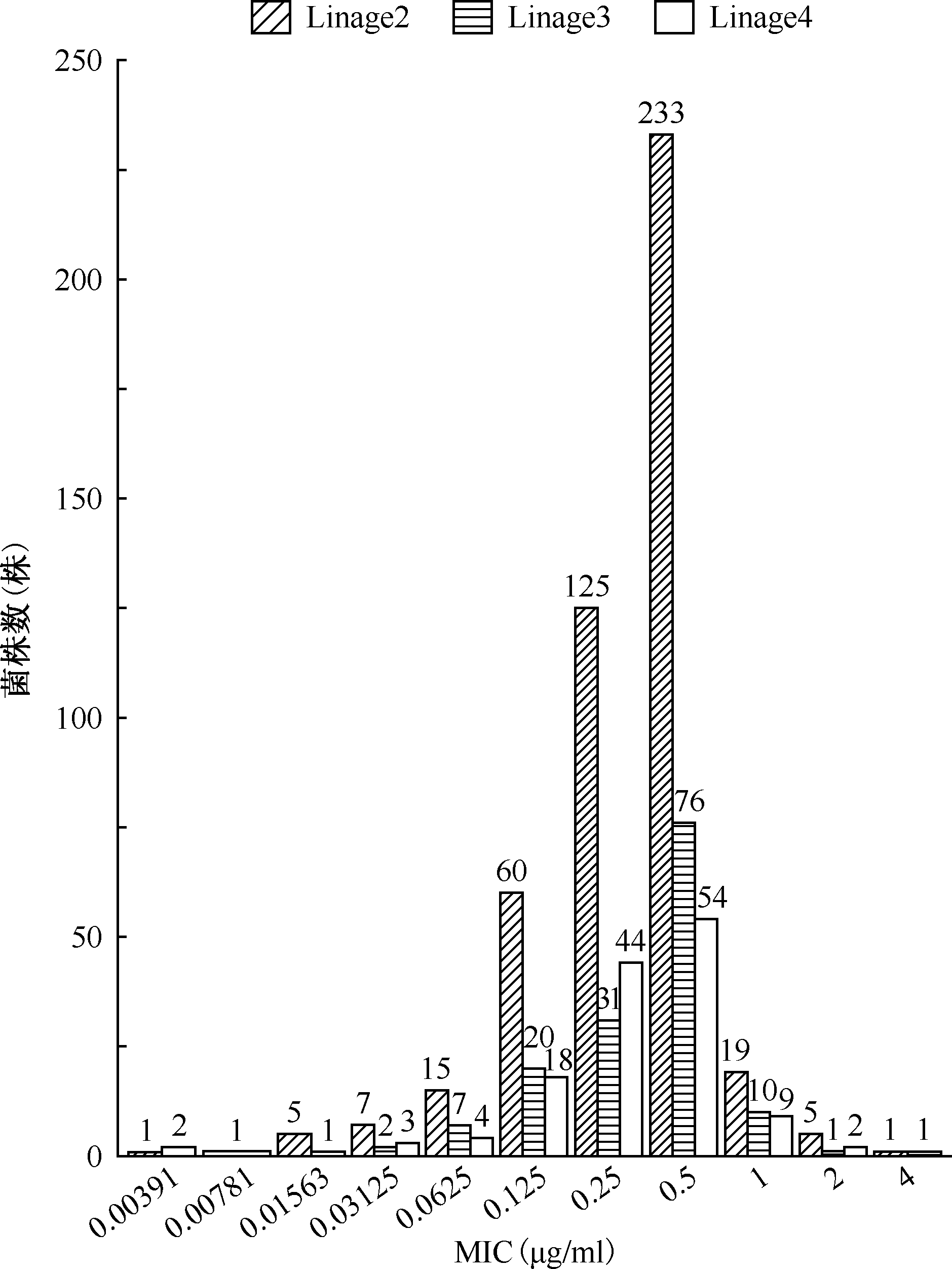
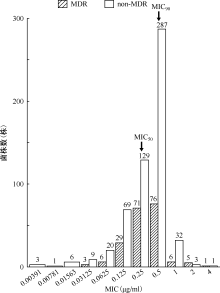
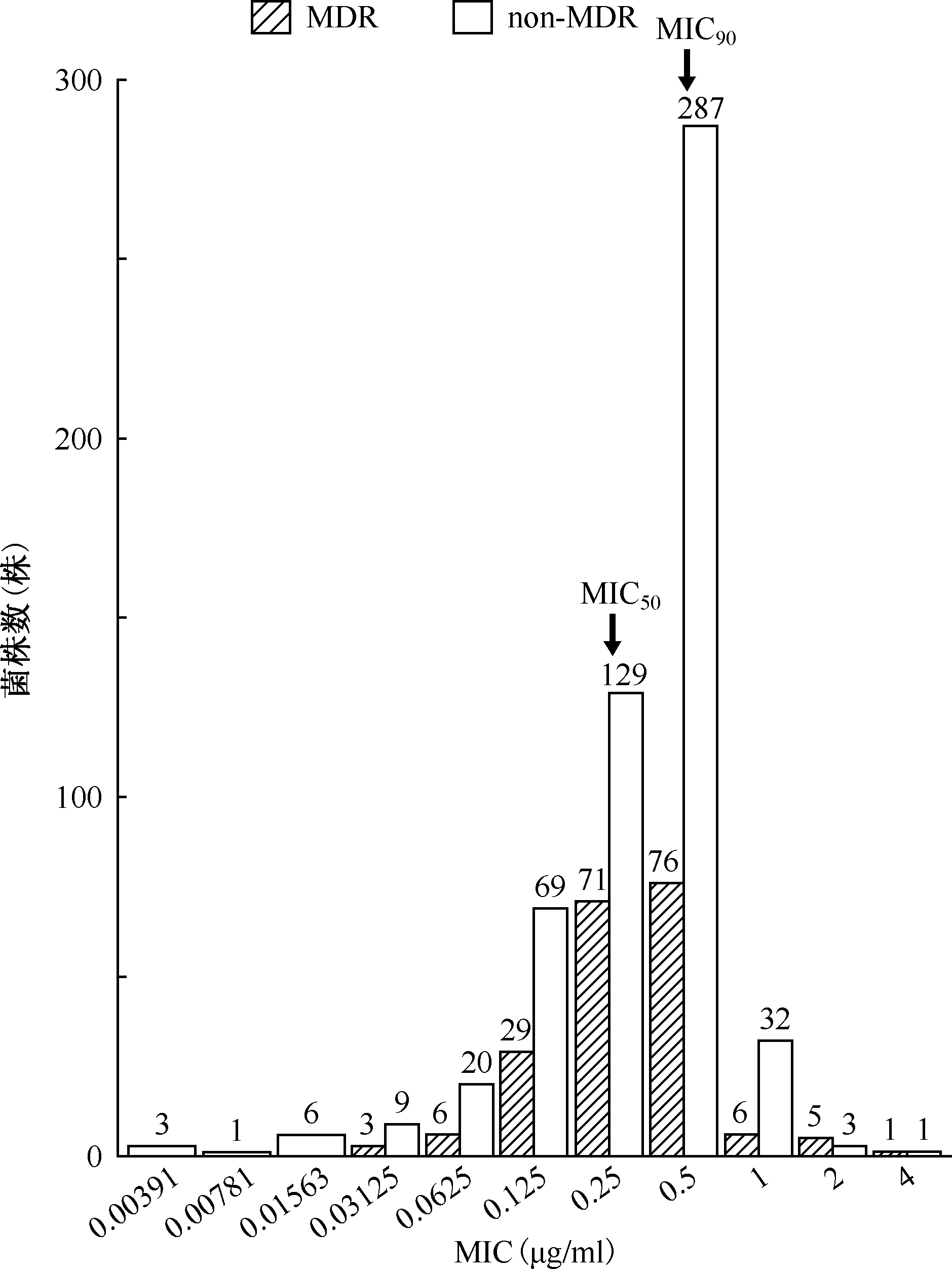
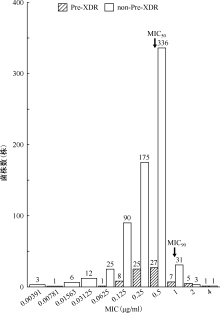
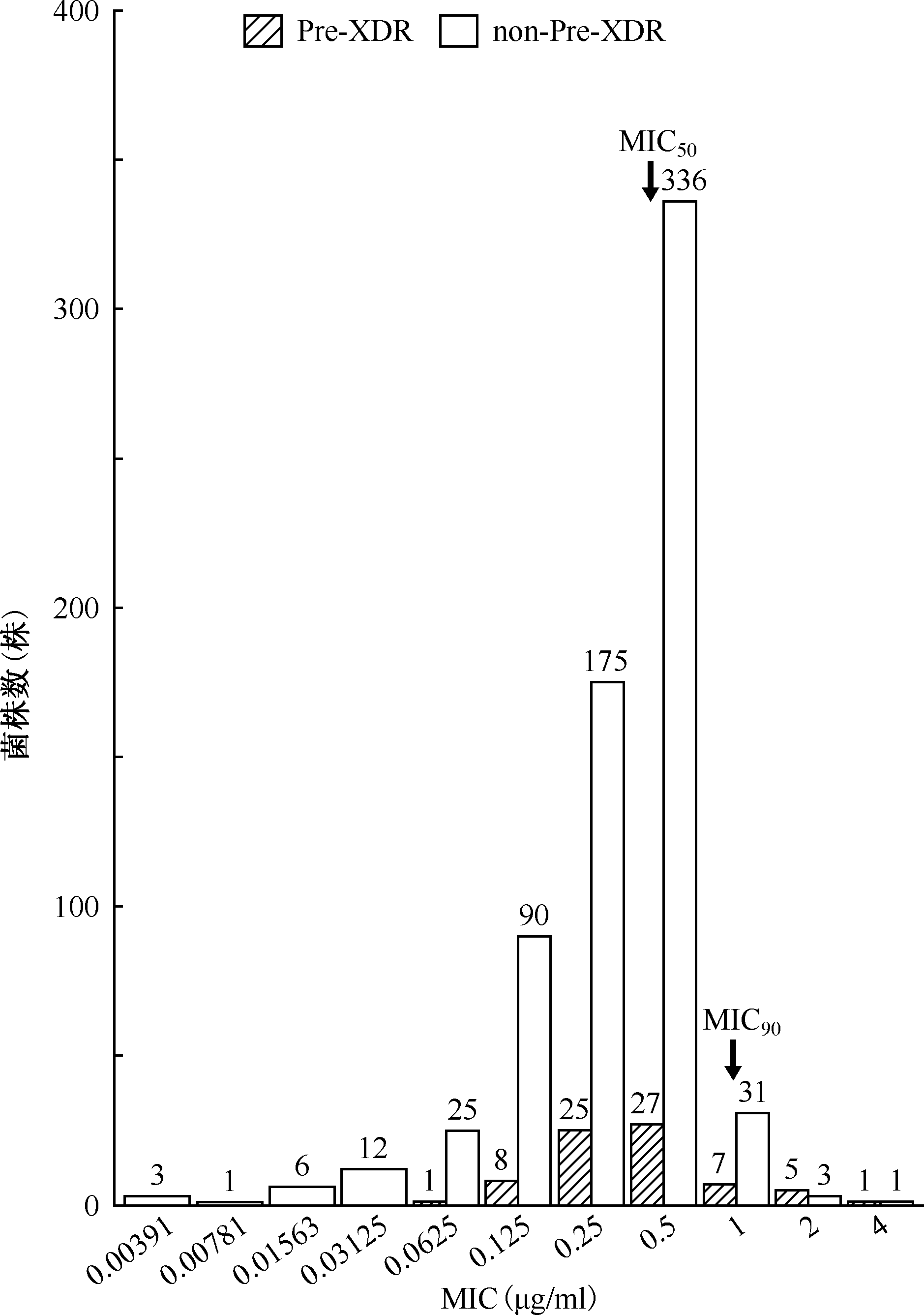

| 组别 | 利奈唑胺耐药性 | 合计 [株,构成比(%)] | χ2值 | P值 | |
|---|---|---|---|---|---|
| 耐药[株,构成比(%)] | 敏感[株,构成比(%)] | ||||
| 谱系 | 2.242 | 0.326 | |||
| L2 | 25(5.31) | 446(94.69) | 471(62.22) | ||
| L3 | 12(8.11) | 136(91.89) | 148(19.55) | ||
| L4 | 11(7.97) | 127(92.03) | 138(18.23) | ||
| MDR | 0.028 | 0.867 | |||
| 是 | 12(6.09) | 185(93.91) | 197(26.02) | ||
| 否 | 36(6.43) | 524(93.57) | 560(73.98) | ||
| pre-XDR | 17.407 | <0.001 | |||
| 是 | 13(17.57) | 61(82.43) | 74(9.78) | ||
| 否 | 35(5.12) | 648(94.88) | 683(90.22) | ||
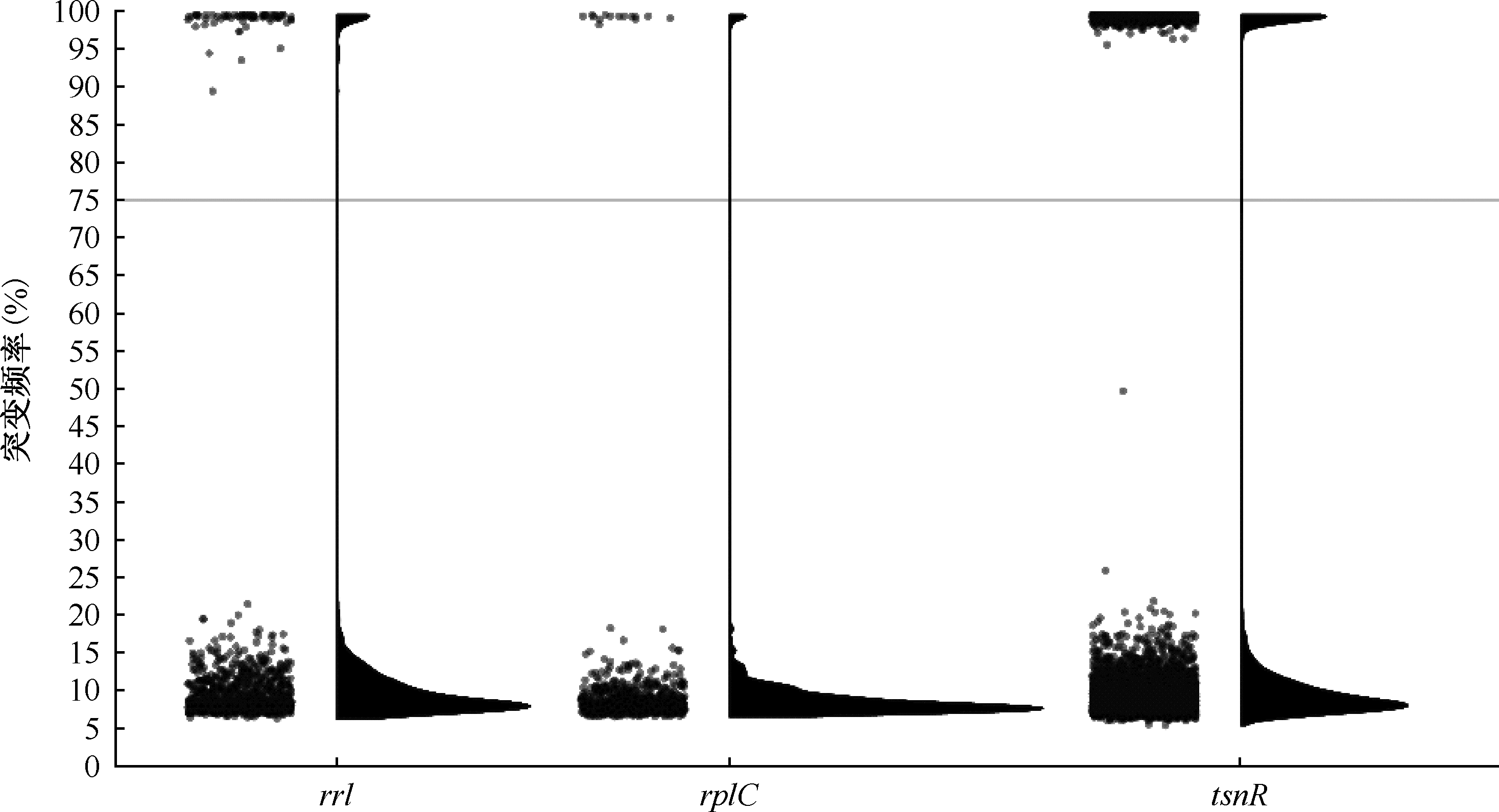
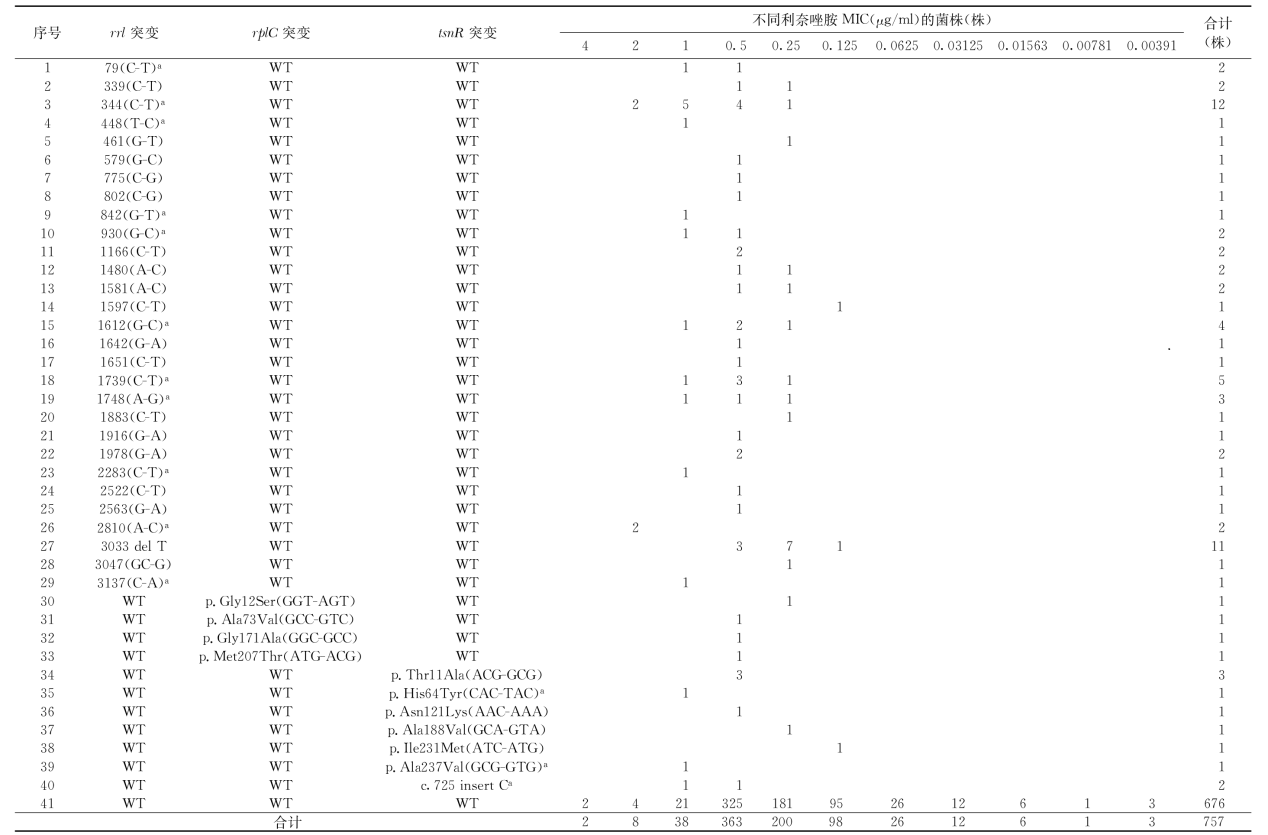
| MIC(μg/ml) | rrl基因突变[株,率(%)] | rplC基因突变[株,率(%)] | tsnR基因突变[株,率(%)] | 合计[株,率(%)] |
|---|---|---|---|---|
| 4 | 0(0.00) | 0(0.00) | 0(0.00) | 0(0.00) |
| 2 | 4(0.53) | 0(0.00) | 0(0.00) | 4(0.53) |
| 1 | 14(1.85) | 0(0.00) | 3(0.40) | 17(2.25) |
| 0.5 | 30(3.96) | 3(0.40) | 5(0.66) | 38(5.02) |
| 0.25 | 17(2.25) | 1(0.13) | 1(0.13) | 19(2.51) |
| 0.125 | 2(0.26) | 0(0.00) | 1(0.13) | 3(0.40) |
| 0.0625 | 0(0.00) | 0(0.00) | 0(0.00) | 0(0.00) |
| 0.03125 | 0(0.00) | 0(0.00) | 0(0.00) | 0(0.00) |
| 0.01563 | 0(0.00) | 0(0.00) | 0(0.00) | 0(0.00) |
| 0.00781 | 0(0.00) | 0(0.00) | 0(0.00) | 0(0.00) |
| 0.00391 | 0(0.00) | 0(0.00) | 0(0.00) | 0(0.00) |
| 合计 | 67(8.85) | 4(0.53) | 10(1.32) | 81(10.70) |
 |
| 预设耐药阈值 (μg/ml) | 基因 | 突变 类型 | 利奈唑胺 | χ2值 | P值 | 敏感度 (%) | 特异度 (%) | 阳性 预测值 (%) | 阴性 预测值 (%) | |||||||||
|---|---|---|---|---|---|---|---|---|---|---|---|---|---|---|---|---|---|---|
| 耐药菌株 [株,率(%)] | 敏感菌株 [株,率(%)] | |||||||||||||||||
| MIC≥1 | rrl | 突变型 | 18(26.87) | 49(73.13) | 48.419 | <0.001 | 37.50 | 93.09 | 26.87 | 95.65 | ||||||||
| 野生型 | 30(4.35) | 660(95.65) | ||||||||||||||||
| rplC | 突变型 | 0(0.00) | 4(100.00) | -a | 1.000 | 0.00 | 99.44 | 0.00 | 93.63 | |||||||||
| 野生型 | 48(6.37) | 705(93.63) | ||||||||||||||||
| tsnR | 突变型 | 3(30.00) | 7(70.00) | 5.941 | 0.015 | 6.25 | 99.01 | 30.00 | 93.98 | |||||||||
| 野生型 | 45(6.02) | 702(93.98) | ||||||||||||||||
| rrl+tsnR | 突变型 | 21(27.27) | 56(72.73) | 59.378 | <0.001 | 43.75 | 92.10 | 27.27 | 96.03 | |||||||||
| 野生型 | 27(3.97) | 653(96.03) | ||||||||||||||||
| rrl+rplC+tsnR | 突变型 | 21(25.93) | 60(74.07) | 58.586 | <0.001 | 43.75 | 91.54 | 25.93 | 96.01 | |||||||||
| 野生型 | 27(3.99) | 649(96.01) | ||||||||||||||||
| MIC≥0.25 | rrl | 突变型 | 65(97.01) | 2(2.99) | 12.548 | <0.001 | 10.64 | 98.63 | 97.01 | 20.82 | ||||||||
| 野生型 | 546(79.13) | 144(20.87) | ||||||||||||||||
| rplC | 突变型 | 4(100.00) | 0(0.00) | -a | 1.000 | 0.65 | 100.00 | 100.00 | 19.39 | |||||||||
| 野生型 | 607(80.61) | 146(19.39) | ||||||||||||||||
| tsnR | 突变型 | 9(90.00) | 1(10.00) | 0.120 | 0.729 | 1.47 | 99.32 | 90.00 | 19.41 | |||||||||
| 野生型 | 602(80.59) | 145(19.41) | ||||||||||||||||
| rrl+tsnR | 突变型 | 74(96.10) | 3(3.90) | 13.043 | <0.001 | 12.11 | 97.95 | 96.10 | 21.03 | |||||||||
| 野生型 | 537(78.97) | 143(21.03) | ||||||||||||||||
| rrl+rplC+tsnR | 突变型 | 78(96.30) | 3(3.70) | 14.149 | <0.001 | 12.77 | 97.95 | 96.30 | 21.15 | |||||||||
| 野生型 | 533(78.85) | 143(21.14) | ||||||||||||||||
| MIC≥0.5 | rrl | 突变型 | 48(71.64) | 19(28.36) | 8.915 | 0.003 | 11.68 | 94.51 | 71.64 | 47.39 | ||||||||
| 野生型 | 363(52.61) | 327(47.39) | ||||||||||||||||
| rplC | 突变型 | 3(75.00) | 1(25.00) | -a | 0.630 | 0.73 | 99.71 | 75.00 | 45.82 | |||||||||
| 野生型 | 408(54.18) | 345(45.82) | ||||||||||||||||
| tsnR | 突变型 | 8(80.00) | 2(20.00) | 1.751 | 0.186 | 1.95 | 99.42 | 80.00 | 46.05 | |||||||||
| 野生型 | 403(53.95) | 344(46.05) | ||||||||||||||||
| rrl+tsnR | 突变型 | 56(72.73) | 21(27.27) | 11.738 | <0.001 | 13.63 | 93.93 | 72.73 | 47.79 | |||||||||
| 野生型 | 355(52.21) | 325(47.79) | ||||||||||||||||
| rrl+rplC+tsnR | 突变型 | 59(72.84) | 22(27.16) | 12.572 | <0.001 | 14.36 | 93.64 | 72.84 | 47.93 | |||||||||
| 野生型 | 352(52.07) | 324(47.93) | ||||||||||||||||
| 互作蛋白 编码基因 | 利奈唑胺耐药性 | χ2值 | P值 | 敏感度 (%) | 特异度 (%) | 阳性预测 值(%) | 阴性预测 值(%) | ||||||||
|---|---|---|---|---|---|---|---|---|---|---|---|---|---|---|---|
| 耐药(株,%) | 敏感(株,%) | ||||||||||||||
| Rv1540 | 5.941 | 0.015 | 6.25 | 99.01 | 30.00 | 93.98 | |||||||||
| 突变型 | 3(30.00) | 7(70.00) | |||||||||||||
| 野生型 | 45(6.02) | 702(93.98) | |||||||||||||
| dnaJ | 4.985 | 0.026 | 25.00 | 86.60 | 11.21 | 94.46 | |||||||||
| 突变型 | 12(11.21) | 95(88.79) | |||||||||||||
| 野生型 | 36(5.54) | 614(94.46) | |||||||||||||
| fbiC | 5.027 | 0.025 | 10.42 | 96.90 | 18.52 | 94.11 | |||||||||
| 突变型 | 5(18.52) | 22(81.48) | |||||||||||||
| 野生型 | 43(5.89) | 687(94.11) | |||||||||||||
| fmu | 4.732 | 0.030 | 14.58 | 94.36 | 14.89 | 94.23 | |||||||||
| 突变型 | 7(14.89) | 40(85.11) | |||||||||||||
| 野生型 | 41(5.77) | 669(94.23) | |||||||||||||
| fusA2 | 3.944 | 0.047 | 10.42 | 96.47 | 16.67 | 94.09 | |||||||||
| 突变型 | 5(16.67) | 25(83.33) | |||||||||||||
| 野生型 | 43(5.91) | 684(94.09) | |||||||||||||
| infC | 4.673 | 0.031 | 25.00 | 86.32 | 11.01 | 94.44 | |||||||||
| 突变型 | 12(11.01) | 97(88.99) | |||||||||||||
| 野生型 | 36(5.55) | 612(94.44) | |||||||||||||
| nusG | -a | 0.011 | 4.17 | 99.86 | 66.67 | 93.90 | |||||||||
| 突变型 | 2(66.67) | 1(33.33) | |||||||||||||
| 野生型 | 46(6.10) | 708(93.90) | |||||||||||||
| purA | 19.814 | <0.001 | 12.50 | 98.45 | 35.29 | 94.32 | |||||||||
| 突变型 | 6(35.29) | 11(64.71) | |||||||||||||
| 野生型 | 42(5.68) | 698(94.32) | |||||||||||||
| rpoC | 5.789 | 0.016 | 2.08 | 85.61 | 0.97 | 92.81 | |||||||||
| 突变型 | 1(0.97) | 102(99.03) | |||||||||||||
| 野生型 | 47(7.19) | 607(92.81) | |||||||||||||
| rpsF | 29.234 | <0.001 | 10.42 | 99.44 | 55.56 | 94.25 | |||||||||
| 突变型 | 5(55.56) | 4(44.44) | |||||||||||||
| 野生型 | 43(5.75) | 705(94.25) | |||||||||||||
| [1] | 屈燕, 李涛, 马文斌, 等. 世界卫生组织《2025年全球结核病报告》解读. 结核与肺部疾病杂志, 2025, 6(6): 613-623. doi:10.19983/j.issn.2096-8493.20250178. |
| [2] | 葛赛, 宋欣怡, 姜惠跃, 等. 结核分枝杆菌药物作用机理及耐药机制研究进展. 海南医学院学报, 2023, 29(24): 1904-1913. doi:10.13210/j.cnki.jhmu.20221128.002. |
| [3] | Pi R, Liu Q, Jiang Q, et al. Characterization of linezolid-resistance-associated mutations in Mycobacterium tuberculosis through WGS. J Antimicrob Chemother, 2019, 74(7): 1795-1798. doi:10.1093/jac/dkz150. |
| [4] | 中华医学会结核病学分会. 利奈唑胺抗结核治疗专家共识(2022年版). 中华结核和呼吸杂志, 2022, 45(10): 988-995. doi:10.3760/cma.j.cn112147-20220320-00220. |
| [5] | World Health Organization. WHO consolidated guidelines on tuberculosis. Module 4: treatment-drug-resistant tuberculosis treatment, 2022 update. Geneva: World Health Organization, 2022. |
| [6] | 段鸿飞. 世界卫生组织对BPaLM方案治疗耐多药结核病指南的解读. 中国医学前沿杂志(电子版), 2024, 16(3): 1-4. doi:10.12037/YXQY.2024.03-01. |
| [7] | 王煜童, 刘宇红. 世界卫生组织《关于耐药结核病治疗关键性修订的快速通告》解读. 中国防痨杂志, 2024, 46(11): 1303-1305. doi:10.19982/j.issn.1000-6621.20240422. |
| [8] |
Richter E, Rüsch-Gerdes S, Hillemann D. First linezolid-resistant clinical isolates of Mycobacterium tuberculosis. Antimicrob Agents Chemother, 2007, 51(4): 1534-1536. doi:10.1128/AAC.01113-06.
URL pmid: 17242139 |
| [9] | Azimi T, Khoshnood S, Asadi A, et al. Linezolid resistance in multidrug-resistant mycobacterium tuberculosis: A systematic review and meta-analysis. Front Pharmacol, 2022, 13: 955050. doi:10.3389/fphar.2022.955050. |
| [10] | Gan WC, Ng HF, Ngeow YF. Mechanisms of Linezolid Resistance in Mycobacteria. Pharmaceuticals-Base, 2023, 16(6): 784. doi:10.3390/ph16060784. |
| [11] | 郑伟, 田甜, 王琦, 等. 结核分枝杆菌的耐药机制研究进展. 中国人兽共患病学报, 2021, 37(11): 1044-1052. doi:10.3969/j.issn.1002-2694.2021.00.148. |
| [12] | Dong J, Cheng Q, Tang C, et al. Comparative In Vitro Drug Susceptibility Study of Five Oxazolidinones Against Mycobacterium tuberculosis in Hainan, China. Pathogens, 2025, 14(3). doi:10.3390/pathogens14030218. |
| [13] | 中国防痨协会结核病基础专业分会. 中国结核分枝杆菌微量肉汤稀释法药物敏感性试验标准化专家共识. 中国防痨杂志, 2025, 47(5): 535-545. doi:10.19982/j.issn.1000-6621.20250070. |
| [14] | World Health Organization. Catalogue of mutations in Mycobacterium tuberculosis complex and their association with drug resistance. Geneva: World Health Organization, 2023. |
| [15] | World Health Organization. Global tuberculosis report 2025. Geneva: World Health Organization, 2025. |
| [16] | 王前, 宋媛媛, 王玉峰, 等. 158株耐多药结核分枝杆菌对利奈唑胺耐药及相关基因突变情况研究. 中国防痨杂志, 2016, 38(9): 712-717. doi:10.3969/j.issn.1000-6621.2016.09.004. |
| [17] | Wang G, Jiang G, Jing W, et al. Prevalence and molecular characterizations of seven additional drug resistance among multidrug-resistant tuberculosis in China: A subsequent study of a national survey. J Infection, 2021, 82(3): 371-377. doi:10.1016/j.jinf.2021.02.004. |
| [18] | Tornheim JA, Intini E, Gupta A, et al. Clinical features associated with linezolid resistance among multidrug resistant tuberculosis patients at a tertiary care hospital in Mumbai, India. J Clin Tuber Oth Myc, 2020, 20: 100175. doi:10.1016/j.jctube.2020.100175. |
| [19] | Ushtanit A, Mikhailova Y, Lyubimova A, et al. Genetic Profile of Linezolid-Resistant M.tuberculosis Clinical Strains from Moscow. Antibiotics-Basel, 2021, 10(10): 1243. doi:10.3390/antibiotics10101243. |
| [20] | Huang H, Ding N, Yang T, et al. Cross-sectional Whole-genome Sequencing and Epidemiological Study of Multidrug-resistant Mycobacterium tuberculosis in China. Clin Infect Dis, 2019, 69(3): 405-413. doi:10.1093/cid/ciy883. |
| [21] | Li Y, Kong X, Song W, et al. Genomic analysis of lineage-specific transmission of multidrug resistance tuberculosis in China. Emerging Microbes Infect, 2024, 13(1): 2294858. doi:10.1080/22221751.2023.2294858. |
| [22] | Dreyer V, Mandal A, Dev P, et al. High fluoroquinolone resistance proportions among multidrug-resistant tuberculosis driven by dominant L 2 Mycobacterium tuberculosis clones in the Mumbai Metropolitan Region. Genome Med, 2022, 14(1): 95. doi:10.1186/s13073-022-01076-0. |
| [23] | 左天宇, 柳清云, 甘明宇, 等. 结核分枝杆菌利福平耐药菌株补偿性突变的系统性鉴定. 中华结核和呼吸杂志, 2018, 41(3): 207-212. doi:10.3760/cma.j.issn.1001-0939.2018.03.012. |
| [24] | 高敏, 杨婷婷, 李桂莲, 等. 基于全基因组测序的我国耐多药结核分枝杆菌耐药突变特征分析. 中华流行病学杂志, 2020, 41(5): 770-775. doi:10.3760/cma.j.cn112338-20191111-00800. |
| [25] |
Vīksna A, Sadovska D, Berge I, et al. Genotypic and phenotypic comparison of drug resistance profiles of clinical multidrug-resistant Mycobacterium tuberculosis isolates using whole genome sequencing in Latvia. BMC Infect Dis, 2023, 23(1): 638. doi:10.1186/s12879-023-08629-7.
URL pmid: 37770850 |
| [26] |
Zhang S, Chen J, Cui P, et al. Mycobacterium tuberculosis Mutations Associated with Reduced Susceptibility to Linezolid. Antimicrob Agents Chemother, 2016, 60(4): 2542-2544. doi:10.1128/AAC.02941-15.
URL pmid: 26810645 |
| [27] |
Kadura S, King N, Nakhoul M, et al. Systematic review of mutations associated with resistance to the new and repurposed Mycobacterium tuberculosis drugs bedaquiline, clofazimine, linezolid, delamanid and pretomanid. J Antimicrob Chemother, 2020, 75(8): 2031-2043. doi:10.1093/jac/dkaa136.
URL pmid: 32361756 |
| [28] | 唐正洪, 陈玲. 结核分枝杆菌耐利奈唑胺相关基因研究进展. 实用心脑肺血管病杂志, 2018, 26(11): 28-31. doi:10.3969/j.issn.1008-5971.2018.11.007. |
| [29] | An Q, Lin R, Yang Q, et al. Evaluation of genetic mutations associated with phenotypic resistance to fluoroquinolones, bedaquiline, and linezolid in clinical Mycobacterium tuberculosis: A systematic review and meta-analysis. J Global Antimicrob Resist, 2023, 34: 214-226. doi:10.1016/j.jgar.2023.05.001. |
| [30] |
Singh K, Sharma S, Banerjee T, et al. Mutation detection and minimum inhibitory concentration determination against linezolid and clofazimine in confirmed XDR-TB clinical isolates. BMC Microbiol, 2022, 22(1): 236. doi:10.1186/s12866-022-02622-x.
URL pmid: 36192704 |
| [31] |
Zheng H, He W, Jiao W, et al. Molecular characterization of multidrug-resistant tuberculosis against levofloxacin, moxifloxacin, bedaquiline, linezolid, clofazimine, and delamanid in southwest of China. BMC Infect Dis, 2021, 21(1): 330. doi:10.1186/s12879-021-06024-8.
URL pmid: 33832459 |
| [32] | 唐正洪. 结核分枝杆菌耐利奈唑胺相关基因突变的研究. 遵义:遵义医科大学, 2019. doi:10.7666/d.D01727224. |
| [33] | Li S, Poulton NC, Chang JS, et al. CRISPRi chemical genetics and comparative genomics identify genes mediating drug potency in Mycobacterium tuberculosis. Nat Microbiol, 2022, 7(6): 766-779. doi:10.1038/s41564-022-01130-y. |
| [34] | Aono A, Murase Y, Chikamatsu K, et al. In vitro activity of tedizolid and linezolid against multidrug-resistant Mycobacterium tuberculosis: a comparative study using microdilution broth assay and genomics. Diagn Micr Infec Dis, 2022, 103(3): 115714. doi:10.1016/j.diagmicrobio.2022.115714. |
| [35] | Sikandar M, Xing L. Advances in the mechanisms of drug resistance of Mycobacteriumtuberculosis. Microb Pathogen, 2025, 206: 107861. doi:10.1016/j.micpath.2025.107861. |
| [36] | Sengupta S, Jain P, Ratnam R, et al. Agreement between Phenotypically Detected Linezolid Resistance and Mutations in rrl and rplC Genes of Mycobacterium tuberculosis Isolates Using Nanopore Sequencing. Int J Mycobact, 2024, 13(3): 331-336. doi:10.4103/ijmy.ijmy_139_24. |
| [37] | 宗兆婧, 荆玮, 霍凤敏, 等. 广泛耐药结核分枝杆菌对利奈唑胺的耐药情况分析. 新发传染病电子杂志, 2017, 2(3): 160-163. doi:10.3877/j.issn.2096-2738.2017.03.009 |
| [38] | Wang S, Zhou Y, Zhao B, et al. Characteristics of compensatory mutations in the rpoC gene and their association with compensated transmission of Mycobacterium tuberculosis. Front Med-Prc, 2020, 14(1): 51-59. doi:10.1007/s11684-019-0720-x. |
| [39] | Rupasinghe P, Ismail N, Mulders W, et al. In vitro exposure to clofazimine can select for delamanid and pretomanid resis-tance in Mycobacterium tuberculosis. ntimicrob Agents Chemother, 2025, 69(11): e0111325. doi:10.1128/aac.01113-25. |
| [40] | Pathak R, Rathor N, Garima K, et al. lspA gene of Mycobacterium tuberculosis co-transcribes with Rv1540 and induced by surface and acidic stress. Gene, 2015, 560(1): 57-62. doi:10.1016/j.gene.2015.01.061. |
| [41] | Lupoli TJ, Fay A, Adura C, et al. Reconstitution of a Mycobacterium tuberculosis proteostasis network highlights essential cofactor interactions with chaperone DnaK. Proc Nat Acad Sci, 2016, 113(49): E7947-E7956. doi:10.1073/pnas.1617644113. |
| [42] | Seshadri A, Samhita L, Gaur R, et al. Analysis of the fusA 2 locus encoding EFG2 in Mycobacterium smegmatis. Tuberculosis, 2009, 89(6): 453-464. doi:10.1016/j.tube.2009.06.003. |
| [43] | Delbeau M, Omollo EO, Froom R, et al. Structural and functional basis of the universal transcription factor NusG pro-pausing activity in Mycobacterium tuberculosis. Mol Cell, 2023, 83(9): 1474-1488. doi:10.1016/j.molcel.2023.04.007. |
| [44] | Farnia P, Maleknia M, Farnia P, et al. Adaptive Mechanisms of Mycobacterium tuberculosis: Role of fbiC Mutations in Dormancy and Survival. Int J Mycobact, 2024, 13(4): 355-361. doi:10.4103/ijmy.ijmy_198_24. |
| [1] | Li Jing, Chen Shuangshuang, Chen Chunhua, Yang Guoxiang, Yang Chengnao, Zheng Luyun, Tan Chengjian, Li Chuanyou, Li Jie, Zhou Peifu, Dai Xiaowei. Screening of anti-tuberculosis activity and analysis of chemical constituents of the Ethnomedicine Botrychium ternatum [J]. Chinese Journal of Antituberculosis, 2026, 48(6): 787-794. |
| [2] | Jiang Xuefeng, Zhou Linjun, Sun Yan, Jiang Mingxia, Ma Ling, Mei Li, Liu Dongxin. Analysis of drug resistance gene mutation characteristics in Mycobacterium tuberculosis strains from five northwestern provinces of China [J]. Chinese Journal of Antituberculosis, 2026, 48(6): 856-864. |
| [3] | Qiao Xiaobo, Li Jing, Wang Baoqian, Zhou Weidong, Wang Fei, Zhang Qibo, Li Tongxia. Study on the diagnostic value of GeneXpert MTB/RIF and BACTEC MGIT 960 in bronchoalveolar lavage fluid combined with peripheral blood IGRA testing for etiologically negative pulmonary tuberculosis diagnosis [J]. Chinese Journal of Antituberculosis, 2026, 48(6): 874-881. |
| [4] | Che Yang, Zhang Dongliang, Li Xiangchen, Lu Yewei, Liu Zhengwei. Molecular characterization and risk factors of cross-resistance between isoniazid and prothionamide in multidrug-resistant Mycobacterium tuberculosis in Ningbo, China [J]. Chinese Journal of Antituberculosis, 2026, 48(5): 576-585. |
| [5] | Xie Cifu, Yin Pengliang, Song Lixin, Xiong Zi. Analysis of out-of-pocket medical expenses and influencing factors of multidrug-resistant/rifampicin-resistant pulmonary tuberculosis patients in Changsha City [J]. Chinese Journal of Antituberculosis, 2026, 48(5): 594-602. |
| [6] | Zhang Shanshan, Han Yaxuan, Zhang Xiaoyan, Li Jianying, Ren Fei, Zhang Yaohui, Yang Haixia. Clinical characteristics and survival analysis of patients with lung cancer concurrent with drug-resistant pulmonary tuberculosis [J]. Chinese Journal of Antituberculosis, 2026, 48(5): 641-650. |
| [7] | Li Qin, Li Linhong, Liu Jiao, Feng Mei, Xie Qi, Zhang Guixian, Yang Qiong, Yang Dandan. A case of AIDS with rifampicin-resistant tuberculous breast abscess and literature review [J]. Chinese Journal of Antituberculosis, 2026, 48(5): 687-693. |
| [8] | Hu Xinyang, Liu Yang, Gao Jingtao. Research progress on latent tuberculosis infection in patients with hematological malignancies [J]. Chinese Journal of Antituberculosis, 2026, 48(5): 694-699. |
| [9] | Huang Zhenyang, Li Wenjun, Sun Yansong, Li Hao. Advances in CRISPR-Cas system-based detection of Mycobacterium tuberculosis [J]. Chinese Journal of Antituberculosis, 2026, 48(5): 707-715. |
| [10] | Miao Honghao, Zhang Jie, Pang Mengdi, Ren Yixuan, Deng Yang, Yi Junli, Fan Ruifang, Chen Shuangshuang, Chen Hao, Yu Lan, Li Jie, Li Chuanyou, Yang Xinyu. Genotypic and drug resistance of Mycobacterium tuberculosis in Beijing,2024 [J]. Chinese Journal of Antituberculosis, 2026, 48(4): 477-484. |
| [11] | Li Jing, Zhang Yangyi, Yang Jinghui, Wu Zheyuan, Li Ningdi, Yu Chenlei, Wang Lili, Shen Xuhui, Jiang Yuan, Shen Xin. Study on the characteristics of rpoB gene mutations in Mycobacterium tuberculosis and its correlation with rifampicin resistance level in Shanghai [J]. Chinese Journal of Antituberculosis, 2026, 48(4): 485-494. |
| [12] | Jiang Lina, Dai Wenxi, Ju Hanfang, Meng Sukai, Wang Chunhua. Clinical value of auramine O fluorescence staining automatic microscopic scanning and recognition system for detecting tuberculosis [J]. Chinese Journal of Antituberculosis, 2026, 48(4): 504-509. |
| [13] | Hou Tianyong, Ren Liping, Li Jingying, Wang Jianwei, Fan Shuhui, Wu Yuanming, Wang Quanhong, Ding Weimin. Clinical application value of combined molecular biology testing with bronchoalveolar lavage fluid (BALF) for diagnosing smear-negative pulmonary tuberculosis [J]. Chinese Journal of Antituberculosis, 2026, 48(3): 329-334. |
| [14] | Zhang Jian, Chen Bin, Zhang Mingwu, Qin Jiasheng, Song Yufang, Li Xuejing, Wang Wei. Analysis of the dynamics and influencing factors of latent tuberculosis infection in a rural elderly population in Changxing County [J]. Chinese Journal of Antituberculosis, 2026, 48(3): 405-412. |
| [15] | Su Wei, Bai Xinyu, Maiwulajiang Yimamu, Keyoumu Wubulikasimu, Diermulati Tusun, Lai Fuli, Mirenisha Abudurexiti, Xirizhati Mamuti, Zhou Linjun, Huang Fei. Survival status and influencing factors analysis of patients with rifampicin-resistant pulmonary tuberculosis in Kashgar Prefecture, Xinjiang Uygur Autonomous Region, 2013—2022 [J]. Chinese Journal of Antituberculosis, 2026, 48(2): 197-205. |
| Viewed | ||||||
|
Full text |
|
|||||
|
Abstract |
|
|||||
 京公网安备11010202007215号
Total visitors: Visitors of today: Now online:
京公网安备11010202007215号
Total visitors: Visitors of today: Now online:
 This work is licensed under Creative Commons Attribution 3.0 License.
