
Chinese Journal of Antituberculosis ›› 2026, Vol. 48 ›› Issue (9): 1346-1355.doi: 10.19982/j.issn.1000-6621.20260055
• Original Articles • Previous Articles Next Articles
Yang Qiuping1, Wen Haoyu2, Yu Ya3( )
)
Received:2026-01-26
Online:2026-09-10
Published:2026-09-08
Contact:
Yu Ya
E-mail:yuya324@126.com
Supported by:CLC Number:
Yang Qiuping, Wen Haoyu, Yu Ya. Prevalence and influencing factors of latent Mycobacterium tuberculosis infection in patients with pneumoconiosis: a meta-analysis[J]. Chinese Journal of Antituberculosis, 2026, 48(9): 1346-1355. doi: 10.19982/j.issn.1000-6621.20260055
Add to citation manager EndNote|Ris|BibTeX
URL: https://www.zgflzz.cn/EN/10.19982/j.issn.1000-6621.20260055

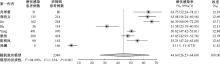
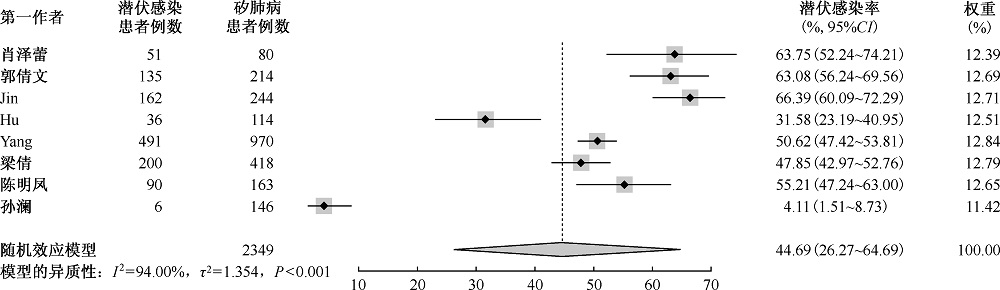
| 第一作者/ 文献序号 | 发表 年份 | 研究设计 类型 | 研究时间 | 研究地区 | 研究机构 性质/数量 | 工种/尘肺病类型 | 样本量 (例) | 筛查 方法 | 潜伏感染 率(%) |
|---|---|---|---|---|---|---|---|---|---|
| 孙澜[ | 2024 | 病例对照研究 | 2020—2023 | 中国贵州省安顺市 | 1家医院 | 石雕从业者/矽肺病 | 146 | QFT | 4.11 |
| Jin[ | 2018 | 横断面研究 | 2016 | 中国北京市 | 1家医院 | 煤炭工人/煤工尘肺病 | 242 | QFT | 66.4 |
| Hu[ | 2024 | 横断面研究 | 2023 | 中国江苏省 | 社区 | 矿工工人/矽肺 | 114 | QFT | 31.6 |
| Yang[ | 2022 | 病例对照研究 | 2014—2018 | 中国浙江省 | 社区 | 矽肺 | 970 | QFT-GIT/TST | 50.6 |
| 梁倩[ | 2021 | 横断面研究 | 2017—2020 | 中国四川省 | 1家医院 | 矽肺 | 418 | QFT | 47.89 |
| 陈明凤[ | 2021 | 横断面研究 | 2016—2020 | 中国北京市 | 1家医院 | 煤工尘肺病 | 163 | QFT | 55.21 |
| 肖泽蕾[ | 2024 | 病例对照研究 | 2020—2023 | 中国江西省赣州 | 1家医院 | 煤工尘肺病 | 80 | QFT | 63.75 |
| 郭倩文[ | 2020 | 病例对照研究 | 2003—2015 | 中国江苏省南京市、昆山市 | 2家医院 | 尘肺病 | 214 | QFT | 63.08 |
| Ringshausen[ | 2013 | 病例对照研究 | 2008—2010 | 德国 | 2家医院 | 硬煤矿工人/矽肺 | 118 | QFT; T-SPOT.TB | 46.6 60.1 |
| 亚组 | 合并感染率(%,95%CI) | I2值(%,95%CI) | Cochran’s Q值 | P值 |
|---|---|---|---|---|
| 研究类型 | ||||
| 横断面研究 | 50.45(36.20~64.62) | 92.71(84.55~96.59) | 41.141 | <0.001 |
| 病例对照研究 | 38.33(10.18~77.32) | 96.02(92.54~97.88) | 75.456 | <0.001 |
| 尘肺病类型 | ||||
| 矽肺 | 43.89(33.11~55.27) | 86.05(59.52~95.20) | 14.341 | <0.001 |
| 煤工尘肺 | 62.08(54.34~69.24) | 65.18(0.00~90.00) | 5.743 | 0.056 |
| 除外矽肺和煤工尘肺 | 45.15(16.96~78.83) | 95.02(91.06~97.23) | 80.366 | <0.001 |
| 其他尘肺病a | 62.57(58.91~66.10) | 48.07(0.00~82.79) | 5.777 | 0.123 |
| 研究人群b | ||||
| 退休/退养人员 | 43.20(22.50~66.57) | 93.22(77.73~97.94) | 14.759 | <0.001 |
| 在职脱尘/转岗人员 | 44.93(21.17~71.26) | 94.87(91.28~97.98) | 97.515 | <0.001 |
| 研究地区 | ||||
| 结核病高负担地区 | 29.65(43.90~79.44) | 96.75(93.35~98.41) | 61.588 | <0.001 |
| 非结核高负担地区 | 53.65(41.68~65.22) | 91.61(83.41~95.76) | 47.685 | <0.001 |
| 研究地点 | ||||
| 社区 | 41.31(24.38~60.56) | 92.98(76.67~97.89) | 14.237 | <0.001 |
| 医院 | 45.68(21.53~72.05) | 94.67(90.88~96.88) | 93.773 | <0.001 |
| 第一作者/ 文献序号 | 研究类型 | 研究地点 | 样本量(例) | 危险因素 | OR(95%CI)值 | P值 | |||||||||
|---|---|---|---|---|---|---|---|---|---|---|---|---|---|---|---|
| 合计 | 病例组 | 对照组 | |||||||||||||
| 肖泽蕾[ | 病例对照研究 | 中国江西赣州 | 80 | 51 | 29 | 混合工种 | 1.984(1.135~3.478) | 0.017 | |||||||
| 工作场所通风差 | 1.846(1.167~2.920) | 0.009 | |||||||||||||
| 吸烟频率10支/d | 1.626(0.884~2.991) | 0.119 | |||||||||||||
| 郭倩文[ | 病例对照研究 | 中国昆山和南京 | 214 | 135 | 79 | 工作场所通风差 | 1.879(1.153~3.063) | 0.011 | |||||||
| 营养摄入不均衡 | 1.390(1.025~1.886) | 0.034 | |||||||||||||
| Jin[ | 横断面研究 | 中国北京 | 242 | 162 | 80 | 摄入水果频次≥4d/周 | 0.81(0.65~0.99) | 0.049 | |||||||
| 工作场所通风差 | 1.26(1.03~1.52) | 0.02 | |||||||||||||
| Hu[ | 横断面研究 | 中国北京 | 114 | 36 | 78 | 饮酒 | 6.92(1.47~32.66) | 0.015 | |||||||
| 隧道掘进作业 | 3.91(1.20~12.70) | 0.024 | |||||||||||||
| Yang[ | 病例对照研究 | 中国浙江 | 970 | 393 | 577 | 矽肺分期为2期 | 0.527(0.320~0.868) | 0.012 | |||||||
| 卡介苗疤痕 | 0.791(0.692~0.904) | 0.001 | |||||||||||||
| 梁倩[ | 横断面研究 | 中国四川 | 418 | 196 | 222 | 胸痛胸闷/呼吸困难 | - | <0.05 | |||||||
| 接尘类型(大理石/金矿) | - | ||||||||||||||
| 陈明凤[ | 横断面研究 | 中国北京 | 163 | 112 | 50 | 陈旧性脑梗死 | 3.06(1.33~7.01) | 0.008 | |||||||
| 经常吸烟 | 8.20(2.12~7.01) | 0.002 | |||||||||||||
| 重度吸烟 | 9.19(2.07~40.74) | 0.004 | |||||||||||||
| 孙澜[ | 病例对照研究 | 中国贵州安顺 | 146 | 6 | 140 | 吸烟频率≥10支/d | 1.854(1.196~2.543) | 0.002 | |||||||
| 营养膳食不均衡 | 1.423(1.168~1.997) | 0.021 | |||||||||||||
| Ringshausen[ | 病例对照研究 | 德国 | 118 | 55 | 63 | 年龄>80岁 | 5.8(2.04~16.26) | <0.001 | |||||||
| 出生在结核病高负担国家 | 6.8(1.91~24.0) | 0.003 | |||||||||||||
| [1] | Mangione C M, Barry M J, Nicholson W K, et al. Screening for Latent Tuberculosis Infection in Adults: US Preventive Services Task Force Recommendation Statement[J]. JAMA, 2023, 329(17):1487-1494. doi:10.1001/jama.2023.4899. |
| [2] |
Louie J K, Keh C E. Latent Tuberculosis Infection Treatment: Still a Long Road Ahead[J]. Clin Infect Dis, 2023, 77(2):295-297. doi:10.1093/cid/ciad251.
pmid: 37125504 |
| [3] | 高磊, 张慧, 胡茂桂, 等. 基于多中心调查数据和空间统计模型的全国结核分枝杆菌潜伏感染率估算[J]. 中国防痨杂志, 2022, 44(1):54-59. doi:10.19982/j.issn.1000-6621.2022.01.005. |
| [4] | 周林, 初乃惠, 陆伟. 高危人群结核分枝杆菌潜伏感染检测及预防性治疗专家共识[J]. 中国防痨杂志, 2021, 43(9):874-878. doi:10.3969/j.issn.1000-6621.2021.09.004. |
| [5] | 中华人民共和国国家卫生健康委员会. 2024年我国卫生健康事业发展统计公报[EB/OL]. ((2025-12-02)[2026-07-16]. https://www.nhc.gov.cn/guihuaxxs/c100133/202512/f1c3a3c617484a27a1a26a468afbaeee/files/2024年我国卫生健康事业发展统计公报-20251201161542231.pdf |
| [6] | 张旭辉, 张景暄, 付庭吕, 等. 尘肺共病肺结核的系统性综述[J]. 工业卫生与职业病, 2025, 51(4):370-374. doi:10.13692/j.cnki.gywsyzyb.2025.04.017. |
| [7] | 中华预防医学会劳动卫生与职业病分会职业性肺部疾病学组. 尘肺病治疗中国专家共识(2024年版)[J]. 环境与职业医学, 2024, 41(1):1-21. doi:10.11836/JEOM23379. |
| [8] | Ehrlich R, Murray J, Said-Hartley Q, et al. Silicotuberculosis: a critical narrative review[J]. Eur Respir Rev, 2024, 33(174):240168. doi:10.1183/16000617.0168-2024. |
| [9] | Albadrani M. Exploring the Impact of Silicosis Incidence on Tuberculosis Mortality and Morbidity: A Multi-Country Study[J]. Med Sci (Basel), 2023, 11(4):63. doi:10.3390/medsci11040063. |
| [10] | Guidelines for the use of the ILO international Classification of Radiographs of Pneumoconioses (Revised edition 2022)[J]. Sangyo Eiseigaku Zasshi, 2025, 67(supplement):1-23. doi:10.1539/sangyoeisei.2025-ilo-guideline-jpn. |
| [11] | 中华人民共和国国家卫生和计划生育委员会. GBZ 70-2015 职业性尘肺病的诊断[S]. 2015-12-15. |
| [12] | World Health Organization. WHO consolidated guidelines on tuberculosis. Module 1: prevention: tuberculosis preventive treatment[R]. Geneva: World Health Organization, 2020. |
| [13] | 中华人民共和国国家卫生和计划生育委员会. WS 288-2017肺结核诊断[J]. 结核与肺部疾病杂志, 2024, 5(4): 376-378. doi:10.19983/j.issn.2096-8493.2024022. |
| [14] | 国家疾病预防控制局, 中华人民共和国国家卫生健康委员会, 中华人民共和国国家发展和改革委员会, 等. 关于印发《全国结核病防治规划(2024-2030年)》的通知[EB/OL]. 国疾控传防发〔2024〕19号.2024-11-28. https://www.gov.cn/zhengce/zhengceku/202412/content_6991217.htm. |
| [15] | 中华人民共和国国家卫生健康委员会. 2024中国卫生健康统计年鉴[M]. 北京: 中国协和医科大学出版社, 2025. |
| [16] | 孙澜, 郭奕梅, 张海龙. 安顺市石雕从业者尘肺合并肺结核潜伏感染的现状研究[J]. 智慧健康, 2024, 10(24):4-6. doi:10.19335/j.cnki.2096-1219.2024.24.002. |
| [17] | Jin Y, Wang H, Zhang J, et al. Prevalence of latent tuberculosis infection among coal workers’ pneumoconiosis patients in China: a cross-sectional study[J]. BMC Public Health, 2018, 18(1):473. doi:10.1186/s12889-018-5373-1. |
| [18] | Ringshausen F C, Nienhaus A, Schablon A, et al. Frequent Detection of Latent Tuberculosis Infection among Aged Underground Hard Coal Miners in the Absence of Recent Tuberculosis Exposure[J]. PLoS One, 2013, 8(12):e82005. doi:10.1371/journal.pone.0082005. |
| [19] |
Hu X, Chen C, Gao Q, et al. Latent tuberculosis infection and infection-associated risk factors for miner workers with silicosis in eastern China[J]. BMC Pulm Med, 2024, 24(1):177. doi:10.1186/s12890-024-02985-z.
pmid: 38622607 |
| [20] | Yang Q, Lin M, He Z, et al. Mycobacterium tuberculosis Infection among 1,659 Silicosis Patients in Zhejiang Province, China[J]. Microbiol Spectr, 2022, 10(6):e0145122. doi:10.1128/spectrum.01451-22. |
| [21] | 梁倩, 龙莹, 李蕊丹, 等. 四川省某院矽肺住院患者流行病学特征及结核潜伏感染率分析[J]. 现代预防医学, 2021, 48(15):2730-2733, 2754. doi:10.20043/j.cnki.mpm.2021.15.010. |
| [22] | 陈明凤. 退休煤工尘肺潜伏性结核感染转归的随访研究[D]. 北京: 中国疾病预防控制中心, 2021. |
| [23] | 肖泽蕾, 陈峭. 煤工尘肺患者的结核潜伏感染风险及危险因素分析[J]. 四川生理科学杂志, 2024, 46(9):1930-1932,1977. |
| [24] | 郭倩文, 朱晓敏, 朱芳, 等. 接尘作业工人尘肺患者结核潜伏性感染的患病情况及影响因素分析[J]. 实用预防医学, 2020, 27(9):1122-1124. doi:10.3969/j.issn.1006-3110.2020.09.027. |
| [25] | 全国第五次结核病流行病学抽样调查技术指导组, 全国第五次结核病流行病学抽样调查办公室. 2010年全国第五次结核病流行病学抽样调查报告[J]. 中国防痨杂志, 2012, 34(8):485-508. |
| [26] | Wang H, Ye Q, Chen Y, et al. Epidemiology of coal miners’ pneumoconiosis and its social determinants: An ecological study from 1949 to 2021 in China[J]. Chin Med J Pulm Crit Care Med, 2023, 1(1):46-55. doi:10.1016/j.pccm.2023.03.002. |
| [27] | Gong X, Cui K, Liu Z, et al. The disease burden of pneumoconiosis in China from 1990 to 2021 and projection to 2050 based on GBD 2021: a cross-sectional study[J]. Front Public Health, 2025, 13:1583895. doi:10.3389/fpubh.2025.1583895. |
| [28] | 郑亦沐, 赵赞梅, 李晓, 等. 2014-2023年北京市某职业病诊断机构职业病诊断受理及确诊情况分析[J]. 中国煤炭工业医学杂志, 2025, 28(1):96-100. doi:10.11723/mtgyyx1007-9564202501012. |
| [29] |
Ehrlich R, Akugizibwe P, Siegfried N, et al. The association between silica exposure, silicosis and tuberculosis: a systematic review and meta-analysis[J]. BMC Public Health, 2021, 21(1):953. doi:10.1186/s12889-021-10711-1.
pmid: 34016067 |
| [30] |
Gao L, Lu W, Bai L, et al. Latent tuberculosis infection in rural China: baseline results of a population-based, multicentre, prospective cohort study[J]. Lancet Infect Dis, 2015, 15(3):310-319. doi:10.1016/s1473-3099(14)71085-0.
pmid: 25681063 |
| [31] |
Ranjan A, Panneerselvam A, Meena S, et al. Silicotuberculosis: Newer trends[J]. Indian J Tuberc, 2025, 72(4):521-526. doi:10.1016/j.ijtb.2025.01.010.
pmid: 40975585 |
| [32] | Chen H, Tao X, Cao H, et al. Nicotine exposure exacerbates silica-induced pulmonary fibrosis via STAT3-BDNF-TrkB-mediated epithelial-mesenchymal transition in alveolar type Ⅱ cells[J]. Food Chem Toxicol, 2023, 175:113694. doi:10.1016/j.fct.2023.113694. |
| [33] | Mutua F, Su R C, Ball T B, et al. The Role of Type I Interferons in Tuberculosis and in Tuberculosis-Risk-Associated Comorbidities[J]. Infect Dis Rep, 2025, 17(4):81. doi:10.3390/idr17040081. |
| [34] | Hu X, Liu J, Shao Y, et al. Smoking Exposure and the Risk of Latent Tuberculosis Infection: Results from NHANES 2011-2012[J]. Toxics, 2024, 12(1):94. doi:10.3390/toxics12010094. |
| [35] | Malherbe D C, Messaoudi I. Transcriptional and Epigenetic Regulation of Monocyte and Macrophage Dysfunction by Chronic Alcohol Consumption[J]. Front Immunol, 2022, 13:911951. doi:10.3389/fimmu.2022.911951. |
| [36] | Lewis S A, Doratt B M, Sureshchandra S, et al. Ethanol Consumption Induces Nonspecific Inflammation and Functional Defects in Alveolar Macrophages[J]. Am J Respir Cell Mol Biol, 2022, 67(1):112-124. doi:10.1165/rcmb.2021-0346OC. |
| [37] | Saukkonen J J, Cohn D L, Jasmer R M, et al. An official ATS statement: hepatotoxicity of antituberculosis therapy[J]. Am J Respir Crit Care Med, 2006, 174(8):935-952. doi:10.1164/rccm.200510-1666ST. |
| [38] |
Herzmann C, Sotgiu G, Bellinger O, et al. Risk for latent and active tuberculosis in Germany[J]. Infection, 2017, 45(3):283-290. doi:10.1007/s15010-016-0963-2.
pmid: 27866367 |
| [39] | Wu X, Fan X, Miyata T, et al. Recent Advances in Understanding of Pathogenesis of Alcohol-Associated Liver Disease[J]. Annu Rev Pathol, 2023, 18:411-438. doi:10.1146/annurev-pathmechdis-031521-030435. |
| [40] |
Jiang L, Yan T, Zhang X, et al. Association between low vitamin B-12 status and latent tuberculosis infection among adults[J]. Asia Pac J Clin Nutr, 2025, 34(4):627-635. doi:10.6133/apjcn.202508_34(4).0014.
pmid: 40738730 |
| [41] | Nasare D, Bagade S. Phytoconstituents and Immunological Responses in Tuberculosis: Insights Into Network Pharmacology[J]. Chem Biodivers, 2025, 22(11):e01727. doi:10.1002/cbdv.202501727. |
| [42] | Nalam S M, Chintamaneni P K, Sacena Pal R, et al. From nature’s bounty to drug discovery: Leveraging phytochemicals and molecular approaches to combat multi-drug-resistant (MDR) tuberculosis[J]. Indian J Tuberc, 2024, 71 Suppl 1:S117-S129. doi:10.1016/j.ijtb.2023.08.007. |
| [43] | Xu H, Zhou J, Yang Q, et al. QuantiFERON-TB supernatant-based biomarkers predicting active tuberculosis progression[J]. Int J Infect Dis, 2025, 157:107915. doi:10.1016/j.ijid.2025.107915. |
| [44] | Vedel J O, Furtado O, Almeida L L, et al. Refresher training in administering intradermal BCG-vaccine increased BCG-scarring rates in rural Guinea-Bissau[J]. Vaccine, 2025, 55:127039. doi:10.1016/j.vaccine.2025.127039. |
| [45] | Jensen T M, Jensen S K, Birk N M, et al. Determinants of Bacille Calmette-Guérin scarification in Danish children[J]. Heliyon, 2021, 7(1):e05757. doi:10.1016/j.heliyon.2020.e05757. |
| [46] | Shabariah R, Hatta M, Idris I, et al. Comparison TLR2 and TLR4 serum levels in children with pulmonary and extrapulmonary tuberculosis with and without a Bacillus Calmette-Guérin (BCG) scar[J]. J Clin Tuberc Other Mycobact Dis, 2021, 25:100272. doi:10.1016/j.jctube.2021.100272. |
| [47] | Villanueva P, Crawford N W, Croda M G, et al. Factors influencing scar formation following Bacille Calmette-Guérin (BCG) vaccination[J]. Heliyon, 2023, 9(4):e15241. doi:10.1016/j.heliyon.2023.e15241. |
| [48] | Kim H, Choi Hh, Shin S J. Bridging the gaps to overcome major hurdles in the development of next-generation tuberculosis vaccines[J]. Front Immunol, 2023, 14:1193058. doi:10.3389/fimmu.2023.1193058. |
| [49] | Wang W, Chen X, Chen S, et al. The burden and predictors of latent tuberculosis infection among elder adults in high epidemic rural area of tuberculosis in Zhejiang, China[J]. Front Cell Infect Microbiol, 2022, 12:990197. doi:10.3389/fcimb.2022.990197. |
| [50] | Cubilla-Batista I, Ruiz N, Sambrano D, et al. Overweight, Obesity, and Older Age Favor Latent Tuberculosis Infection among Household Contacts in Low Tuberculosis-Incidence Settings within Panama[J]. Am J Trop Med Hyg, 2019, 100(5):1141-1144. doi:10.4269/ajtmh.18-0927. |
| [51] | Cheng Q, He S, Hu Y, et al. Global, regional, and national trends in the incidence of pneumoconiosis among populations aged 20 and above from 1990 to 2021[J]. Front Public Health, 2025, 13:1608109. doi:10.3389/fpubh.2025.1608109. |
| [52] | Tan S, Chen S. Macrophage Autophagy and Silicosis: Current Perspective and Latest Insights[J]. Int J Mol Sci, 2021, 22(1):453. doi:10.3390/ijms22010453. |
| [53] | Jamshidi P, Danaei B, Arbabi M, et al. Silicosis and tuberculosis: A systematic review and meta-analysis[J]. Pulmonology, 2025, 31(1):2416791. doi:10.1016/j.pulmoe.2023.05.001. |
| [54] | Roy P, Bardhan M, Roy S, et al. Silico-tuberculosis amidst COVID-19 pandemic: global scenario and Indian perspective[J]. Ann Med Surg (Lond), 2023, 85(12):6083-6090. doi:10.1097/ms9.0000000000001471. |
| [55] | 徐爽. 健康教育干预在尘肺合并肺结核患者中的应用[J]. 工业卫生与职业病, 2018, 44(5):387-388. doi:10.13692/j.cnki.gywsyzyb.2018.05.020. |
| [1] | Liu Zisen, Zhao Yaqi, Zhang Bin, Xin Henan, Du Jiang, Feng Boxuan, He Yijun, Li Zihan, Yu Yilin, Wang Dakuan, Yan Jiaoxia, Gao Lei, Jin Qi, Duan Weitao, Cao Xuefang. Analysis of re-screening for latent tuberculosis infection in 2025 and related factors affecting infection status among rural doctors in Zhongmu County, Henan Province, based on 2017 screening [J]. Chinese Journal of Antituberculosis, 2026, 48(8): 1139-1147. |
| [2] | Cheng Wen, Nie Wenjuan. Factors associated with treatment outcomes of Mycobacterium abscessus pulmonary disease: a retrospective case-control study [J]. Chinese Journal of Antituberculosis, 2026, 48(8): 1176-1183. |
| [3] | Wang Wenyu, Zhang Tongqiang. Expression and diagnostic value of SEMA4A in children with different Mycobacterium tuberculosis infection statuses [J]. Chinese Journal of Antituberculosis, 2026, 48(7): 978-984. |
| [4] | Guo Chenhao, Liu Xinyu, Zhan Sirui, Wang Lili, Ma Mengting, Li Xiumei, Qi Linping, Li Weiping. Interferon-gamma release assays for diagnosing extrapulmonary tuberculosis in adults: a systematic review and Meta-analysis [J]. Chinese Journal of Antituberculosis, 2026, 48(6): 803-812. |
| [5] | Gao Li, Zhang Guoqin. Current status and optimization paths of latent tuberculosis infection screening in patients with rheumatic immune diseases in China [J]. Chinese Journal of Antituberculosis, 2026, 48(5): 561-566. |
| [6] | Tong Jing, Liu Kewei, Guo Can, Shi Jin, Pang Yu, Gao Mengqiu, Li Shanshan. Expression and clinical significance of co-signaling molecules on surface of T lymphocytes in different states of Mycobacterium tuberculosis infection [J]. Chinese Journal of Antituberculosis, 2026, 48(5): 621-630. |
| [7] | Wang Yongbing, Zhong Yuexiang, Fu Xiuying, Zhang Ying, Weng Wenpei, Zhou Fangjing, Yang Yingzhou, Luo Jilun. Survey of Mycobacterium tuberculosis infection rate and analysis of associated factors among three priority populations in Yingde’s zero-TB community pilot areas,Guangdong Province [J]. Chinese Journal of Antituberculosis, 2026, 48(4): 468-476. |
| [8] | Liu Shuya, Zhang Ting, Wang Qingya, Fan Jun, Wang Ni. Analysis of close contacts screening situation and time changing trends of pulmonary tuberculosis patients in Chongqing from 2015 to 2024 [J]. Chinese Journal of Antituberculosis, 2026, 48(2): 230-237. |
| [9] | Zhou Cang, Li Guoli, Jiang Hui, Shao Yan, Song Honghuan, Xue Hao, Ning Jingxian, Pan Yuchen, Fei Xinru, Sun Zheng, Chen Cheng, Zhu Limei, Liu Qiao. Evaluation of the diagnostic efficacy of AIMTB-fluorescent immunochromatography for screening latent tuberculosis infection [J]. Chinese Journal of Antituberculosis, 2026, 48(2): 289-298. |
| [10] | Shang Yuanyuan, Nie Wenjuan, Chu Naihui. Comparison of clinical characteristics and prognostic factors between elderly and non-elderly patients with Mycobacterium abscessus pulmonary disease [J]. Chinese Journal of Antituberculosis, 2026, 48(1): 106-112. |
| [11] | Tan Xiao, Li Fangping, Zhang Qian, Zhang Meijia. Causal effects of gut microbiota on non-tuberculous mycobacterial lung infection: a bidirectional two-sample mendelian randomization study [J]. Chinese Journal of Antituberculosis, 2026, 48(1): 121-130. |
| [12] | Wang Na, Wan Bin, Zhao Xia, He Ting, Zhang Miao, Yao Rong, Yang Xiaoyi. Meta-analysis of diagnostic delay rate among Chinese students patients with pulmonary tuberculosis [J]. Chinese Journal of Antituberculosis, 2026, 48(1): 73-83. |
| [13] | Fan Ruifang, Dai Xiaowei, Yang Xinyu, Chen Shuangshuang, Chen Hao, Yu Lan, Zhao Yanfeng, Li Chuanyou, Wang Nenhan. A study on the identification of Mycobacterium species using fluorescent PCR probe melting curve technique and DNA microarray chip technique [J]. Chinese Journal of Antituberculosis, 2025, 47(8): 1031-1037. |
| [14] | Nontuberculous Mycobacterial Diseases Branch of Chinese Antituberculosis Association. Expert consensus on molecular biology diagnosis of nontuberculous mycobacteria diseases [J]. Chinese Journal of Antituberculosis, 2025, 47(8): 961-975. |
| [15] | Li Longfen, Shi Chunjing, Luo Yun, Zhang Huajie, Liu Jun, Wang Ge, Zhao Yanhong, Yuan Lijuan, Li Shan, Li Wenming, Shen Lingjun. Establishing and validating a prediction model for HIV-associated nontuberculous mycobacterial disease based on machine learning [J]. Chinese Journal of Antituberculosis, 2025, 47(6): 708-718. |
| Viewed | ||||||
|
Full text |
|
|||||
|
Abstract |
|
|||||
 京公网安备11010202007215号
Total visitors: Visitors of today: Now online:
京公网安备11010202007215号
Total visitors: Visitors of today: Now online:
 This work is licensed under Creative Commons Attribution 3.0 License.
