
Chinese Journal of Antituberculosis ›› 2026, Vol. 48 ›› Issue (9): 1266-1276.doi: 10.19982/j.issn.1000-6621.20260078
• Original Articles • Previous Articles Next Articles
Bai Yan1,2, Chen Yu3, Gao Xusheng4, Liang Jianqin5, Zeng Yi6, Wang Yun1( ), Fan Lin1,2()
Received:2026-02-05
Online:2026-09-10
Published:2026-09-08
Contact:
Wang Yun,Fan Lin
E-mail:fanlinsj@163.com;441334899@qq.com
Supported by:CLC Number:
Bai Yan, Chen Yu, Gao Xusheng, Liang Jianqin, Zeng Yi, Wang Yun, Fan Lin. Analysis of clinical characteristics and factors influencing outcomes in elderly patients with drug-susceptible pulmonary tuberculosis[J]. Chinese Journal of Antituberculosis, 2026, 48(9): 1266-1276. doi: 10.19982/j.issn.1000-6621.20260078
Add to citation manager EndNote|Ris|BibTeX
URL: https://www.zgflzz.cn/EN/10.19982/j.issn.1000-6621.20260078

| 方案类型 | 核心药物组合 |
|---|---|
| 治疗方案一 | 2H-R-Z-E/4H-R(标准治疗方案) |
| 治疗方案二 | 9H-Rpt-E-Lfx |
| 治疗方案三 | 2H-Rpt-Z-E/4H-Rpt |
| 治疗方案四 | 9H-R-E-Lfx |
| 特征 | 例数 | 构成比(%) |
|---|---|---|
| 性别 | ||
| 男性 | 1758 | 74.84 |
| 女性 | 591 | 25.16 |
| 年龄组(岁) | ||
| 60~64 | 515 | 21.92 |
| 65~69 | 705 | 30.01 |
| 70~74 | 503 | 21.41 |
| 75~79 | 309 | 13.15 |
| ≥80 | 317 | 13.50 |
| 治疗类型 | ||
| 初治 | 2015 | 85.78 |
| 复治 | 334 | 14.22 |
| 治疗方案 | ||
| 2H-R-Z-E/4H-R | 1022 | 43.51 |
| 9H-Rpt-E-Lfx | 539 | 22.95 |
| 2H-Rpt-Z-E/4H-Rpt | 282 | 12.01 |
| 9H-R-E-Lfx | 347 | 14.77 |
| 其他a | 159 | 6.77 |
| 并发结核性胸膜炎 | 296 | 12.60 |
| 并发支气管结核 | 187 | 7.96 |
| 并发肺外结核 | 390 | 16.60 |
| 并发糖尿病 | 701 | 29.84 |
| 并发心脏疾病 | 320 | 13.62 |
| 并发脑血管疾病 | 213 | 9.07 |
| 并发恶性肿瘤 | 152 | 6.47 |
| 并发免疫性疾病 | 75 | 3.19 |
| 并发慢性肺病 | 270 | 11.49 |
| 并发慢性肝病 | 291 | 12.39 |
| 并发慢性肾病 | 180 | 7.66 |
| 并发营养不良 | 75 | 3.19 |
| 并发呼吸衰竭 | 32 | 1.36 |
| 肺部病灶范围(个) | ||
| <3 | 1525 | 64.92 |
| ≥3 | 824 | 35.08 |
| 空洞 | ||
| 有 | 1066 | 45.38 |
| 无 | 1283 | 54.62 |
| 药物不良反应 | ||
| 有 | 766 | 32.61 |
| 无 | 1583 | 67.39 |
| 治疗转归 | ||
| 治愈 | 962 | 40.95 |
| 完成治疗 | 665 | 28.31 |
| 治疗失败 | 620 | 26.39 |
| 失访 | 79 | 3.36 |
| 死亡 | 23 | 0.98 |
| 因素 | 例数 | 成功治疗组 (1627例) | 不良治疗转归组 (722例) | χ2值 | P值 |
|---|---|---|---|---|---|
| 性别[例(构成比,%)] | 0.989 | 0.320 | |||
| 女性 | 591 | 419(70.90) | 172(29.10) | ||
| 男性 | 1758 | 1208(68.71) | 550(31.29) | ||
| 年龄组[例(构成比,%)] | 2.993 | 0.559 | |||
| 60~64岁 | 515 | 371(72.04) | 144(27.96) | ||
| 65~69岁 | 705 | 486(68.94) | 219(31.06) | ||
| 70~74岁 | 503 | 347(68.99) | 156(31.01) | ||
| 75~79岁 | 309 | 206(66.67) | 103(33.33) | ||
| ≥80岁 | 317 | 217(68.45) | 100(31.55) | ||
| 治疗类型[例(构成比,%)] | 8.182 | 0.004 | |||
| 初治 | 2015 | 1418(70.37) | 597(29.63) | ||
| 复治 | 334 | 209(62.57) | 125(37.43) | ||
| 治疗方案[例(构成比,%)] | 34.397 | <0.001 | |||
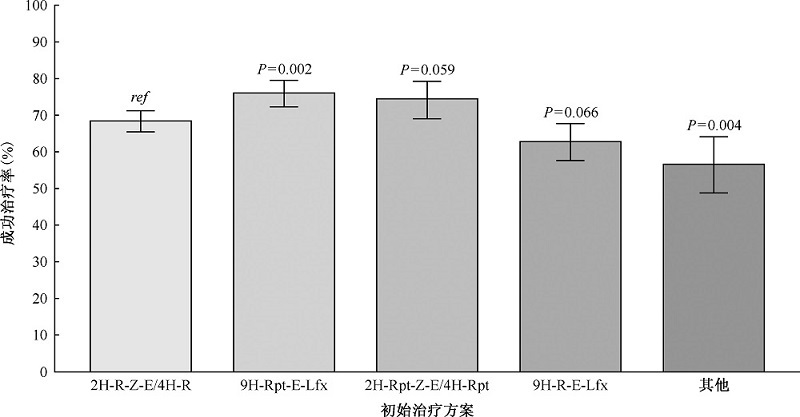
| 2H-R-Z-E/4H-R | 1022 | 699(68.40) | 323(31.60) | ||
| 9H-Rpt-E-Lfx | 539 | 410(76.07) | 129(23.93) | ||
| 2H-Rpt-Z-E/4H-Rpt | 282 | 210(74.47) | 72(25.53) | ||
| 9H-R-E-Lfx | 347 | 218(62.82) | 129(37.18) | ||
| 其他a | 159 | 90(56.60) | 69(43.40) | ||
| 并发结核性胸膜炎[例(构成比,%)] | 0.019 | 0.891 | |||
| 是 | 296 | 204(68.92) | 92(31.08) | ||
| 否 | 2053 | 1423(69.31) | 630(30.69) | ||
| 并发支气管结核[例(构成比,%)] | 7.410 | 0.007 | |||
| 是 | 187 | 146(78.07) | 41(21.93) | ||
| 否 | 2162 | 1481(68.50) | 681(31.50) | ||
| 并发肺外结核[例(构成比,%)] | 0.011 | 0.917 | |||
| 是 | 390 | 271(69.49) | 119(30.51) | ||
| 否 | 1959 | 1356(69.22) | 603(30.78) | ||
| 并发糖尿病[例(构成比,%)] | 0.285 | 0.593 | |||
| 是 | 701 | 491(70.04) | 210(29.96) | ||
| 否 | 1648 | 1136(68.93) | 512(31.07) | ||
| 并发心脏疾病[例(构成比,%)] | 0.226 | 0.635 | |||
| 是 | 320 | 218(68.13) | 102(31.88) | ||
| 否 | 2029 | 1409(69.44) | 620(30.56) | ||
| 并发脑血管疾病[例(构成比,%)] | 0.742 | 0.389 | |||
| 是 | 213 | 142(66.67) | 71(33.33) | ||
| 否 | 2136 | 1485(69.52) | 651(30.48) | ||
| 并发恶性肿瘤[例(构成比,%)] | 1.751 | 0.186 | |||
| 是 | 152 | 98(64.47) | 54(35.53) | ||
| 否 | 2197 | 1529(69.59) | 668(30.41) | ||
| 并发免疫性疾病[例(构成比,%)] | <0.001 | 0.989 | |||
| 是 | 75 | 52(69.33) | 23(30.67) | ||
| 否 | 2274 | 1575(69.26) | 699(30.74) | ||
| 并发慢性肺病[例(构成比,%)] | 0.176 | 0.675 | |||
| 是 | 270 | 190(70.37) | 80(29.63) | ||
| 否 | 2079 | 1437(69.12) | 642(30.88) | ||
| 并发慢性肝病[例(构成比,%)] | 0.364 | 0.546 | |||
| 是 | 291 | 206(70.79) | 85(29.21) | ||
| 否 | 2058 | 1421(69.05) | 637(30.95) | ||
| 并发慢性肾病[例(构成比,%)] | 0.802 | 0.371 | |||
| 是 | 180 | 130(72.22) | 50(27.78) | ||
| 否 | 2169 | 1497(69.02) | 672(30.98) | ||
| 并发营养不良[例(构成比,%)] | 20.840 | <0.001 | |||
| 是 | 75 | 34(45.33) | 41(54.67) | ||
| 否 | 2274 | 1593(70.05) | 681(29.95) | ||
| 并发呼吸衰竭[例(构成比,%)] | 3.969 | 0.046 | |||
| 是 | 32 | 17(53.12) | 15(46.88) | ||
| 否 | 2317 | 1610(69.49) | 707(30.51) | ||
| 肺部病灶范围[例(构成比,%)] | 48.433 | <0.001 | |||
| <3个 | 1525 | 982(64.39) | 543(35.61) | ||
| ≥3个 | 824 | 645(78.28) | 179(21.72) | ||
| 出现空洞[例(构成比,%)] | 25.616 | <0.001 | |||
| 是 | 1066 | 682(63.98) | 384(36.02) | ||
| 否 | 1283 | 945(73.66) | 338(26.34) | ||
| 药物不良反应[例(构成比,%)] | 190.153 | <0.001 | |||
| 是 | 766 | 386(50.39) | 380(49.61) | ||
| 否 | 1583 | 1241(78.40) | 342(21.60) | ||
| 疗程(月)[M(Q1,Q3)]b | - | 12(10,14) | 11(8,14) | -2.810 | 0.005 |
| 变量 | 赋值 |
|---|---|
| 治疗转归 | 成功治疗=0,不良治疗转归=1 |
| 性别 | 女性=0,男性=1 |
| 年龄 | 60~64岁=0,65~69岁=1,70~74岁=2,75~79岁=3,≥80岁=4 |
| 并发支气管结核 | 否=0,是=1 |
| 并发恶性肿瘤 | 否=0,是=1 |
| 并发营养不良 | 否=0,是=1 |
| 并发呼吸衰竭 | 否=0,是=1 |
| 肺部病灶范围 | <3个肺野=0,≥3个肺野=1 |
| 肺部空洞 | 无=0,有=1 |
| 治疗类型 | 初治=0,复治=1 |
| 治疗方案(月) | 2H-R-Z-E/4H-R=0,9H-Rpt-E-Lfx=1,2H-Rpt-Z-E/4H-Rpt=2,其他=3 |
| 药物不良反应 | 未发生=0,发生=1 |
| 治疗疗程(月) | 原值代入 |
| 因素 | β值 | s | P值 | OR(95%CI)值 |
|---|---|---|---|---|
| 年龄组(60~64岁为参照组) | ||||
| 65~69岁 | 0.057 | 0.138 | 0.677 | 1.059(0.808~1.387) |
| 70~74岁 | 0.050 | 0.150 | 0.736 | 1.052(0.784~1.411) |
| 75~79岁 | 0.248 | 0.171 | 0.148 | 1.281(0.916~1.792) |
| ≥80岁 | 0.073 | 0.178 | 0.681 | 1.076(0.760~1.524) |
| 并发支气管结核 | -0.323 | 0.202 | 0.110 | 0.724(0.488~1.076) |
| 并发恶性肿瘤 | 0.218 | 0.194 | 0.262 | 1.243(0.850~1.819) |
| 并发营养不良 | 0.977 | 0.262 | <0.001 | 2.657(1.588~4.444) |
| 并发呼吸衰竭 | 0.486 | 0.390 | 0.213 | 1.627(0.757~3.495) |
| ≥3个肺野 | 0.574 | 0.112 | <0.001 | 1.776(1.425~2.213) |
| 出现肺部空洞 | 0.362 | 0.103 | <0.001 | 1.436(1.173~1.757) |
| 复治 | 0.302 | 0.136 | 0.026 | 1.352(1.037~1.764) |
| 治疗方案(2H-R-Z-E/4H-R为参照组) | ||||
| 9H-Rpt-E-Lfx | -0.432 | 0.135 | 0.001 | 0.649(0.498~0.846) |
| 2H-Rpt-Z-E/4H-Rpt | -0.272 | 0.163 | 0.096 | 0.762(0.553~1.049) |
| 9H-R-E-Lfx | 0.154 | 0.142 | 0.277 | 1.167(0.884~1.540) |
| 其他a | 0.221 | 0.191 | 0.247 | 1.247(0.858~1.813) |
| 发生药物不良反应 | 1.387 | 0.101 | <0.001 | 4.005(3.284~4.884) |
| 疗程(月) | -0.065 | 0.013 | <0.001 | 0.937(0.913~0.962) |
| 治疗方案 | 分类 | 60~64岁 (515例) | 65~69岁 (705例) | 70~74岁 (503例) | 75~79岁 (309例) | ≥80岁 (317例) | χ2值 | P值 |
|---|---|---|---|---|---|---|---|---|
| 2H-R-Z-E/4H-R | 方案使用率 | 55.53(286/515) | 49.22(347/705) | 42.15(212/503) | 33.01(102/309) | 23.66(75/317) | 104.710 | <0.001 |
| 成功治疗率 | 71.68(205/286) | 69.45(241/347) | 65.57(139/212) | 65.69(67/102) | 62.67(47/75) | 3.876 | 0.423 | |
| 9H-Rpt-E-Lfx | 方案使用率 | 13.79(71/515) | 17.59(124/705) | 22.27(112/503) | 30.42(94/309) | 43.53(138/317) | 121.770 | <0.001 |
| 成功治疗率 | 81.69(58/71) | 70.16(87/124) | 82.14(92/112) | 74.47(70/94) | 74.64(103/138) | 6.167 | 0.187 | |
| 2H-Rpt-Z-E/4H-Rpt | 方案使用率 | 10.10(52/515) | 10.78(76/705) | 12.92(65/503) | 13.59(42/309) | 14.83(47/317) | 6.302 | 0.178 |
| 成功治疗率 | 80.77(42/52) | 72.37(55/76) | 76.92(50/65) | 66.67(28/42) | 74.47(35/47) | 2.813 | 0.590 | |
| 9H-R-E-Lfx | 方案使用率 | 13.79(71/515) | 16.03(113/705) | 15.90(80/503) | 14.89(46/309) | 11.67(37/317) | 4.217 | 0.378 |
| 成功治疗率 | 60.56(43/71) | 69.91(79/113) | 60.00(48/80) | 56.52(26/46) | 59.46(22/37) | 3.821 | 0.431 | |
| 其他a | 方案使用率 | 6.80(35/515) | 6.38(45/705) | 6.76(34/503) | 8.09(25/309) | 6.31(20/317) | 1.129 | 0.890 |
| 成功治疗率 | 65.71(23/35) | 53.33(24/45) | 52.94(18/34) | 60.00(15/25) | 50.00(10/20) | 2.037 | 0.729 |
| 因素 | 复治 | 治疗方案[n/、2H-R-Z-E/4H-R为参照组] | |||
|---|---|---|---|---|---|
| 9H-Rpt-E-Lfx | 2H-Rpt-Z-E/4H-Rpt | 9H-R-ELfx | 其他a | ||
| 主效应分析 | 1.352(1.037~1.764) | 0.649(0.498~0.846) | 0.762(0.553~1.049) | 1.167(0.884~1.540) | 1.247(0.858~1.813) |
| 剔除单位1 | 1.367(1.008~1.855) | 0.852(0.617~1.176) | 0.812(0.552~1.194) | 1.052(0.752~1.472) | 1.259(0.814~1.945) |
| 剔除单位2 | 1.476(1.069~2.039) | 0.633(0.447~0.896) | 0.880(0.592~1.306) | 1.262(0.869~1.832) | 1.470(0.879~2.460) |
| 剔除单位3 | 1.372(1.043~1.804) | 0.676(0.517~0.886) | 0.723(0.518~1.009) | 1.142(0.859~1.518) | 1.224(0.833~1.799) |
| 剔除单位4 | 1.260(0.950~1.670) | 0.621(0.471~0.820) | 0.787(0.566~1.093) | 1.154(0.866~1.539) | 1.103(0.749~1.625) |
| 剔除单位5 | 1.232(0.893~1.700) | 0.585(0.435~0.788) | 0.681(0.471~0.986) | 1.304(0.964~1.764) | 1.350(0.897~2.031) |
| [1] | 屈燕, 李涛, 马文斌, 等. 世界卫生组织《2025年全球结核病报告》解读[J]. 结核与肺部疾病杂志, 2025, 6(6): 613-623. doi:10.19983/j.issn.2096-8493.20250178. |
| [2] | 张梦迪, 王琦琦, 王鑫, 等. 2005-2020年中国60岁及以上老年人群肺结核疾病负担研究[J]. 中国防痨杂志, 2025, 47(3):338-347. doi:10.19982/j.issn.1000-6621.20240508 |
| [3] | Li S, Li Y, Song W, et al. Population aging and trends of pulmonary tuberculosis incidence in the elderly[J]. BMC Infect Dis, 2021, 21(1):302. doi:10.1186/s12879-021-05994-z. |
| [4] |
Jun C, Yan-Ni S, Can-You Z, et al. Incidence and risk factors of tuberculosis among the elderly population in China: a prospective cohort study[J]. Infect Dis Poverty, 2020, 9(1):13. doi:10.1186/s40249-019-0614-9.
pmid: 32005290 |
| [5] | 滕人聪, 李涛, 李玉红, 等. 2015-2021年全国65岁及以上老年肺结核患者登记情况分析[J]. 中国防痨杂志, 2023, 45(4):367-371. doi:10.19982/j.issn.1000-6621.20220494. |
| [6] |
Luo D, Wang F, Chen S, et al. Age-period-cohort study of active pulmonary tuberculosis in eastern China: analysis of 15-year surveillance data[J]. BMC Public Health, 2025, 25(1):651. doi:10.1186/s12889-025-21770-z.
pmid: 39962430 |
| [7] |
Singh K P, Carvalho A C C, Centis R, et al. Clinical standards for the management of adverse effects during treatment for TB[J]. Int J Tuberc Lung Dis, 2023, 27(7):506-519. doi:10.5588/ijtld.23.0078.
pmid: 37353868 |
| [8] | Saukkonen J J, Duarte R, Munsiff S S, et al. Updates on the Treatment of Drug-Susceptible and Drug-Resistant Tuberculosis: An Official ATS/CDC/ERS/IDSA Clinical Practice Guideline[J]. Am J Respir Crit Care Med, 2025, 211(1):15-33. doi:10.1164/rccm.202410-2096ST. |
| [9] | World Health Organization. WHO consolidated guidelines on tuberculosis: Module 4: treatment: drug-susceptible tuberculosis treatment[R]. Geneva: World Health Organization, 2022. |
| [10] | World Health Organization. WHO consolidated guidelines on tuberculosis: Module 3: diagnosis[R]. Geneva: World Health Organization, 2025. |
| [11] | Linh N N, Viney K, Gegia M, et al. World Health Organization treatment outcome definitions for tuberculosis: 2021 update[J]. Eur Respir J, 2021, 58(2): 2100804. doi:10.1183/13993003.00804-2021. |
| [12] | World Health Organization. Meeting report of the WHO expert consultation on drug-resistant tuberculosis treatment outcome definitions[R]. Geneva: World Health Organization, 2021. |
| [13] | World Health Organization. WHO consolidated operational handbook on tuberculosis: Module 4: treatment and care[R]. Geneva: World Health Organization, 2025. |
| [14] |
Tabernero E, Rodrigo T, Garros J, et al. TB in the elderly: clinical features and outcomes[J]. Int J Tuberc Lung Dis, 2022, 26(9):842-849. doi:10.5588/ijtld.22.0010.
pmid: 35996280 |
| [15] | Medrano B A, Lee M, Gemeinhardt G, et al. Tuberculosis presentation and outcomes in older Hispanic adults from Tamaulipas, Mexico[J]. Medicine (Baltimore), 2023, 102(41):e35458. doi:10.1097/MD.0000000000035458. |
| [16] | Hong H Y, Park Y, Yong S H, et al. Risk Factors for Unfavorable Outcomes of Tuberculosis in Korea: Implications for Patient-Centered Care in Tuberculosis Treatment[J]. J Korean Med Sci, 2024, 39(2):e4. doi:10.3346/jkms.2024.39.e4. |
| [17] | Sinha P, Ponnuraja C, Gupte N, et al. Impact of Undernutrition on Tuberculosis Treatment Outcomes in India: A Multicenter, Prospective, Cohort Analysis[J]. Clin Infect Dis, 2023, 76(8):1483-1491. doi:10.1093/cid/ciac915. |
| [18] | Nimmo C, Millard J, Faulkner V, et al. Evolution of Mycobacterium tuberculosis drug resistance in the genomic era[J]. Front Cell Infect Microbiol, 2022, 12:954074. doi:10.3389/fcimb.2022.954074. |
| [19] | Vadakunnel M J, Nehru V J, Brammacharry U, et al. Factors associated with unfavourable treatment outcomes among patients with Multidrug-resistant Tuberculosis receiving outpatients care[J]. Sci Rep, 2025, 15(1):28335. doi:10.1038/s41598-025-13227-5. |
| [20] | Webber T, Macdonald C, Tameris M, et al. Immune, metabolic, anatomical, and functional features of people after successful tuberculosis treatment: an exploratory analysis[J]. Sci Rep, 2025, 15(1):18392. doi:10.1038/s41598-025-01656-1. |
| [21] | Carwile M E, Hochberg N S, Sinha P. Undernutrition is feeding the tuberculosis pandemic: A perspective[J]. J Clin Tuberc Other Mycobact Dis, 2022, 27:100311. doi:10.1016/j.jctube.2022.100311. |
| [22] | Ozer N T, Gundogan K. The Vicious Cycle of Malnutrition and Tuberculosis: A Narrative Review[J]. J Clin Pract Res, 2024, 46(5):444-448. doi:10.14744/cpr.2024.60895. |
| [23] | Chandrasekaran P, Saravanan N, Bethunaickan R, et al. Malnutrition: Modulator of Immune Responses in Tuberculosis[J]. Front Immunol, 2017, 8:1316. doi:10.3389/fimmu.2017.01316. |
| [24] | Gomes M, Saad Júnior R, Stirbulov R. Pulmonary tuberculosis: relationship between sputum bacilloscopy and radiological lesions[J]. Rev Inst Med Trop Sao Paulo, 2003, 45(5):275-281. doi:10.1590/s0036-46652003000500007. |
| [25] | Strydom N, Gupta S V, Fox W S, et al. Tuberculosis drugs’ distribution and emergence of resistance in patient’s lung lesions: A mechanistic model and tool for regimen and dose optimization[J]. PLoS Med, 2019, 16(4):e1002773. doi:10.1371/journal.pmed.1002773. |
| [26] | Zhang L, Pang Y, Yu X, et al. Risk factors for pulmonary cavitation in tuberculosis patients from China[J]. Emerg Microbes Infect, 2016, 5(10):e110. doi:10.1038/emi.2016.111. |
| [27] | Li X, Ye J, Wang S, et al. Factors associated with post-treatment resorption of lung cavities in individuals with first episodes of drug-sensitive cavitary pulmonary tuberculosis in China[J]. BMC Infect Dis, 2025, 25(1):899. doi:10.1186/s12879-025-11287-6. |
| [28] | Ma L, Fan H. Key Factors Influencing Liver Function Injury in Elderly Patients with Newly Diagnosed Pulmonary Tuberculosis Complicated by Diabetes after Antituberculosis Treatment[J]. Am J Trop Med Hyg, 2025, 112(1):135-142. doi:10.4269/ajtmh.24-0248. |
| [29] |
Saito N, Yoshii Y, Kaneko Y, et al. Impact of renal function-based anti-tuberculosis drug dosage adjustment on efficacy and safety outcomes in pulmonary tuberculosis complicated with chronic kidney disease[J]. BMC Infect Dis, 2019, 19(1):374. doi:10.1186/s12879-019-4010-7.
pmid: 31046706 |
| [30] | Wu I L, Chitnis A S, Jaganath D. A narrative review of tuberculosis in the United States among persons aged 65 years and older[J]. J Clin Tuberc Other Mycobact Dis, 2022, 28:100321. doi:10.1016/j.jctube.2022.100321. |
| [31] | Osipov N N, Spelnikov D, Belyaeva E, et al. Drug Resistance and Comorbidities in the Treatment of Pulmonary Tuberculosis: A Multicenter Retrospective Cohort Study[J]. Antibiotics (Basel), 2025, 14(10):986. doi:10.3390/antibiotics14100986. |
| [32] | Mereškevičienė R, Danila E. The Adverse Effects of Tuberculosis Treatment: A Comprehensive Literature Review[J]. Medicina (Kaunas), 2025, 61(5):911. doi:10.3390/medicina61050911. |
| [33] | Louie J K, Keh C, Agraz-Lara R, et al. Adverse Events Associated with Treatment for Pan-Susceptible Tuberculosis in San Francisco[J]. Clin Infect Dis, 2023, 76(6):1121-1124. doi:10.1093/cid/ciac867. |
| [34] |
Ngcobo N N. Influence of Ageing on the Pharmacodynamics and Pharmacokinetics of Chronically Administered Medicines in Geriatric Patients: A Review[J]. Clin Pharmacokinet, 2025, 64(3):335-367. doi:10.1007/s40262-024-01466-0.
pmid: 39798015 |
| [35] | Hosford J D, von Fricken M E, Lauzardo M, et al. Hepatotoxicity from antituberculous therapy in the elderly: a systematic review[J]. Tuberculosis (Edinb), 2015, 95(2):112-122. doi:10.1016/j.tube.2014.10.006. |
| [36] | Xu A Y, Velásquez G E, Zhang N, et al. Pyrazinamide Safety, Efficacy, and Dosing for Treating Drug-Susceptible Pulmonary Tuberculosis: A Phase 3, Randomized Controlled Clinical Trial[J]. Am J Respir Crit Care Med, 2024, 210(11):1358-1369. doi:10.1164/rccm.202401-0165OC. |
| [37] | He Y, Liang L, Wei S. Comparative safety profile of levofloxacin versus moxifloxacin in first-line tuberculosis therapy: a pharmacovigilance study of the FAERS database[J]. Front Pharmacol, 2025, 16:1713170. doi:10.3389/fphar.2025.1713170. |
| [38] | Liu C, Chen R, Shu C, et al. Prevalence, clinical reasons and associated factors of extended treatment duration for drug susceptible tuberculosis-a real-world experience[J]. Sci Rep, 2025, 15(1):14709. doi:10.1038/s41598-025-97517-y. |
| [39] | Caraux-Paz P, Diamantis S, de Wazières B, et al. Tuberculosis in the Elderly[J]. J Clin Med, 2021, 10(24): 5888. doi:10.3390/jcm10245888. |
| [1] | Ma Liang, Ilyar Batyr, Gu Fuding, Tang Wei, Zhou Wenzheng, Dilixiati Abulizi, Mierzhati Aisha, Qin Wei. Retrospective analysis of 21 cases of advanced knee tuberculosis treated with one-stage radical debridement and total knee arthroplasty [J]. Chinese Journal of Antituberculosis, 2026, 48(9): 1300-1306. |
| [2] | Shangguan Shichao, Hu Qingping, Zhen Lili, Pan Wei, Jiang Xuemei, Dai Bingqin. Analysis of characteristics and trends of patient delay in elderly pulmonary tuberculosis patients in Shandong Province, 2010—2024 [J]. Chinese Journal of Antituberculosis, 2026, 48(9): 1402-1408. |
| [3] | Li Xinda, Hou Zhili, Ouyang Bing, Du Yadong, Guan Liying, Yu Hongmei, Zhang Haiqin, Xie Yongjie, Tang Peijun, Xiao Yu, Zhang Ying, Lu Yu. Evaluation of safety and efficacy of anti-tuberculosis fixed-dose combination in patients with drug-susceptible pulmonary tuberculosis [J]. Chinese Journal of Antituberculosis, 2026, 48(8): 1158-1162. |
| [4] | Wei Daijue, Deng Mingkun, Chen Yan, Yang Zengwei, Tong Chongxiang. Serum expression levels and clinical value of IFN-γ, IL-2 and IL-6 in elderly pulmonary tuberculosis patients aged 60 years and older [J]. Chinese Journal of Antituberculosis, 2026, 48(8): 1170-1175. |
| [5] | Cheng Wen, Nie Wenjuan. Factors associated with treatment outcomes of Mycobacterium abscessus pulmonary disease: a retrospective case-control study [J]. Chinese Journal of Antituberculosis, 2026, 48(8): 1176-1183. |
| [6] | Feng Yinping, Luo Shuirong, Liu Zhongda, Zhang Zunjing. An association study of the comorbidity spectrum and core traditional Chinese medicine syndromes in 832 elderly patients with pulmonary tuberculosis [J]. Chinese Journal of Antituberculosis, 2026, 48(7): 1038-1043. |
| [7] | Liu Liangli, Yang Yunbin, Yang Rui, Chen Jinou, Yang Xing, Qiu Yubing, Li Ling, Xu Lin. Temporal trends and influencing factors of adverse treatment outcomes in patients with rifampicin-resistant pulmonary tuberculosis: a comparison based on different treatment regimens [J]. Chinese Journal of Antituberculosis, 2026, 48(7): 958-964. |
| [8] | Reyhangul·Aken , Muratjan·Amat , Gao Xusheng, Ding Caihong, Zeng Yi, Chen Yu, Bai Yan, Fan Lin. Analysis of influencing factors of malnutrition and treatment outcomes among elderly patients with pulmonary tuberculosis aged 60 years and above [J]. Chinese Journal of Antituberculosis, 2026, 48(6): 751-759. |
| [9] | Du Xilong, Maiwulajiang·Yimamu , Na Yan, Paziliya·Yasheng , Guo Gang, Maiweilanjiang·Abulimiti , Zhang Liping, Zheng Yanling. Construction of an optimal prediction model for treatment outcomes in retreatment pulmonary tuberculosis [J]. Chinese Journal of Antituberculosis, 2026, 48(6): 830-839. |
| [10] | Yuan Shaoying, Cui Zhongfeng, Du Jiang, Cao Xuefang, Feng Boxuan, He Yijun, Li Zihan, Zhao Yaqi, Yu Yilin, Gao Lei, Xin He’nan, Li Hongzhi. The application value of the QuantiFERON-TB Gold Plus for active pulmonary tuberculosis diagnosis and treatment response monitoring [J]. Chinese Journal of Antituberculosis, 2026, 48(6): 865-873. |
| [11] | Yang Jie, Dong Ning, Wei Xiaowen, Wu Yan, Dong Wenfang, Wu Yuanhao, Zhang Lin. Effects of family participatory intervention on medication adherence and lung function based on health action process approach in elderly patients with pulmonary tuberculosis [J]. Chinese Journal of Antituberculosis, 2026, 48(4): 525-533. |
| [12] | Wang Jing, Jing Wei, Li Weiwen, Zhu Qingdong, Pang Yu, Chu Naihui, Nie Wenjuan. Clinical cohort analysis of the efficacy and safety of extended-course bedaquiline in patients with multidrug-resistant/rifampicin-resistant pulmonary tuberculosis [J]. Chinese Journal of Antituberculosis, 2026, 48(3): 313-319. |
| [13] | Wei Liuying, Wu Xingxing, Huang Lianpiao, Zeng Chunmei, Zhao Chunyan, Song Chang, Nie Wenjuan, Pei Jie, Wei Xiaoying, Huang Aichun, Zhu Qingdong, Xie Zhouhua, Huang Xianzhen. Analysis of the application effect of compound balanced nutrition powder in anti-tuberculosis treatment on multidrug-resistant tuberculosis patients [J]. Chinese Journal of Antituberculosis, 2026, 48(3): 349-355. |
| [14] | Zhang Jian, Chen Bin, Zhang Mingwu, Qin Jiasheng, Song Yufang, Li Xuejing, Wang Wei. Analysis of the dynamics and influencing factors of latent tuberculosis infection in a rural elderly population in Changxing County [J]. Chinese Journal of Antituberculosis, 2026, 48(3): 405-412. |
| [15] | Wu Xiaoying, He Gang, Cai Xiaoting, He Liqian, Deng Hong, He Liyan. Analysis on the prognostic outcome model of elderly pulmonary tuberculosis patients with comorbidities based on the Chinese multimorbidity-weighted index [J]. Chinese Journal of Antituberculosis, 2026, 48(2): 206-216. |
| Viewed | ||||||
|
Full text |
|
|||||
|
Abstract |
|
|||||
 京公网安备11010202007215号
Total visitors: Visitors of today: Now online:
京公网安备11010202007215号
Total visitors: Visitors of today: Now online:
 This work is licensed under Creative Commons Attribution 3.0 License.
