
Chinese Journal of Antituberculosis ›› 2026, Vol. 48 ›› Issue (7): 933-940.doi: 10.19982/j.issn.1000-6621.20250491
• Original Articles • Previous Articles Next Articles
Liu Jia1, Tan Jing2,3, Tian Yao2,4, Fu Manjiao1, Liu Huimin1, Chen Hongmei1, Zhai An1, Kang Yi1, Chen Liang1, Bei Chengli1,5( )
)
Received:2025-12-16
Online:2026-07-10
Published:2026-07-02
Contact:
Bei Chengli, Email: Supported by:CLC Number:
Liu Jia, Tan Jing, Tian Yao, Fu Manjiao, Liu Huimin, Chen Hongmei, Zhai An, Kang Yi, Chen Liang, Bei Chengli. Risk factors and predictive model for poor prognosis among HIV-negative patients with disseminated tuberculosis admitted to intensive care unit[J]. Chinese Journal of Antituberculosis, 2026, 48(7): 933-940. doi: 10.19982/j.issn.1000-6621.20250491
Add to citation manager EndNote|Ris|BibTeX
URL: https://www.zgflzz.cn/EN/10.19982/j.issn.1000-6621.20250491

| 因素 | 总计 (204例) | 预后不良组 (49例) | 预后良好组 (155例) | 统计 检验值 | P值 |
|---|---|---|---|---|---|
| 一般情况 | |||||
| 年龄[岁, | 56.2±19.1 | 59.8±18.6 | 55.1±19.2 | t=1.509 | 0.133 |
| 男性[例(构成比,%)] | 150(73.5) | 36(73.5) | 114(73.5) | χ2=0.000 | 0.991 |
| 吸烟[例(构成比,%)] | 85(41.7) | 21(42.9) | 64(41.3) | χ2=0.038 | 0.846 |
| 饮酒[例(构成比,%)] | 54(26.5) | 15(30.6) | 39(25.2) | χ2=0.568 | 0.451 |
| 症状持续时间[月,M(Q1,Q3)] | 1.0(0.7,4.0) | 2.0(0.8,5.5) | 1.0(0.5,3.0) | Z=-2.143 | 0.032 |
| APACHE Ⅱ评分[分, | 20.4±8.3 | 25.1±8.4 | 18.9±7.7 | t=4.812 | <0.001 |
| NRS 2002评分[分, | 4.9±1.3 | 5.1±1.5 | 4.8±1.3 | t=1.664 | 0.098 |
| 既往基础疾病 | |||||
| 慢性肺病[例(构成比,%)] | 49(24.0) | 12(24.5) | 37(23.9) | χ2=0.008 | 0.930 |
| 糖尿病[例(构成比,%)] | 48(23.5) | 12(24.5) | 36(23.2) | χ2=0.033 | 0.856 |
| 慢性肾脏病[例(构成比,%)] | 43(21.1) | 15(30.6) | 28(18.1) | χ2=3.524 | 0.060 |
| 慢性肝病[例(构成比,%)] | 34(16.7) | 9(18.4) | 25(16.1) | χ2=0.134 | 0.714 |
| 自身免疫性疾病[例(构成比,%)] | 32(15.7) | 9(18.4) | 23(14.8) | χ2=0.351 | 0.554 |
| 血液系统疾病[例(构成比,%)] | 24(11.8) | 9(18.4) | 15(9.7) | χ2=2.708 | 0.100 |
| 实体肿瘤[例(构成比,%)] | 8(3.9) | 1(2.0) | 7(4.5) | χ2=0.605 | 0.437 |
| 基线实验室资料 | |||||
| 降钙素原[ng/ml,M(Q1,Q3)] | 0.9(0.2,4.8) | 3.0(0.7,11.9) | 0.6(0.1,3.7) | Z=-3.588 | <0.001 |
| C反应蛋白[mg/l,M(Q1,Q3)] | 59.4(27.4,100.6) | 80.4(48.5,118.0) | 50.0(23.9,96.5) | Z=-2.815 | 0.005 |
| 白细胞计数[×109/L,M(Q1,Q3)] | 7.9(5.5,11.5) | 10.0(5.7,16.3) | 7.4(5.3,10.3) | Z=-2.475 | 0.013 |
| 血红蛋白[g/L,M(Q1,Q3)] | 91.0(73.0,109.0) | 93.0(73.5,111.0) | 90.0(73.0,108.0) | Z=-0.584 | 0.559 |
| 白蛋白[g/L,M(Q1,Q3)] | 27.0(24.0,31.0) | 25.0(23.0,28.0) | 28.0(24.0,32.0) | Z=-2.734 | 0.006 |
| 因素 | 总计 (204例) | 预后不良组 (49例) | 预后良好组 (155例) | χ2值 | P值 |
|---|---|---|---|---|---|
| 浸润性肺结核 | 98(48.0) | 19(38.8) | 79(51.0) | 2.217 | 0.136 |
| 血行播散性肺结核 | 80(39.2) | 16(32.7) | 64(41.3) | 1.165 | 0.280 |
| 空洞性肺结核 | 60(29.4) | 19(38.8) | 41(26.5) | 2.724 | 0.099 |
| 痰涂片抗酸杆菌阳性 | 44(21.6) | 17(34.7) | 27(17.4) | 6.567 | 0.010 |
| 痰分枝杆菌培养阳性 | 62(30.4) | 16(32.7) | 46(29.7) | 0.156 | 0.693 |
| ≥2个部位肺外结核 | 81(39.7) | 18(36.7) | 63(40.6) | 0.238 | 0.626 |
| 肠结核 | 106(52.0) | 27(55.1) | 79(51.0) | 0.255 | 0.614 |
| 中枢神经系统结核 | 78(38.2) | 17(34.7) | 61(39.4) | 0.342 | 0.558 |
| 复治结核病 | 52(25.5) | 11(22.4) | 41(26.5) | 0.314 | 0.575 |
| 耐药结核病 | 15(7.4) | 5(10.2) | 10(6.5) | 0.770 | 0.380 |
| 并发肝功能不全 | 90(44.1) | 25(51.0) | 65(41.9) | 1.246 | 0.264 |
| 并发肾功能不全 | 70(34.3) | 24(49.0) | 46(29.7) | 6.154 | 0.013 |
| 并发呼吸衰竭 | 118(57.8) | 33(67.3) | 85(54.8) | 2.389 | 0.122 |
| 并发重症肺炎 | 108(52.9) | 46(93.9) | 62(40.0) | 43.379 | <0.001 |
| 并发脓毒症 | 67(32.8) | 33(67.3) | 34(21.9) | 34.809 | <0.001 |
| 因素 | 总计 (204例) | 预后不良组 (49例) | 预后良好组 (155例) | χ2值 | P值 |
|---|---|---|---|---|---|
| 入住ICU初始抗结核治疗药物不足 | 44.1(90/204) | 61.2(30/49) | 38.7(60/155) | 7.655 | 0.006 |
| 抗结核药物不良反应 | 69.7(138/198) | 80.4(37/46) | 66.4(101/152) | 3.271 | 0.071 |
| 变量 | 赋值 | 变量 | 赋值 |
|---|---|---|---|
| 症状持续时间(月) | 原值纳入 | 痰涂片抗酸杆菌结果 | 阴性=0,阳性=1 |
| APACHEⅡ评分(分) | <20=0,≥20=1 | 入住ICU初始抗结核治疗药物不足 | 无=0,有=1 |
| 降钙素原(ng/ml) | <2=0,≥2=1 | 并发肾功能不全 | 无=0,有=1 |
| C反应蛋白(mg/L) | 原值纳入 | 并发重症肺炎 | 无=0,有=1 |
| 白细胞计数(×109/L) | 原值纳入 | 并发脓毒症 | 无=0,有=1 |
| 白蛋白(g/L) | >30=0,≤30=1 |
| 因素 | β值 | s | Wald χ2值 | P值 | OR(95%CI)值 |
|---|---|---|---|---|---|
| 痰涂片抗酸杆菌阳性 | 1.057 | 0.478 | 4.889 | 0.027 | 2.878(1.128~7.348) |
| 入住ICU初始抗结核治疗药物不足 | 1.022 | 0.423 | 5.831 | 0.016 | 2.779(1.212~6.369) |
| 并发重症肺炎 | 2.691 | 0.640 | 17.663 | <0.001 | 14.746(4.204~51.727) |
| 并发脓毒症 | 1.392 | 0.414 | 11.324 | <0.001 | 4.023(1.788~9.051) |
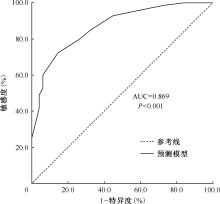
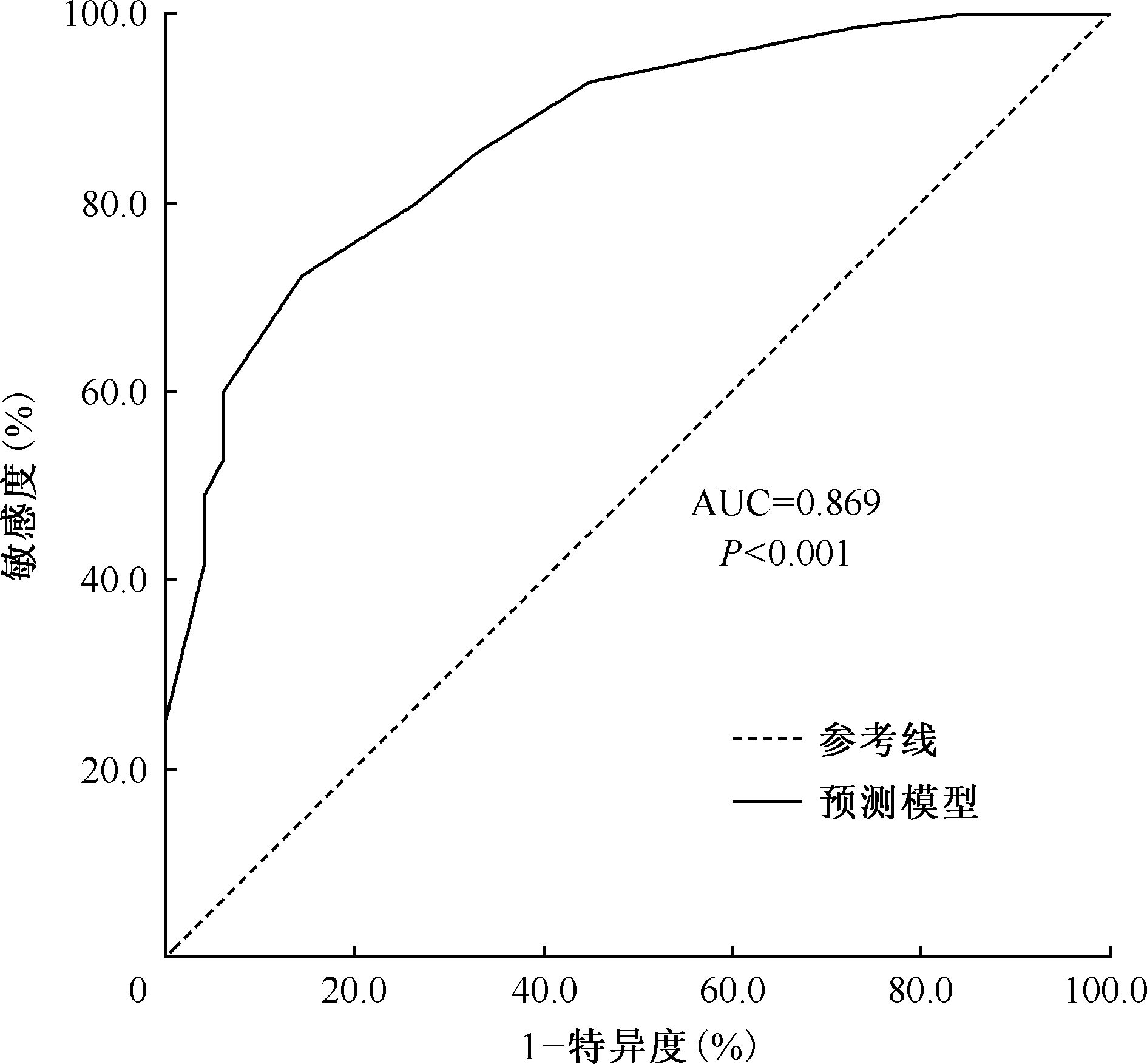
| [1] | 屈燕, 李涛, 马文斌, 等. 世界卫生组织《2025年全球结核病报告》解读[J]. 结核与肺部疾病杂志, 2025, 6(6): 613-623. doi:10.19983/j.issn.2096-8493.20250178. |
| [2] |
Khan F Y. Review of literature on disseminated tuberculosis with emphasis on the focused diagnostic workup[J]. J Family Community Med, 2019, 26(2): 83-91. doi:10.4103/jfcm.JFCM_106_18.
pmid: 31143078 |
| [3] |
Meira L, Chaves C, Araújo D, et al. Predictors and outcomes of disseminated tuberculosis in an intermediate burden setting[J]. Pulmonology, 2019, 25(6): 320-327. doi:10.1016/j.pulmoe.2018.11.001.
pmid: 30819659 |
| [4] | Huang W, Fei Z, Yan B, et al. Risk Factors for Disseminated Tuberculosis and Associated Survival in Adults Without Human Immunodeficiency Virus[J]. Open Forum Infect Dis, 2024, 12(1): ofae739. doi:10.1093/ofid/ofae739. |
| [5] |
Abuabat F, Badri M, Abuabat S, et al. Disseminated tuberculosis: Clinical presentation, diagnosis, and outcomes in a tertiary-care hospital in Saudi Arabia[J]. Int J Mycobacteriol, 2023, 12(4): 407-411. doi:10.4103/ijmy.ijmy_141_23.
pmid: 38149535 |
| [6] | 中华人民共和国国家卫生和计划生育委员会. WS 288—2017 肺结核诊断[J]. 结核与肺部疾病杂志, 2024, 5(4): 376-378. doi:10.19983/j.issn.2096-8493.2024022. |
| [7] | 中华医学会结核病学分会重症专业委员会. 结核病重症加强治疗病房建设与管理专家共识(2018)[J]. 中华结核和呼吸杂志, 2018, 41 (1): 19-24. doi:10.3760/cma.j.issn.1001-0939.2018.01.007. |
| [8] |
Sharma S K, Mohan A, Sharma A. Miliary tuberculosis: A new look at an old foe[J]. J Clin Tuberc Other Mycobact Dis, 2016, 3: 13-27. doi:10.1016/j.jctube.2016.03.003.
pmid: 31723681 |
| [9] | Huang Y, Long R, Ferrara G, et al. Refining the definition of miliary/disseminated tuberculosis in Canada[J]. Int J Infect Dis, 2024, 148: 107238. doi:10.1016/j.ijid.2024.107238. |
| [10] | Mert A, Arslan F, Kuyucu T, et al. Miliary tuberculosis: Epidemiologicaland clinical analysis of large-case series from moderate to low tuberculosis endemic Country[J]. Medicine (Baltimore), 2017, 96(5): e5875. doi:10.1097/MD.0000000000005875. |
| [11] | Thomas L, Chacko B, Jupudi S, et al. Clinical Profile and Outcome of Critically Ill Patients with Tuberculosis[J]. Indian J Crit Care Med, 2021, 25 (1): 21-28. doi:10.5005/jp-journals-10071-23503. |
| [12] | Ketema D B, Alene M, Assemie M A, et al. Risk factors for mortality among drug-resistant tuberculosis patients registered for drug-resistant treatment in Amhara region, Ethiopia: a historical cohort study[J]. Arch Public Health, 2020, 78: 69. doi:10.1186/s13690-020-00448-5. |
| [13] |
Nicholson T J, Hoddinott G, Seddon J A, et al. A systematic review of risk factors for mortality among tuberculosis patients in South Africa[J]. Syst Rev, 2023, 12 (1): 23. doi:10.1186/s13643-023-02175-8.
pmid: 36814335 |
| [14] | 裴飞, 吴健锋. 重症肺炎与炎症风暴:共识与争议[J]. 中国实用内科杂志, 2022, 42(3): 182-185. doi:10.19538/j.nk2022030102. |
| [15] | Li Y, Fang M, Li D, et al. Association of gut microbiota with critical pneumonia: A two-sample Mendelian randomization study[J]. Medicine (Baltimore), 2024, 103(42): e39677. doi:10.1097/MD.0000000000039677. |
| [16] | Zhang W, Zhu J. Development and Validation of a Nomogram to Predict Multidrug-Resistant Organism Infection in Severe Pneumonia: A Retrospective Cohort Study[J]. Int J Gen Med, 2026, 19: 575149. doi:10.2147/IJGM.S575149. |
| [17] | Simmons N, Olsen M A, Buss J, et al. Missed Opportunities in the Diagnosis of Tuberculosis Meningitis[J]. Open Forum Infect Dis. 2023, 10(2): ofad050. doi:10.1093/ofid/ofad050. |
| [18] | Font M D, Thyagarajan B, Khanna A K. Sepsis and Septic Shock-Basics of diagnosis, pathophysiology and clinical decision making[J]. Med Clin North Am, 2020, 104(4): 573-585. doi:10.1016/j.mcna.2020.02.011. |
| [19] | Unar A, Bertolino L, Patauner F, et al. Pathophysiology of Disseminated Intravascular Coagulation in Sepsis: A Clinically Focused Overview[J]. Cells, 2023, 12(17): 2120. doi:10.3390/cells12172120. |
| [20] | 陈佳欣, 徐祖辉, 徐慧兰, 等. 湖南省肺结核患者抗结核治疗期间死亡情况及其影响因素[J]. 中南大学学报(医学版), 2024, 49(10): 1663-1670. doi:10.11817/j.issn.1672-7347.2024.240344. |
| [21] |
Wang Y, Shang X, Wang L, et al. Clinical characteristics and chest computed tomography findings related to the infectivity of pulmonary tuberculosis[J]. BMC Infect Dis, 2021, 21(1): 1197. doi:10.1186/s12879-021-06901-2.
pmid: 34837990 |
| [22] | Yu S, Gao Y, Lu J, et al. Clinical profiles and related factors in tuberculosis patients with positive sputum smear mycobacterium tuberculosis tests[J]. Sci Rep, 2024, 14(1): 20376. doi:10.1038/s41598-024-71403-5. |
| [23] | Koo H K, Min J, Kim H W, et al. Prediction of treatment failure and compliance in patients with tuberculosis[J]. BMC Infect Dis, 2020, 20(1): 622. doi:10.1186/s12879-020-05350-7. |
| [24] | Khor L A, A Wahid U, Ling L L, et al. Prevalence and associated factors of delayed sputum smear conversion in patients treated for smear positive pulmonary tuberculosis: A retrospective follow up study in Sabah, Malaysia[J]. PLoS One, 2023, 18(3): e0282733. doi:10.1371/journal.pone.0282733. |
| [25] | World Health Organization. WHO consolidated guidelines on tuberculosis. Module 4: Treatment and care[M]. Geneva: World Health Organization, 2025. |
| [26] |
Guo J, Liu Z D, Feng Y P, et al. Assessment of Effective Anti-TB Regimens and Adverse Outcomes Related Risk Factors in the Elderly and Senile-Aged TB Patients[J]. Infect Drug Resist, 2023, 16: 3903-3915. doi:10.2147/IDR.S414918.
pmid: 37361933 |
| [27] | Chen R T, Liu C Y, Lin S Y, et al. The prevalence, clinical reasoning and impact of non-standard anti-tuberculosis regimens at the initial prescription[J]. Sci Rep, 2024, 14(1): 5631. doi:10.1038/s41598-024-55273-5. |
| [28] | 中华医学会结核病学分会. 重症肺结核诊断和治疗专家共识[J]. 中华结核和呼吸杂志, 2025, 48(12): 1127-1143. doi:10.3760/cma.j.cn112147-20250722-00429. |
| [29] | 侯可可, 李桃, 何江林, 等. 基于重症监护治疗下的重症肺结核死亡风险预测模型[J]. 中国热带医学, 2025, 25(6): 706-711,749. doi:10.13604/j.cnki.46-1064/r.2025.06.06. |
| [30] | Yuan Q, Li W, Yang K, et al. Predictive mortality of the prognostic nutritional index combined with APACHE Ⅱ score for critically ill tuberculosis patients[J]. Am J Trop Med Hyg, 2024, 111(5): 1027-1033. doi:10.4269/ajtmh.23-0661. |
| [1] | Guo Xiaowen, Jiao Tianyu, Sun Li, Ni Conghui, Wang Zilin, Wang Hao. Multi-center study on CE-T1WI radiomics-based machine learning model in differentiating tuberculous spondylitis from brucella spondylitis [J]. Chinese Journal of Antituberculosis, 2026, 48(8): 1184-1191. |
| [2] | Lyu Yongyun, Li Xiaoqin, Wu Mengtai, Zhou Min, Tian Nan, Shen Ling. Study on hospitalization cost and its influencing factors of pulmonary tuberculosis under the diagnosis-related group payment model [J]. Chinese Journal of Antituberculosis, 2026, 48(8): 1205-1213. |
| [3] | Yang Yueqi, Fu Linlin, He Lanfang, Cao Yuanlin, Yu Sihan, Zhang Yingfang, Xia Tongxia. Research progress on influencing factors and management strategies of medical delay in patients with spinal tuberculosis [J]. Chinese Journal of Antituberculosis, 2026, 48(8): 1226-1230. |
| [4] | Sun Danyuchen, Liu Yuhong. Pharmacotherapy of rifampicin-resistant/multidrug-resistant tuberculosis: advances and prospects in health economic research [J]. Chinese Journal of Antituberculosis, 2026, 48(8): 1231-1230. |
| [5] | Gao Qian. Rational return to non-sputum screening for tuberculosis: inherent limitations and reconsideration of the position of tongue swabs [J]. Chinese Journal of Antituberculosis, 2026, 48(8): 1120-1123. |
| [6] | Liao Wenping, Zhang Liyi, Lyu Juan, Xin Yu, Su Qian, Zhang Wen. Association between magnitude of tuberculin skin test reactions and risk of pulmonary tuberculosis among senior high school students [J]. Chinese Journal of Antituberculosis, 2026, 48(8): 1124-1129. |
| [7] | Liu Zisen, Zhao Yaqi, Zhang Bin, Xin Henan, Du Jiang, Feng Boxuan, He Yijun, Li Zihan, Yu Yilin, Wang Dakuan, Yan Jiaoxia, Gao Lei, Jin Qi, Duan Weitao, Cao Xuefang. Analysis of re-screening for latent tuberculosis infection in 2025 and related factors affecting infection status among rural doctors in Zhongmu County, Henan Province, based on 2017 screening [J]. Chinese Journal of Antituberculosis, 2026, 48(8): 1139-1147. |
| [8] | Li Xinda, Hou Zhili, Ouyang Bing, Du Yadong, Guan Liying, Yu Hongmei, Zhang Haiqin, Xie Yongjie, Tang Peijun, Xiao Yu, Zhang Ying, Lu Yu. Evaluation of safety and efficacy of anti-tuberculosis fixed-dose combination in patients with drug-susceptible pulmonary tuberculosis [J]. Chinese Journal of Antituberculosis, 2026, 48(8): 1158-1162. |
| [9] | Qi Yunfeng, Wang Xueyu, Kang Wanli, Nie Wenjuan, Wang Yiwen. The application value of tongue swab nucleic acid testing in the diagnosis of suspected tuberculosis [J]. Chinese Journal of Antituberculosis, 2026, 48(8): 1163-1169. |
| [10] | Zeng Lina, Li Wensi, Lu Hailin, Wang Wenfei, Chen Xinchun, Deng Guofang, Xie Shuixiang. Advances in Mycobacterium tuberculosis regulation of host lipid metabolism reprogramming [J]. Chinese Journal of Antituberculosis, 2026, 48(8): 1214-1219. |
| [11] | Standardization Professional Branch of Chinese Antituberculosis Association, Tuberculosis Infect Control Branch of Chinese Antituberculosis Association, Editorial Board of Chinese Journal of Antituberculosis. Guidelines for the application of tuberculin skin test [J]. Chinese Journal of Antituberculosis, 2026, 48(8): 1083-1095. |
| [12] | Wang Xiaomin, Xu Peng, Chen Zhenyan, Long Yujiao, Wang Jin, Liu Han, Gao Wenying, Fang Mutong. Interpretation of the Guidelines for the prevention and management of mother-to-child transmission of tuberculosis [J]. Chinese Journal of Antituberculosis, 2026, 48(8): 1113-1119. |
| [13] | Guo Jinlong, Min Xuhong, Song Biao, Li Yuan, Wang Shanghu, Chen Wu. Imaging feature analysis of pseudo-pulmonary embolism on dual-phase computed tomography angiography in pulmonary tuberculosis patients with bronchial-pulmonary shunts [J]. Chinese Journal of Antituberculosis, 2026, 48(8): 1192-1198. |
| [14] | Ding Guangzhao, Liu Rongmei. Cell-free RNA liquid biopsy for stratified diagnosis and dynamic monitoring of tuberculosis: research progress and translational challenges [J]. Chinese Journal of Antituberculosis, 2026, 48(8): 1220-1225. |
| [15] | Xia Hongli, Hua Jiao, Lu Jiankang. Investigation results and analysis of associated factors of tuberculosis infection and disease among school students in Xichang City, Sichuan Province, 2023 [J]. Chinese Journal of Antituberculosis, 2026, 48(8): 1130-1138. |
| Viewed | ||||||
|
Full text |
|
|||||
|
Abstract |
|
|||||
 京公网安备11010202007215号
Total visitors: Visitors of today: Now online:
京公网安备11010202007215号
Total visitors: Visitors of today: Now online:
 This work is licensed under Creative Commons Attribution 3.0 License.
