
Chinese Journal of Antituberculosis ›› 2026, Vol. 48 ›› Issue (3): 320-328.doi: 10.19982/j.issn.1000-6621.20250380
• Original Articles • Previous Articles Next Articles
Zhang Yujie1,2, Zhou Jie2, Wang Yun1( ), Fan Lin1,2()
Received:2025-09-19
Online:2026-03-10
Published:2026-03-06
Contact:
Wang Yun,Fan Lin
E-mail:441334899@qq.com;fanlinsj@163.com
Supported by:CLC Number:
Zhang Yujie, Zhou Jie, Wang Yun, Fan Lin. Evaluation of diagnostic value of novel blood-derived biomarkers for active pulmonary tuberculosis[J]. Chinese Journal of Antituberculosis, 2026, 48(3): 320-328. doi: 10.19982/j.issn.1000-6621.20250380
Add to citation manager EndNote|Ris|BibTeX
URL: https://www.zgflzz.cn/EN/10.19982/j.issn.1000-6621.20250380

| 基因(人) | 前引物 | 后引物 |
|---|---|---|
| β-actin | 5'-CCTGGACTTCGAGCAAGAGATGG-3' | 5'-CAGGAAGGAAGGCTGGAAGAGTG-3' |
| ETV5 | 5'-TCAGCAAGTCCCTTTTATGGTC-3' | 5'-GCTCTTCAGAATCGTGAGCCA-3' |
| CDKL3 | 5'-TTCATCACGAAAACCTGGTCAA-3' | 5'-AAGTCGCTTACTCTCTAGTCCAT-3' |
| AJUBA | 5'-ATGGGGAAGTCCTATCATCCAG-3' | 5'-TGGTAGTCGGTGACACAGTAT-3' |
| P4HA2 | 5'-CAAACTGGTGAAGCGGCTAAA-3' | 5'-GCACAGAGAGGTTGGCGATA-3' |
| CFB | 5'-GCGATCTGTGACAACGGAG-3' | 5'-GCTGTCTTCAAGGCGGTACT-3' |
| LIPT2 | 5'-CTGACGCCCGAGGAAACTG-3' | 5'-GTGGGATGTGATGTGCCTTC-3' |
| TUBB3 | 5'-GGCCAAGGGTCACTACACG-3' | 5'-GCAGTCGCAGTTTTCACACTC-3' |
| BEND7 | 5'-CTGGATCAAACTGCTGTACTTG-3' | 5'-GGGAAATTGGAGGTTGTTGTCTG-3' |
| DDAH1 | 5'-CAAAAGGACAAATCAACGAGGT-3' | 5'-TGTGCAGATTCACTAGACCCAA-3' |
| KLHL23 | 5'-ATGCCACGGAAAGGATATACCT-3' | 5'-CAACACCTGAGGACCAAACTAC-3' |
| MOK | 5'-CCGGAGTGTCTCCTCACTGAT-3' | 5'-CAGACTGGCGATCTCGTAGAA-3' |
| DOCK6 | 5'-GCTTCTGGAGACGAGAGGTC-3' | 5'-AGGTTCCTCAGGTCGAAGATG-3' |
| FKBP9 | 5'-CAGGTGTCTGATTTTGTGAGGT-3' | 5'-TTCATGCGATTGTGACTCGAA-3' |
| TG | 5'-AGGGAGAGTTTATGCCTGTCC-3' | 5'-CAATACCCAGATACCTCAGGGA-3' |
| ERRFI1 | 5'-GACCCACCGAAGATTAAGAAGG-3' | 5'-GGTCTAGGAGGTATGGGAACTCT-3' |
| TRIM22 | 5'CTGTCCTGTGTGTCAGACCAG-3' | 5'TGTGGGCTCATCTTGACCTCT-3' |
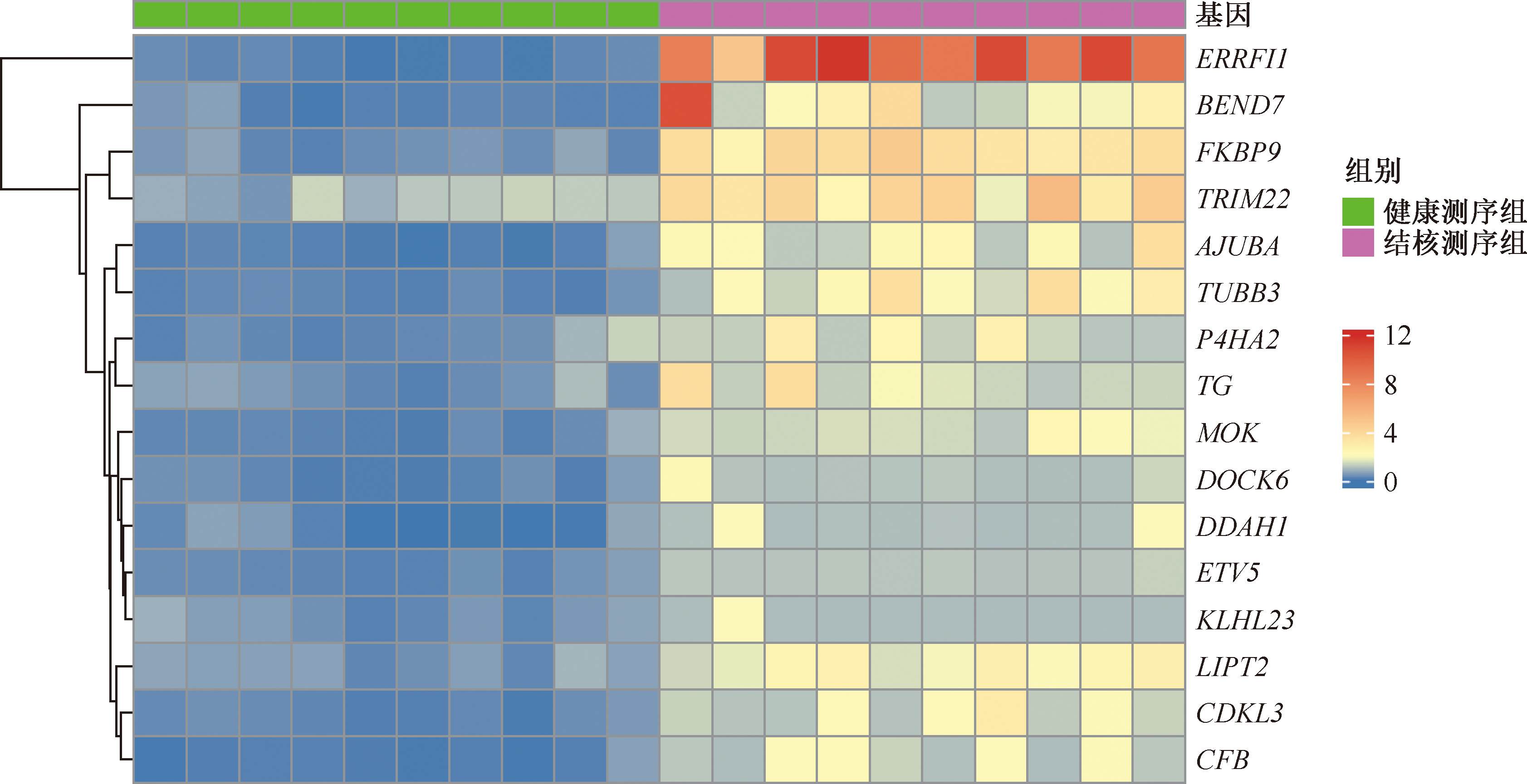
| 基因 | 健康验证组 (58例) | 结核验证组 | Z值 | P值 | |
|---|---|---|---|---|---|
| 病原学阳性(35例) | 病原学阴性(34例) | ||||
| ETV5 | 0.87(0.48,2.65) | 0.18(0.14,0.29) | 0.11(0.09,0.47) | 4.543 | 0.077 |
| CDKL3 | 0.94(0.50,3.09) | 0.22(0.17,0.38) | 0.36(0.13,0.70) | 3.938 | 0.008 |
| AJUBA | 0.40(0.13,1.53) | 0.22(0.14,0.35) | 0.44(0.29,0.90) | 0.379 | 0.557 |
| P4HA2 | 0.05(0.02,0.09) | 0.02(0.02,0.03) | 0.04(0.03,0.06) | 3.009 | 0.002 |
| CFB | 0.86(0.35,5.05) | 0.29(0.09,0.45) | 0.37(0.11,0.56) | 2.857 | 0.323 |
| LIPT2 | 0.37(0.15,1.03) | 0.39(0.32,0.57) | 0.40(0.29,0.77) | -0.729 | 0.647 |
| TUBB3 | 0.44(0.18,1.42) | 0.34(0.18,0.94) | 0.45(0.20,1.69) | 0.076 | 0.543 |
| DDAH1 | 0.30(0.09,1.68) | 0.07(0.05,0.10) | 0.08(0.05,0.13) | 3.304 | 0.327 |
| KLHL23 | 1.69(0.79,3.96) | 0.02(0.01,0.04) | 0.03(0.00,0.07) | 6.044 | <0.001 |
| BEND7 | 1.30(0.72,3.72) | 6.11(3.86,17.81) | 4.36(2.68,12.57) | -4.007 | 0.911 |
| MOK | 0.55(0.21,1.53) | 0.31(0.12,0.45) | 0.45(0.16,0.63) | 1.003 | 0.752 |
| DOCK6 | 0.19(0.10,0.35) | 0.07(0.05,0.13) | 0.08(0.06,0.12) | 3.498 | 0.044 |
| FKBP9 | 0.20(0.11,0.49) | 6.41(4.05,12.32) | 5.70(2.54,7.40) | -4.425 | 0.007 |
| TG | 0.27(0.15,0.51) | 0.23(0.13,0.36) | 0.26(0.15,0.40) | 1.065 | 0.248 |
| ERRGI1 | 0.44(0.17,1.37) | 5.70(3.05,13.46) | 5.57(2.95,7.38) | -6.044 | 0.002 |
| TRIM22 | 14.53(12.40,15.45) | 42.32(29.75,72.16) | 43.69(32.85,64.09) | -5.030 | <0.001 |
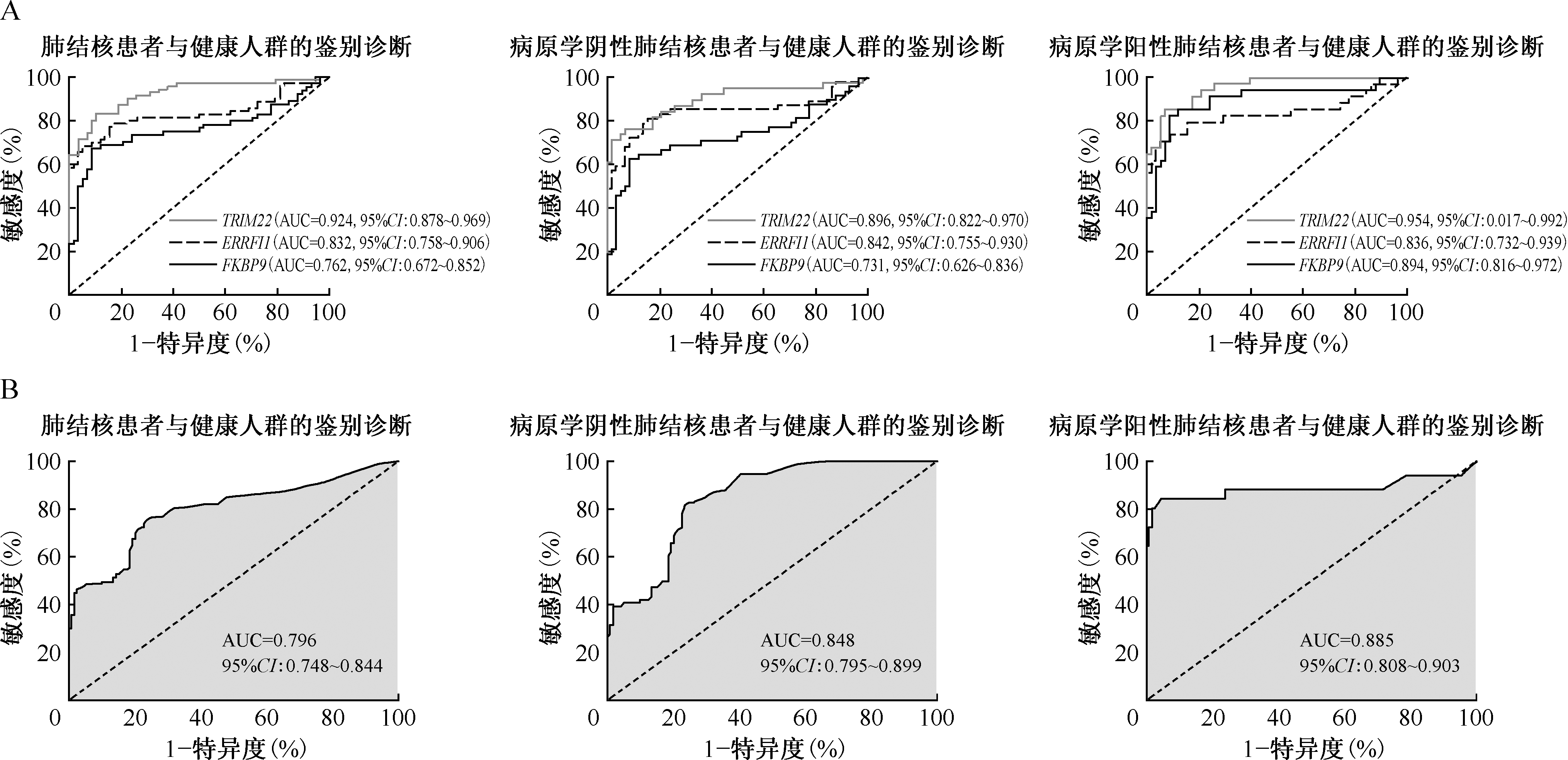
| 指标 | 最佳界值 | 敏感度(%) | 特异度(%) | AUC值 |
|---|---|---|---|---|
| TRIM22 | ||||
| 肺结核患者 | 22.60 | 80.00 | 91.38 | 0.956 |
| 病原学阴性 | 32.33 | 98.21 | 93.79 | 0.896 |
| 病原学阳性 | 32.63 | 97.21 | 93.79 | 0.958 |
| FKBP9 | ||||
| 肺结核患者 | 0.201 | 98.44 | 91.67 | 0.769 |
| 病原学阴性 | 0.206 | 95.83 | 86.02 | 0.731 |
| 病原学阳性 | 3.754 | 82.35 | 91.38 | 0.894 |
| ERRFI1 | ||||
| 肺结核患者 | 0.095 | 94.29 | 97.76 | 0.819 |
| 病原学阴性 | 1.184 | 85.11 | 75.86 | 0.842 |
| 病原学阳性 | 3.542 | 70.59 | 94.83 | 0.838 |
| 联合检测 | ||||
| 肺结核患者 | 0.545 | 88.24 | 76.11 | 0.796 |
| 病原学阴性 | 0.685 | 98.53 | 97.23 | 0.848 |
| 病原学阳性 | 0.005 | 80.39 | 98.23 | 0.885 |
| 基因 | Non-TB组 | TB(MTB阳性)组 | TB(MTB阴性)组 | Z值 | P值a | Z值 | P值b | Z值 | P值c |
|---|---|---|---|---|---|---|---|---|---|
| TRIM22 | 42.32(30.84,60.16) | 42.33(29.76,70.86) | 43.15(32.85,88.45) | 2.279 | 0.651 | 4.507 | 0.528 | 1.977 | 0.778 |
| FKBP9 | 8.85(3.46,12.42) | 5.77(3.84,12.15) | 5.70(2.54,7.40) | 1.826 | 0.349 | 3.362 | 0.058 | 1.841 | 0.085 |
| ERRFI1 | 0.86(0.23,4.46) | 6.41(4.05,12.32) | 5.32(2.89,7.47) | 1.784 | 0.001 | 2.152 | 0.005 | 1.672 | 0.095 |
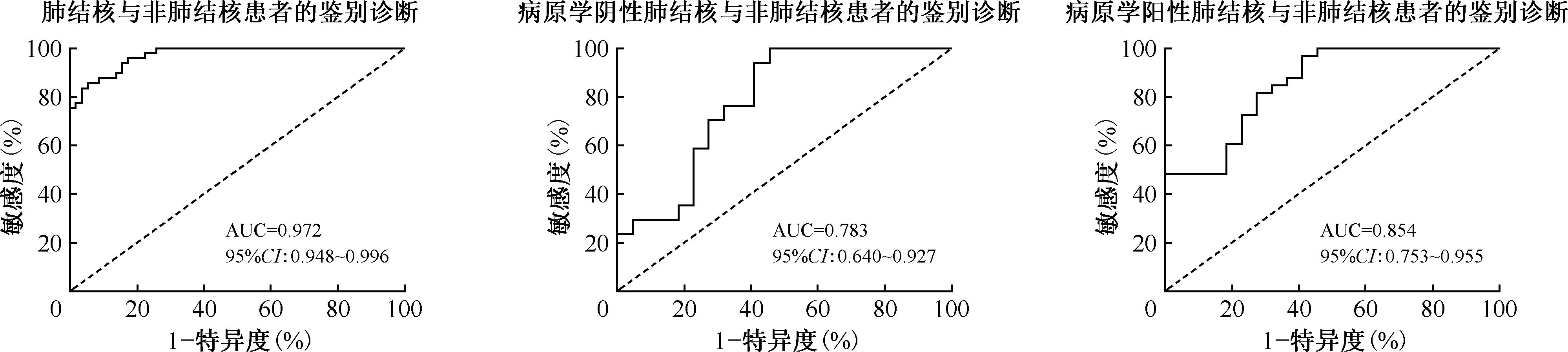
| [1] | Zumla A, George A, Sharma V, et al. WHO’s 2013 global report on tuberculosis: successes, threats, and opportunities. Lancet, 2013, 382(9907):1765-1767. doi:10.1016/S0140-6736(13)62078-4. |
| [2] | Hamada Y, Penn-Nicholson A, Krishnan S, et al. Are mRNA based transcriptomic signatures ready for diagnosing tuberculosis in the clinic? -A review of evidence and the technological landscape. EBioMedicine, 2022, 82:104174. doi:10.1016/j.ebiom.2022.104174. |
| [3] | Nogueira BMF, Krishnan S, Barreto-Duarte B, et al. Diagnostic biomarkers for active tuberculosis: progress and challenges. EMBO Mol Med, 2022, 14(12):e14088. doi:10.15252/emmm.202114088. |
| [4] | Bagcchi S. WHO’s Global Tuberculosis Report 2022. Lancet Microbe, 2023, 4(1):e20. doi:10.1016/S2666-5247(22)00359-7. |
| [5] |
MacLean E, Broger T, Yerlikaya S, et al. A systematic review of biomarkers to detect active tuberculosis. Nat Microbiol, 2019, 4(5):748-758. doi:10.1038/s41564-019-0380-2.
URL pmid: 30804546 |
| [6] |
Mendelsohn SC, Verhage S, Mulenga H, et al. Systematic review of diagnostic and prognostic host blood transcriptomic signatures of tuberculosis disease in people living with HIV. Gates Open Res, 2023, 7:27. doi:10.12688/gatesopenres.14327.2.
URL pmid: 37123047 |
| [7] | Duffy FJ, Thompson EG, Scriba TJ, et al. Multinomial modelling of TB/HIV co-infection yields a robust predictive signature and generates hypotheses about the HIV+TB+ disease state. PLoS One, 2019, 14(7):e0219322. doi:10.1371/journal.pone.0219322. |
| [8] | Mulenga H, Zauchenberger CZ, Bunyasi EW, et al. Performance of diagnostic and predictive host blood transcriptomic signatures for Tuberculosis disease: A systematic review and meta-analysis. PLoS One, 2020, 15(8):e0237574. doi:10.1371/journal.pone.0237574. |
| [9] | Nathavitharana RR, Garcia-Basteiro AL, Ruhwald M, et al. Reimagining the status quo: How close are we to rapid sputum-free tuberculosis diagnostics for all. EBioMedicine, 2022, 78:103939. doi:10.1016/j.ebiom.2022.103939. |
| [10] | 中华人民共和国国家卫生和计划生育委员会. WS 288—2017肺结核诊断. 结核与肺部疾病杂志, 2024, 5(4): 376-378. doi:10.19983/j.issn.2096-8493.2024022. |
| [11] | Bashir S, Ali S, Yerlikaya S, et al. Cost-effectiveness of diagnostic technologies for mycobacterium tuberculosis infection in India and Brazil. PLOS Glob Public Health, 2024, 4(11):e0003638. doi:10.1371/journal.pgph.0003638. |
| [12] |
Sweeney TE, Braviak L, Tato CM, et al. Genome-wide expression for diagnosis of pulmonary tuberculosis: a multicohort analysis. Lancet Respir Med, 2016, 4(3):213-224. doi:10.1016/S2213-2600(16)00048-5.
URL pmid: 26907218 |
| [13] |
Zak DE, Penn-Nicholson A, Scriba TJ, et al. A blood RNA signature for tuberculosis disease risk: a prospective cohort study. Lancet, 2016, 387(10035):2312-2322. doi:10.1016/S0140-6736(15)01316-1.
URL pmid: 27017310 |
| [14] |
Chegou NN, Sutherland JS, Malherbe S, et al. Diagnostic performance of a seven-marker serum protein biosignature for the diagnosis of active TB disease in African primary healthcare clinic attendees with signs and symptoms suggestive of TB. Thorax, 2016, 71(9):785-794. doi:10.1136/thoraxjnl-2015-207999.
URL pmid: 27146200 |
| [15] | Gaeddert M, Glaser K, Chendi BH, et al. Host blood protein biomarkers to screen for tuberculosis disease: a systematic review and meta-analysis. J Clin Microbiol, 2024, 62(11):e0078624. doi:10.1128/jcm.00786-24. |
| [16] | Silwal P, Paik S, Kim JK, et al. Regulatory Mechanisms of Autophagy-Targeted Antimicrobial Therapeutics Against Mycobacterial Infection. Front Cell Infect Microbiol, 2021, 11:633360. doi:10.3389/fcimb.2021.633360. |
| [17] | Son SH, Lee J, Cho SN, et al. Herp regulates intracellular survival of Mycobacterium tuberculosis H37Ra in macrophages by regulating reactive oxygen species-mediated autophagy. mBio, 2023, 14(5):e0153523. doi:10.1128/mbio.01535-23. |
| [18] | Lou J, Wang Y, Zheng X, et al. TRIM22 regulates macrophage autophagy and enhances Mycobacterium tuberculosis clearance by targeting the nuclear factor-multiplicity κB/beclin 1 pathway. J Cell Biochem, 2018, 119(11):8971-8980. doi:10.1002/jcb.27153. |
| [19] |
Xu H, Liu P, Yan Y, et al. FKBP9 promotes the malignant behavior of glioblastoma cells and confers resistance to endoplasmic reticulum stress inducers. J Exp Clin Cancer Res, 2020, 39(1):44. doi:10.1186/s13046-020-1541-0.
URL pmid: 32111229 |
| [20] | Seimon TA, Kim MJ, Blumenthal A, et al. Induction of ER stress in macrophages of tuberculosis granulomas. PLoS One, 2010, 5(9):e12772. doi:10.1371/journal.pone.0012772. |
| [21] |
Ferby I, Reschke M, Kudlacek O, et al. Mig6 is a negative regulator of EGF receptor-mediated skin morphogenesis and tumor formation. Nat Med, 2006, 12(5):568-573. doi:10.1038/nm1401.
URL pmid: 16648858 |
| [22] |
Anastasi S, Baietti MF, Frosi Y, et al. The evolutionarily conserved EBR module of RALT/MIG6 mediates suppression of the EGFR catalytic activity. Oncogene, 2007, 26(57):7833-7846. doi:10.1038/sj.onc.1210590.
URL pmid: 17599051 |
| [23] | Elkington PT, D’Armiento JM, Friedland JS. Tuberculosis immunopathology: the neglected role of extracellular matrix destruction. Sci Transl Med, 2011, 3(71):71ps6. doi:10.1126/scitranslmed.3001847. |
| [24] | Vicenzi E, Poli G. The interferon-stimulated gene TRIM22: A double-edged sword in HIV-1 infection. Cytokine Growth Factor Rev, 2018, 40:40-47. doi:10.1016/j.cytogfr.2018.02.001. |
| [25] | Yang Y, Hao X, Zhang J, et al. The E3 ligase TRIM22 functions as a tumor suppressor in breast cancer by targeting CCS for proteasomal degradation to inhibit STAT3 signaling. Cancer Lett, 2024, 600:217157. doi:10.1016/j.canlet.2024.217157. |
| [26] | Ning L, Huo Q, Xie N. Comprehensive Analysis of the Expression and Prognosis for Tripartite Motif-Containing Genes in Breast Cancer. Front Genet, 2022, 13:876325. doi:10.3389/fgene.2022.876325. |
| [27] |
Tang X, Xu P, Wang B, et al. Identification of a Specific Gene Module for Predicting Prognosis in Glioblastoma Patients. Front Oncol, 2019, 9:812. doi:10.3389/fonc.2019.00812.
URL pmid: 31508371 |
| [28] | Carranza C, Pedraza-Sanchez S, de Oyarzabal-Mendez E, et al. Diagnosis for Latent Tuberculosis Infection: New Alternatives. Front Immunol, 2020, 11:2006. doi:10.3389/fimmu.2020.02006. |
| [29] | Zhao Q, Pan P, Mo L, et al. The ELF3-TRIM22-MAVS signaling axis regulates type I interferon and antiviral responses. J Virol, 2025, 99(5):e0000425. doi:10.1128/jvi.00004-25. |
| [30] | Li S, Xia W, Sun B, et al. The stability of FKBP9 maintained by BiP is crucial for glioma progression. Genes Dis, 2023, 11(6):101123. doi:10.1016/j.gendis.2023.101123. |
| [31] | Zhao H, Mao H. ERRFI 1 exacerbates hepatic ischemia reperfusion injury by promoting hepatocyte apoptosis and ferroptosis in a GRB2-dependent manner. Mol Med, 2024, 30(1):82. doi:10.1186/s10020-024-00837-4. |
| [1] | Hou Tianyong, Ren Liping, Li Jingying, Wang Jianwei, Fan Shuhui, Wu Yuanming, Wang Quanhong, Ding Weimin. Clinical application value of combined molecular biology testing with bronchoalveolar lavage fluid (BALF) for diagnosing smear-negative pulmonary tuberculosis [J]. Chinese Journal of Antituberculosis, 2026, 48(3): 329-334. |
| [2] | Ji Yuanfei, Yu Xia, Wang Jue, Sun Mengyan, He Wei, Lyu Yan, Hou Dailun, Li Chenghai. The CT imaging features of Mycobacterium avium-intracellulare pneumonia and the diagnostic evaluation of in non-tuberculous mycobacterium pneumonia [J]. Chinese Journal of Antituberculosis, 2026, 48(2): 256-263. |
| [3] | Wang Na, Wan Bin, Zhao Xia, He Ting, Zhang Miao, Yao Rong, Yang Xiaoyi. Meta-analysis of diagnostic delay rate among Chinese students patients with pulmonary tuberculosis [J]. Chinese Journal of Antituberculosis, 2026, 48(1): 73-83. |
| [4] | Jiangxi Chest Hospital/Jiangxi Provincial Key Laboratory of Tuberculosis , Guangzhou National Laboratory , Chinese Antituberculosis Association . Expert consensus on the application of host biomarkers for tuberculosis [J]. Chinese Journal of Antituberculosis, 2026, 48(1): 9-20. |
| [5] | Multidisciplinary Diagnosis and Treatment Branch of Chinese Antituberculosis Association , National Clinical Research Center for Infectious Disease/Shenzhen Third People’s Hospital , Beijing Chao-Yang Hospital, Capital Medical University , Guangdong Lung Cancer Institute . Expert consensus on the diagnosis and treatment of coexistent pulmonary tuberculosis and lung cancer [J]. Chinese Journal of Antituberculosis, 2025, 47(9): 1105-1125. |
| [6] | National Clinical Research Center for Infectious Diseases , Peking University Shenzhen Hospital , Shenzhen Key Laboratory of Immunity and Inflammatory Diseases , The Third People’s Hospital of Shenzhen , Expert Consensus Group on the Etiology and Diagnosis of Erythema Nodosum . Expert consensus on the etiology and diagnosis of erythema nodosum (2025 version) [J]. Chinese Journal of Antituberculosis, 2025, 47(9): 1126-1134. |
| [7] | Fan Ruifang, Dai Xiaowei, Yang Xinyu, Chen Shuangshuang, Chen Hao, Yu Lan, Zhao Yanfeng, Li Chuanyou, Wang Nenhan. A study on the identification of Mycobacterium species using fluorescent PCR probe melting curve technique and DNA microarray chip technique [J]. Chinese Journal of Antituberculosis, 2025, 47(8): 1031-1037. |
| [8] | Jiao Jiahuan, Sun Changfeng, Wu Gang, Huang Fuli, Sheng Yunjian. The value of machine learning algorithm-based diagnostic models in tuberculous pleural effusion [J]. Chinese Journal of Antituberculosis, 2025, 47(8): 1053-1061. |
| [9] | Zhu Qingdong, Zhao Chunyan, Xie Zhouhua, Song Shulin, Song Chang. Research progress on the application of artificial intelligence-based CT radiomics in the diagnosis and treatment response monitoring of tuberculosis [J]. Chinese Journal of Antituberculosis, 2025, 47(8): 1068-1076. |
| [10] | Zhu Qingyu, Liu Jiayun, Long Yin. Advances in the application of extracellular vesicles and the diagnosis of tuberculosis [J]. Chinese Journal of Antituberculosis, 2025, 47(8): 1077-1084. |
| [11] | Nontuberculous Mycobacterial Diseases Branch of Chinese Antituberculosis Association. Expert consensus on molecular biology diagnosis of nontuberculous mycobacteria diseases [J]. Chinese Journal of Antituberculosis, 2025, 47(8): 961-975. |
| [12] | Xia Hui, Zhao Yanlin. The potentials and challenges of using tongue swab for Mycobacterium tuberculosis complex detection through nucleic acid amplification tests in the diagnosis and screening of pulmonary tuberculosis [J]. Chinese Journal of Antituberculosis, 2025, 47(8): 976-980. |
| [13] | Liu Yiping, Lin Youfei, Chen Xiaohong, Pan Jianguang. A case of pulmonary Castleman disease prone to misdiagnosis: a literature review [J]. Chinese Journal of Antituberculosis, 2025, 47(7): 921-929. |
| [14] | Ou Xichao, Teng Chong, Song Yuanyuan, Zheng Yang, Chen Lei, Zhu Jun, Wang Jianguo, Pan Zhaobao, Kang Haitao, Wang Yan, Yao Hongyan, Huang Fei. Multicenter evaluation study on the application of a novel PCR fluorescence probe technology for early diagnosis of tuberculosis [J]. Chinese Journal of Antituberculosis, 2025, 47(6): 687-693. |
| [15] | Xie Zhongyao, Zhang Muli, Cao Tingming, Cao Yang, Sun Zhaogang. Research on the diagnostic value of specific ligand protein SMAD2-based detection method for active tuberculosis [J]. Chinese Journal of Antituberculosis, 2025, 47(6): 694-700. |
| Viewed | ||||||
|
Full text |
|
|||||
|
Abstract |
|
|||||
 京公网安备11010202007215号
Total visitors: Visitors of today: Now online:
京公网安备11010202007215号
Total visitors: Visitors of today: Now online:
 This work is licensed under Creative Commons Attribution 3.0 License.
