
Chinese Journal of Antituberculosis ›› 2026, Vol. 48 ›› Issue (6): 821-829.doi: 10.19982/j.issn.1000-6621.20250454
• Original Articles • Previous Articles Next Articles
Zhang Yaying, Wang Senlu, Guliziba Kuerbanjiang, Abulikemu Aili, Liang Chen, Yuan Shuanglong, Li Caihong, Cao Mingqin( )
)
Received:2025-11-17
Online:2026-06-10
Published:2026-05-25
Contact:
Cao Mingqin
E-mail:cmq66@126.com
Supported by:CLC Number:
Zhang Yaying, Wang Senlu, Guliziba Kuerbanjiang, Abulikemu Aili, Liang Chen, Yuan Shuanglong, Li Caihong, Cao Mingqin. Analysis of influencing factors and pathways on psychological burden associated with pulmonary tuberculosis treatment in Southern Xinjiang Region of the Xinjiang Uygur Autonomous Region[J]. Chinese Journal of Antituberculosis, 2026, 48(6): 821-829. doi: 10.19982/j.issn.1000-6621.20250454
Add to citation manager EndNote|Ris|BibTeX
URL: https://www.zgflzz.cn/EN/10.19982/j.issn.1000-6621.20250454

| 模型 | AIC | BIC | Entropy | LMRT | BLRT | 类别比例 |
|---|---|---|---|---|---|---|
| 1 | 65000.89 | 65159.95 | 1.00 | - | - | 1 |
| 2 | 59141.10 | 59384.98 | 1.00 | <0.001 | <0.01 | 0.06/0.94 |
| 3 | 56764.67 | 57093.38 | 0.98 | <0.001 | <0.01 | 0.02/0.83/0.15 |
| 4 | 55246.35 | 55659.89 | 0.98 | <0.001 | <0.01 | 0.01/0.80/0.14/0.05 |
| 5 | 54547.10 | 55045.47 | 0.98 | <0.001 | <0.01 | 0.01/0.79/0.02/0.05/0.13 |
| 6 | 54579.12 | 55162.32 | 0.92 | <0.001 | 1.00 | 0.01/0.76/0.02/0.05/0.03/0.13 |
| 变量 | 合计 (1483例) | 高心理负担 [例(构成比,%)] | 低心理负担 [例(构成比,%)] | χ2值 | P值 | |||||
|---|---|---|---|---|---|---|---|---|---|---|
| 性别 | 1.240 | 0.226 | ||||||||
| 男性 | 713 | 216(30.3) | 497(69.7) | |||||||
| 女性 | 770 | 254(33.0) | 516(67.0) | |||||||
| 年龄组(岁) | 2.236 | 0.327 | ||||||||
| ≤45 | 288 | 89(30.9) | 199(69.1) | |||||||
| 46~64 | 570 | 164(28.8) | 406(71.2) | |||||||
| ≥65 | 625 | 211(33.8) | 414(66.2) | |||||||
| 文化程度 | 10.493 | 0.005 | ||||||||
| 初中及以下 | 1303 | 394(30.2) | 909(69.8) | |||||||
| 高中及中专 | 116 | 49(42.2) | 67(57.8) | |||||||
| 大专及以上 | 64 | 27(42.2) | 37(57.8) | |||||||
| 人均月收入(元) | 1.054 | 0.590 | ||||||||
| <1000 | 616 | 204(33.1) | 412(66.9) | |||||||
| 1000~ | 637 | 197(30.9) | 440(69.1) | |||||||
| ≥3000 | 230 | 69(30.0) | 161(70.0) | |||||||
| 婚姻状况 | 8.690 | 0.034 | ||||||||
| 已婚 | 1009 | 301(29.8) | 708(70.2) | |||||||
| 未婚 | 101 | 42(41.6) | 59(58.4) | |||||||
| 离婚 | 59 | 16(27.1) | 43(72.9) | |||||||
| 丧偶 | 314 | 111(35.4) | 203(64.6) | |||||||
| 医保类型 | 1.650 | 0.199 | ||||||||
| 城镇居民 | 1395 | 437(31.3) | 958(68.7) | |||||||
| 非城镇居民 | 88 | 33(37.5) | 55(62.5) | |||||||
| 疾病认知 | 108.504 | <0.001 | ||||||||
| 较好 | 1161 | 291(25.1) | 870(74.9) | |||||||
| 较差 | 322 | 179(55.6) | 143(44.4) | |||||||
| 服药依从性 | 85.178 | <0.001 | ||||||||
| 较好 | 1290 | 378(29.3) | 912(70.7) | |||||||
| 较差 | 193 | 92(47.7) | 101(52.3) | |||||||
| 家庭支持 | 74.159 | <0.001 | ||||||||
| 支持 | 707 | 147(20.8) | 560(79.2) | |||||||
| 不支持 | 776 | 323(41.6) | 453(58.4) | |||||||
| 满意度 | 106.078 | <0.001 | ||||||||
| 满意 | 1250 | 329(26.3) | 921(73.7) | |||||||
| 不满意 | 233 | 141(60.5) | 92(39.5) | |||||||
| 家庭功能 | 25.701 | <0.001 | ||||||||
| 良好 | 1414 | 429(30.3) | 985(69.7) | |||||||
| 障碍 | 69 | 41(59.4) | 28(40.6) | |||||||
| 参数 | 估计值 | 标准误 | χ2值 | P值 |
|---|---|---|---|---|
| 固定部分(截距)β0 | -0.967 | 0.275 | -3.516 | <0.001 |
| 水平2(县区) | 0.556 | 0.746 | 119.540 | <0.001 |
| 变量 | 赋值情况 |
|---|---|
| 因变量 | |
| 心理负担 | 较低=0;较高=1 |
| 自变量 | |
| 文化程度 | 初中及以下=1;高中含中专=2;大专及以上=3 |
| 婚姻状况 | 已婚=1;未婚=2;离婚=3;丧偶=4 |
| 疾病认知 | 较好=0;较差=1 |
| 家庭功能 | 良好=0;障碍=1 |
| 家庭支持 | 支持=0;不支持=1 |
| 满意度 | 满意=0;不满意=1 |
| 服药依从性 | 较好=0;较差=1 |
| 参数 | 估计值 | 标准误 | χ2值 | P值 | OR值 | 95%CI值 | |
|---|---|---|---|---|---|---|---|
| 截距 | -2.661 | 0.346 | -7.685 | <0.001 | 0.070 | 0.035~0.137 | |
| 文化程度初中及以下 | 0.516 | 0.132 | 3.903 | <0.001 | 1.675 | 1.293~2.169 | |
| 疾病认知较差 | 0.85 | 0.153 | 5.544 | <0.001 | 2.340 | 1.733~3.159 | |
| 服药依从性较差 | 0.863 | 0.188 | 4.589 | <0.001 | 2.370 | 1.639~3.426 | |
| 家庭功能障碍 | 0.528 | 0.292 | 1.806 | 0.041 | 1.695 | 1.157~3.003 | |
| 家庭不支持 | 0.845 | 0.14 | 6.052 | <0.001 | 2.329 | 1.771~3.062 | |
| 不满意 | 1.134 | 0.169 | 6.696 | <0.001 | 3.109 | 2.229~4.336 | |
| 随机效应参数 | 0.533 | 0.730 | 91.874 | <0.001 | - | - | |
| 组内相关系数(ICC) | 0.145 | ||||||
| 路径关系 | 非标准化回归系数 | 标准化回归系数 | s | CR值 | P值 |
|---|---|---|---|---|---|
| 心理负担←家庭支持 | -0.091 | -0.096 | 0.028 | 3.277 | 0.001 |
| 心理负担←家庭功能 | 0.316 | 0.120 | 0.073 | 4.312 | <0.001 |
| 心理负担←满意度 | 0.437 | 0.367 | 0.046 | 9.551 | <0.001 |
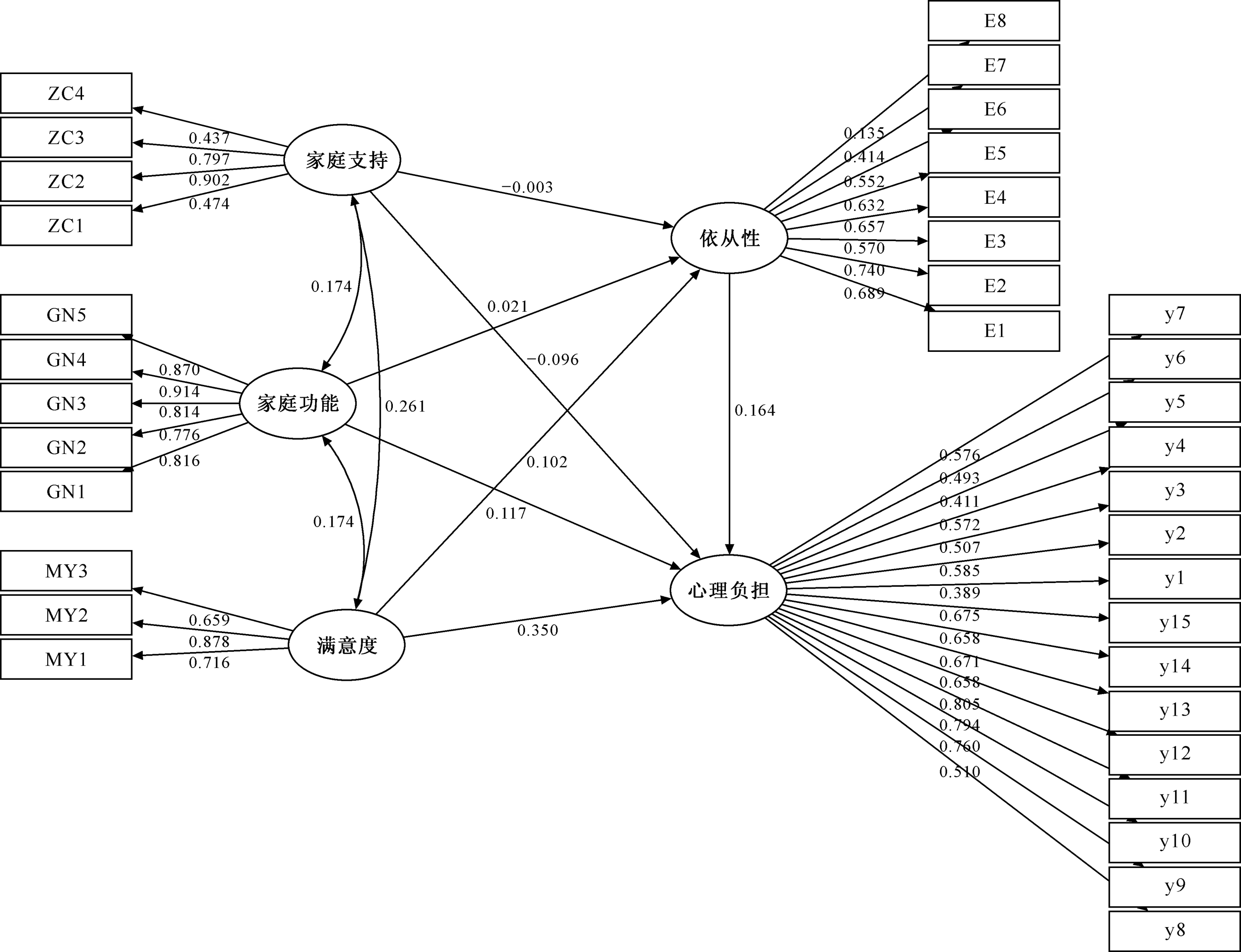
| 路径关系 | 非标准化回归系数 | 标准化回归系数 | SE | CR值 | P值 |
|---|---|---|---|---|---|
| 家庭支持→依从性 | -0.001 | -0.003 | 0.005 | -0.093 | 0.926 |
| 家庭功能→依从性 | 0.010 | 0.021 | 0.014 | 0.676 | 0.499 |
| 满意度→依从性 | 0.022 | 0.102 | 0.007 | 3.061 | 0.002 |
| 依从性→心理负担 | 0.921 | 0.164 | 0.167 | 5.515 | <0.001 |
| 家庭支持→心理负担 | -0.090 | -0.096 | 0.027 | 3.296 | 0.001 |
| 家庭功能→心理负担 | 0.308 | 0.117 | 0.072 | 4.259 | <0.001 |
| 满意度→心理负担 | 0.417 | 0.350 | 0.045 | 9.337 | <0.001 |
| 变量 | 直接效应 | 间接效应 | 总效应 |
|---|---|---|---|
| 服药依从性 | 0.164 | 0.000 | 0.164 |
| 家庭支持 | -0.096 | -0.001 | -0.097 |
| 家庭功能 | 0.117 | 0.003 | 0.120 |
| 满意度 | 0.350 | 0.017 | 0.367 |
| [1] | Lee H, Kim J, Kim J, et al. Review of the global burden of tuberculosis in 2023: Insights from the who global tuberculosis report 2024. Jugan Geongang Gwa Jilbyeong, 2025, 18(11 Suppl):55-69. doi:10.56786/PHWR.2025.18.11suppl.5. |
| [2] | Nasir A Hassan, II, Ma’ruf A, et al. Coping efforts made: Psychological burden of people living with tuberculosis due to social stigma in society. A qualitative phenomenology study. PLoS One, 2024, 19(7): e0303331. doi:10.1371/journal.pone.0303331. |
| [3] | 陈晗, 古丽苏木汗·阿布来提, 陈卫星, 等. 新疆某医院结核病患者心理困扰现状及影响因素分析. 中国医药导报, 2022, 19(9): 59-62. doi:10.20047/j.issn1673-7210.2022.09.011. |
| [4] | Zhang Y, Wang X, Liu N, et al. Intervention effect of new tuberculosis control model on tuberculosis incidence in xinjiang. Infect Drug Resist, 2023, 16: 7485-7496. doi:10.2147/idr.S441899. |
| [5] | Bolarinwa OA. Sample size estimation for health and social science researchers: The principles and considerations for different study designs. Niger Postgrad Med J, 2020, 27(2): 67-75. doi:10.4103/npmj.npmj_19_20. |
| [6] | Tran VT, Harrington M, Montori VM, et al. Adaptation and validation of the treatment burden questionnaire (tbq) in english using an internet platform. BMC Med, 2014, 12: 109. doi:10.1186/1741-7015-12-109. |
| [7] | 余巧林, 雷丽梅, 万彬, 等. 结核病患者健康素养与结核病防治核心知识和社会支持的相关性. 中国防痨杂志, 2020, 42(11): 1227-1231. doi:10.3969/j.issn.1000-6621.2020.11.015. |
| [8] | Morisky DE, Ang A, Krousel-Wood M, et al. Predictive validity of a medication adherence measure in an outpatient setting. J Clin Hypertens (Greenwich), 2008, 10(5): 348-354. doi:10.1111/j.1751-7176.2008.07572.x. |
| [9] | 王洁, 莫永珍, 卞茸文. 中文版8条目morisky用药依从性问卷在2型糖尿病患者中应用的信效度评价. 中国糖尿病杂志, 2013, 21(12): 1101-1104. doi:10.3969/j.issn.1006-6187.2013.12.013. |
| [10] | Smilkstein G. The family apgar: A proposal for a family function test and its use by physicians. J Fam Pract, 1978, 6(6): 1231-1239. |
| [11] | 吕繁, 曾光, 刘松暖, 等. 家庭关怀度指数问卷测量脑血管病病人家庭功能的信度和效度研究. 中国公共卫生, 1999, 15(11): 987-988. |
| [12] | 李秀梅, 郑燕. 家庭功能评估工具研究进展. 全科护理, 2022, 20(20): 2765-2768. doi:10.12104/j.issn.1674-4748.2022.20.007. |
| [13] | 曹金秋, 薛秒, 向希, 等. 结核患者社会支持状况及其对自我效能的影响. 临床与病理杂志, 2020, 40(2): 411-416. doi:10.3978/j.issn.2095-6959.2020.02.025. |
| [14] | Liu S, Li G, Liu N, et al. The impact of patient satisfaction on patient loyalty with the mediating effect of patient trust. Inquiry, 2021, 58: 469580211007221. doi:10.1177/00469580211007221. |
| [15] | Pradhan A, Koirala P, Bhandari SS, et al. Internalized and perceived stigma and depression in pulmonary tuberculosis: Do they explain the relationship between drug sensitivity status and adherence?. Front Psychiatry, 2022, 13: 869647. doi:10.3389/fpsyt.2022.869647. |
| [16] | Chen X, Du L, Wu R, et al. The effects of family, society and national policy support on treatment adherence among newly diagnosed tuberculosis patients: A cross-sectional study. BMC Infect Dis, 2020, 20(1): 623. doi:10.1186/s12879-020-05354-3. |
| [17] | Agbeko CK, Mallah MA, He B, et al. Mental health status and its impact on tb treatment and its outcomes: A scoping literature review. Front Public Health, 2022, 10: 855515. doi:10.3389/fpubh.2022.855515. |
| [18] | 孟婷, 陈敬芳, 邓国防, 等. 结核病患者心理脆弱及焦虑抑郁状态相关研究进展. 结核与肺部疾病杂志, 2024, 5(6): 583-589. doi:10.19983/j.issn.2096-8493.2024131. |
| [19] | Murugan Y, Patel N, Kumar V, et al. Mental health impacts of multidrug-resistant tuberculosis in patients and household contacts: A mixed methods study. Cureus, 2024, 16(5): e60412. doi:10.7759/cureus.60412. |
| [20] | 应小燕. 结核病强化治疗期患者病耻感与心理弹性、社会支持、应对方式的相关性分析. 中外医学研究, 2024, 22(31): 152-155. doi:10.14033/j.cnki.cfmr.2024.31.038. |
| [21] | 范君, 汪清雅, 吴成果, 等. 重庆都市圈445例肺结核患者心理和社会支持状况调查. 中国防痨杂志, 2025, 47(8): 1007-1013. doi:10.19982/j.issn.1000-6621.20250113. |
| [22] | 包亮亮, 王新旗, 张燕, 等. 新疆维吾尔自治区南疆地区结核病防治工作实施现状的定性评价——基于扎根理论的质性访谈. 中国防痨杂志, 2024, 46(2):151-157. doi:10.19982/j.issn.1000-6621.20230288. |
| [23] | Loh SY, Zakaria R, Mohamad N. Knowledge, attitude, and stigma on tuberculosis and the associated factors for attitude among tuberculosis contacts in malaysia. Medeni Med J, 2023, 38(1): 45-53. doi:10.4274/MMJ.galenos.2023.14478. |
| [24] | 吴茜. 基于bcw理论服药干预对青年初治肺结核患者服药依从性的影响研究. 乌鲁木齐: 新疆医科大学, 2024. doi:10.27433/d.cnki.gxyku.2024.000872. |
| [1] | XU Shu-ming,CHENG Lin-xian,YANG Xuan-qin,XIN Lei,FAN Shang-fei. Analysis of 33 cases of atypical pulmonary tuberculosis ball by CT images [J]. Chinese Journal of Antituberculosis, 2013, 35(11): 930-933. |
| [2] | HUANG Mai-ling,WU Xiao-guang,MA Li-ping,GAO Meng-qiu,CHEN Hong-mei,LIU Rong-mei,XIE Li,ZHANG Li-qun. Clinical analysis on 33 elder patients with acute hematogenous disseminated pulmonary tuberculosis [J]. Chinese Journal of Antituberculosis, 2013, 35(11): 927-929. |
| [3] | CHEN Qiu-lan,ZHOU Lin,WANG Ni,HU Dai-yu,LI Fang,CHEN Ming-ting. Exploration and effect evaluation of the intervention of providing transportation subsidies to pulmonary tuberculosis patients in two counties in China [J]. Chinese Journal of Antituberculosis, 2012, 34(10): 642-646. |
| [4] | YANG Hua-lin, BAO Chang-lin, BAI Li-qiong, LI Yan-hong, GONG De-hua, TANG Yi, WAN Yan-ping, XIAO Tao, FAN Jiang-jing, CHEN You-fang. Comparison between the effects of interventions of telephone supervision and traditional supervision to the pulmonary TB patients in Hunan rural areas [J]. Chinese Journal of Antituberculosis, 2011, 33(10): 646-650. |
| [5] | Cao Wenli,Chen Zheng,Xu Qingjie,Han Yuefei,Wu Yin,Wang Jinling,Xiang Xi,Tu Dehua . Clinical analysis on sputum smear positive conversion in patients with pulmonary tuberculosis during regular treatment [J]. Chinese Journal of Antituberculosis, 2010, 32(9): 92-95. |
| [6] | Li Fengjuan,Yan Xiaoting,Nan Qin,Wang Xinhong. Investigation and analysis of the phenomenon of cultural shock of hospital new tuberculosis patients and nursing strategy [J]. Chinese Journal of Antituberculosis, 2010, 32(1): 30-34. |
| [7] | Li Hong,Tangshenjie.. A clinical trial of Mycobaeterium Vaccae vaccine combining chemotherapy in treating new pulmonary tuberculosis [J]. Chinese Journal of Antituberculosis, 2006, 28(4): 241-243. |
| [8] | Jin Kequn.. Clinical analysis of 129 cases suffer from AIDS with pulmonary tuberculosis [J]. Chinese Journal of Antituberculosis, 2005, 27(1): 51-53. |
| [9] | Guo Xingquan,Zhou Xinhua,He Wei.. HRCT manifestation of military pulmonary tuberculosis [J]. Chinese Journal of Antituberculosis, 2005, 27(1): 44-46. |
| [10] | Huang Xuerui,Gao Weiwei,Bu Jianling,et al.. Analysis of therapeutic effect on the individualized regimens for 69 patients with multi-drug resistant pulmonary tuberculosis [J]. Chinese Journal of Antituberculosis, 2004, 26(5): 257-260. |
| [11] | ZHANG Ming,YE Nian-cheng.. Analysis on the effect of the tuberculosis control project in Feshan City(1992-2001) [J]. Chinese Journal of Antituberculosis, 2003, 25(3): 188-192. |
| [12] | ZHU Xing-ming,HUANG Xiang-shui,WU Guang-wei,el al.. The effect analysis of tuberculosis control project of health V in Maoming city [J]. Chinese Journal of Antituberculosis, 2003, 25(3): 181-183. |
| [13] | CHEN Qing-hua1,ZHANG Jin-liang,LI Yan-xiang.. The SCL-90 mental state investigate and intervene in the sailors with tuberculosis [J]. Chinese Journal of Antituberculosis, 2003, 25(3): 153-155. |
| [14] | LU Xi wei, ZHANG Hong juan, SHEN Jie, et al.. The situation and effectiveness of pulmonary tuberculosis convergence case-management in Dalian [J]. Chinese Journal of Antituberculosis, 2001, 23(2): 103-105. |
| [15] | LIU Jin lan,XIONG Chang fu,WANG Xiao jing,et al.. Analysis on effects of TB control project loaned by World Bank in Hubei (1992~1998) [J]. Chinese Journal of Antituberculosis, 2001, 23(2): 91-94. |
| Viewed | ||||||
|
Full text |
|
|||||
|
Abstract |
|
|||||
 京公网安备11010202007215号
Total visitors: Visitors of today: Now online:
京公网安备11010202007215号
Total visitors: Visitors of today: Now online:
 This work is licensed under Creative Commons Attribution 3.0 License.
