
Chinese Journal of Antituberculosis ›› 2026, Vol. 48 ›› Issue (10): 1538-1551.doi: 10.19982/j.issn.1000-6621.20260140
• Original Articles • Previous Articles Next Articles
Wang Zhongjian1, Wang Yunji1, Niu Yulan2, Huang Yan2, Kong Jun2, Cao Hui1, Jiao Fang1, Zhang Xia2, Zhang Xiangrong2( )
)
Received:2026-03-16
Online:2026-10-10
Published:2026-09-30
Contact:
Zhang Xiangrong, Email: Supported by:CLC Number:
Wang Zhongjian, Wang Yunji, Niu Yulan, Huang Yan, Kong Jun, Cao Hui, Jiao Fang, Zhang Xia, Zhang Xiangrong. Establishment and application of a physiologically based pharmacokinetic model for pretomanid in the B-Pa-L/M regimen for drug-resistant pulmonary tuberculosis[J]. Chinese Journal of Antituberculosis, 2026, 48(10): 1538-1551. doi: 10.19982/j.issn.1000-6621.20260140
Add to citation manager EndNote|Ris|BibTeX
URL: https://www.zgflzz.cn/EN/10.19982/j.issn.1000-6621.20260140

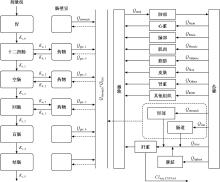
| 模型参数 | 标准人体(70kg) | ||
|---|---|---|---|
| 器官体积 (ml) | 血流速率 (ml/min) | 组织-血浆 分配比(Kt/p) | |
| 肺 | 532 | 5200.0 | 1.58 |
| 肾脏 | 204 | 910.0 | 5.34 |
| 心肌 | 350 | 208.0 | 7.49 |
| 肌肉 | 35000 | 993.0 | 0.78 |
| 皮肤 | 7800 | 300.0 | 3.56 |
| 脂肪 | 10000 | 270.4 | 22.16 |
| 脑组织 | 1400 | 592.8 | 10.57 |
| 其他组织 | 5100 | 745.4 | 1.38 |
| 脾脏 | 190 | 80.0 | 1.88 |
| 肝脏 | 1799 | 239.2 | 6.76 |
| 静脉血 | 2247 | - | - |
| 动脉血 | 749 | - | - |
| 胃 | 147 | 57.2 | 1.87 |
| 肠道 | 1650 | 804.0 | 3.34 |
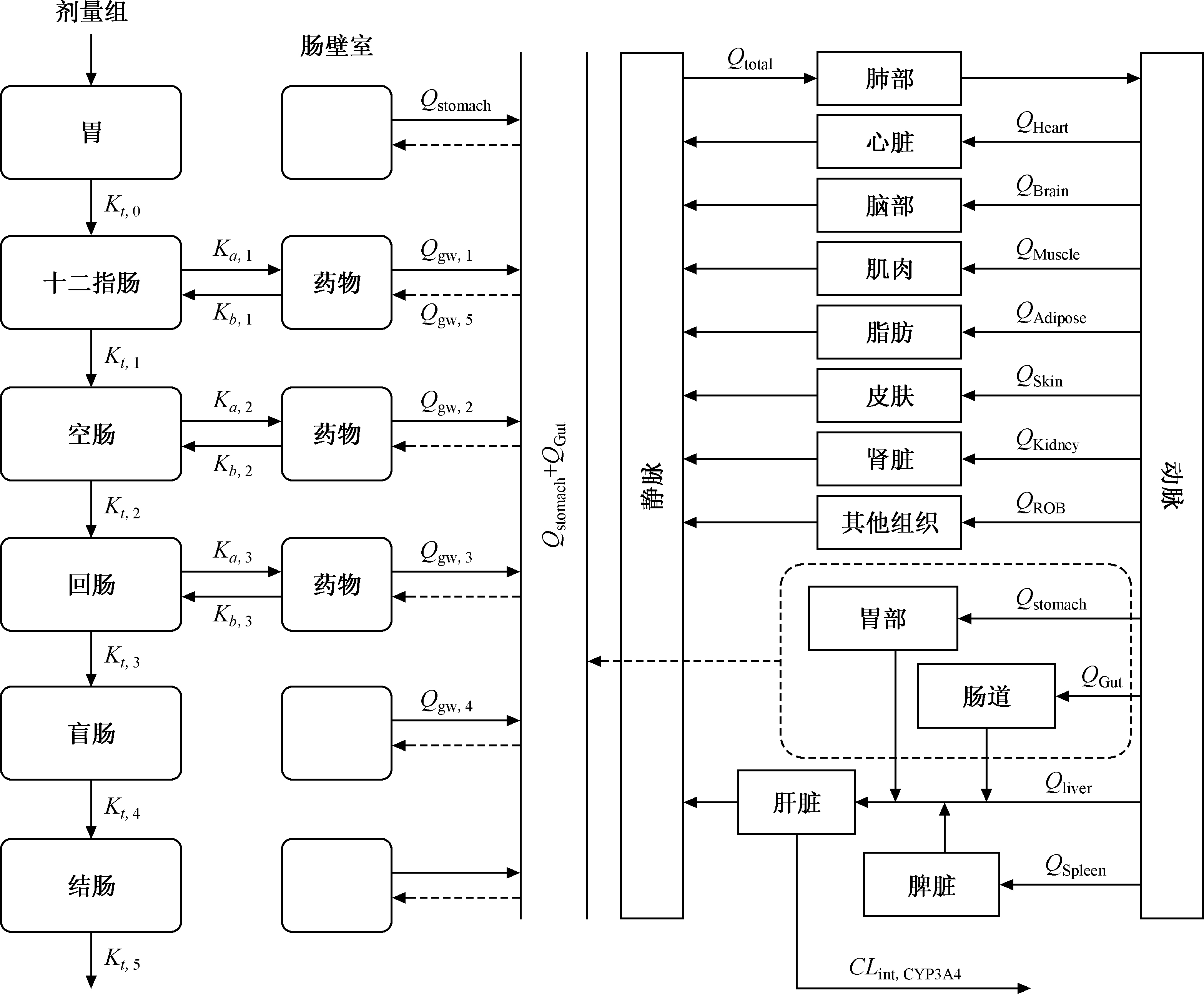
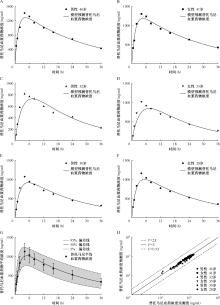

| 患者 | 药物半衰期 (h) | 达峰时间 (h) | 达峰浓度 (μg/ml) | 药时曲线下面积 (μg·h·ml-1) | 表观口服清 除率(L/h) | 平均驻留 时间(h) | 表观分布 容积(L) |
|---|---|---|---|---|---|---|---|
| 46岁男性 | |||||||
| 观测值 | 20.06 | 4.00 | 1.42 | 30.00 | 4.71 | 14.99 | 136.21 |
| 预测值 | 19.33 | 4.00 | 1.29 | 29.88 | 4.76 | 14.99 | 132.76 |
| 41岁女性 | |||||||
| 观测值 | 21.70 | 4.00 | 1.31 | 27.91 | 4.85 | 15.07 | 151.65 |
| 预测值 | 19.79 | 4.00 | 1.18 | 27.92 | 5.03 | 15.12 | 143.53 |
| 32岁男性 | |||||||
| 观测值 | 17.65 | 4.00 | 0.82 | 17.61 | 8.50 | 15.00 | 216.48 |
| 预测值 | 15.13 | 8.00 | 0.73 | 17.22 | 9.02 | 15.27 | 196.94 |
| 35岁女性 | |||||||
| 观测值 | 16.69 | 4.00 | 1.01 | 20.04 | 7.59 | 14.57 | 182.72 |
| 预测值 | 14.17 | 8.00 | 0.84 | 19.65 | 8.11 | 15.13 | 165.71 |
| 30岁男性 | |||||||
| 观测值 | 20.66 | 4.00 | 1.08 | 21.32 | 6.47 | 14.82 | 192.87 |
| 预测值 | 17.31 | 6.00 | 0.92 | 21.33 | 6.97 | 15.04 | 174.00 |
| 28岁女性 | |||||||
| 观测值 | 21.41 | 4.00 | 1.16 | 23.67 | 5.74 | 15.05 | 177.32 |
| 预测值 | 18.75 | 6.00 | 1.00 | 23.65 | 6.06 | 15.17 | 164.00 |
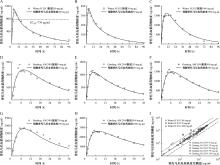

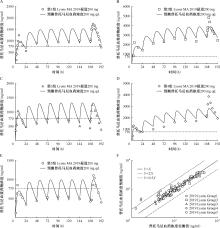

| 药代动力学参数 | Winter H 2013 200mg | Winter H 2013 50mg | Winter H 2013 1000mg | Ginsberg AM 2009 50mg | ||||
|---|---|---|---|---|---|---|---|---|
| 观测值 | 预测值 | 观测值 | 预测值 | 观测值 | 预测值 | 观测值 | 预测值 | |
| 药物半衰期(h) | 28.14 | 27.80 | 19.56 | 21.46 | 13.96 | 21.43 | 16.04 | 14.87 |
| 达峰时间(h) | 3.00 | 4.00 | 4.00 | 4.00 | 16.00 | 8.00 | 5.00 | 7.00 |
| 达峰浓度(μg/ml) | 1.09 | 1.03 | 0.37 | 0.36 | 1.51 | 1.62 | 0.28 | 0.24 |
| 药时曲线下面积(μg·h/ml) | 35.45 | 35.49 | 10.00 | 10.14 | 62.88 | 64.77 | 5.52 | 5.60 |
| 表观口服清除率(L/h) | 4.93 | 5.14 | 4.82 | 4.72 | 15.70 | 14.67 | 6.77 | 6.96 |
| 平均驻留时间(h) | 30.20 | 29.53 | 24.90 | 25.69 | 27.03 | 29.22 | 15.81 | 15.46 |
| 表观分布容积(L) | 200.17 | 206.05 | 135.99 | 146.05 | 316.18 | 453.59 | 156.64 | 149.37 |
| 药代动力学参数 | Ginsberg AM 2009 250mg | Ginsberg AM 2009 500mg | Ginsberg AM 2009 750mg | Ginsberg AM 2009 1000mg | ||||
| 观测值 | 预测值 | 观测值 | 预测值 | 观测值 | 预测值 | 观测值 | 预测值 | |
| 药物半衰期(h) | 14.44 | 13.20 | 13.86 | 13.81 | 15.59 | 13.43 | 20.75 | 22.27 |
| 达峰时间(h) | 4.00 | 5.00 | 5.00 | 7.00 | 8.00 | 8.00 | 5.00 | 8.00 |
| 达峰浓度(μg/ml) | 1.15 | 1.09 | 1.60 | 1.49 | 1.84 | 1.79 | 2.68 | 2.62 |
| 药时曲线下面积(μg·h/ml) | 22.04 | 21.93 | 33.12 | 33.29 | 45.31 | 42.24 | 67.56 | 67.66 |
| 表观口服清除率(L/h) | 9.22 | 9.48 | 12.05 | 12.10 | 12.42 | 14.44 | 9.74 | 9.49 |
| 平均驻留时间(h) | 14.02 | 14.07 | 15.02 | 15.10 | 16.08 | 14.89 | 16.39 | 16.52 |
| 表观分布容积(L) | 191.98 | 180.62 | 241.08 | 241.13 | 279.43 | 279.94 | 291.74 | 304.72 |
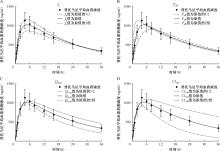

| [1] | Stover C K, Warrener P, VanDevanter D R, et al. A small-molecule nitroimidazopyran drug candidate for the treatment of tuberculosis[J]. Nature, 2000, 405(6789): 962-966. doi:10.1038/35016103. |
| [2] |
Keam S J. Pretomanid: First Approval[J]. Drugs, 2019, 79(16): 1797-1803. doi:10.1007/s40265-019-01207-9.
pmid: 31583606 |
| [3] | 丁杨明, 陆宇. 抗耐药结核新药贝达喹啉、德拉马尼和普托马尼的药动学特征及药物相互作用研究进展[J]. 中国抗生素杂志, 2023, 48(3): 351-356. doi:10.3969/j.issn.1001-8689.2023.03.017. |
| [4] | 刘裔, 杨燕, 张向荣. 贝达喹啉对老年耐多药肺结核免疫功能和心电图QT间期的影响[J]. 中华医院感染学杂志, 2024, 34(5):712-716. doi:10.11816/cn.ni.2024-231071. |
| [5] | World Health Organization. WHO consolidated guidelines on tuberculosis: Module 4: Treatment-Drug-resistant tuberculosis treatment[R]. Geneva: World Health Organization, 2020. |
| [6] | Esmail A, Oelofse S, Lombard C, et al. An All-Oral 6-Month Regimen for Multidrug-Resistant Tuberculosis: A Multicenter, Randomized Controlled Clinical Trial (the NExT Study)[J]. Am J Respir Crit Care Med, 2022, 205(10): 1214-1227. doi:10.1164/rccm.202107-1779OC. |
| [7] | Nyang’wa B T, Berry C, Kazounis E, et al. Short oral regimens for pulmonary rifampicin-resistant tuberculosis (TB-PRACTECAL): an open-label, randomised, controlled, phase 2B-3, multi-arm, multicentre, non-inferiority trial[J]. Lancet Respir Med, 2024, 12(2):117-128. doi:10.1016/S2213-2600(23)00389-2. |
| [8] | 付亮, 任坦坦, 张培泽, 等. 世界卫生组织《结核病整合指南模块4:耐药结核病治疗2022年更新版》解读[J]. 中国防痨杂志, 2023, 45 (4): 336-348. doi:10.19982/j.issn.1000-6621.20220523. |
| [9] | 中国防痨协会, 《中国防痨杂志》编辑委员会, 首都医科大学附属北京胸科医院/北京市结核病胸部肿瘤研究所. 耐药结核病全口服短程治疗专家共识[J]. 中国防痨杂志, 2025, 47(7): 830-839. doi:10.19982/j.issn.1000-6621.20250087. |
| [10] | 杨玉洁, 徐敏, 郗恒, 等. 美罗培南在老年人体中生理药动学模型的建立与应用[J]. 中国医院药学杂志, 2021, 41(21):2196-2201. doi:10.13286/j.1001-5213.2021.21.08. |
| [11] |
Li J, Guo H F, Liu C, et al. Prediction of Drug Disposition in Diabetic Patients by Means of a Physiologically Based Pharmacokinetic Model[J]. Clin Pharmacokinet, 2015, 54(2): 179-193. doi:10.1007/s40262-014-0192-8.
pmid: 25316573 |
| [12] | 丁巧燕, 张欢, 马丽华, 等. 德拉马尼血药浓度测定方法的建立及应用[J]. 中国药房, 2022, 33(24): 3029-3033. doi:10.6039/j.issn.1001-0408.2022.24.17. |
| [13] | 王仲建, 陈夏霖, 张侠, 等. 贝达喹啉治疗药物浓度监测方法的建立与应用[J]. 药学与临床研究, 2024, 32(1): 20-25. doi:10.13664/j.cnki.pcr.2024.01.005. |
| [14] | 程文, 朱慧, 付雷, 等. HPLC-MS/MS法同时测定血浆中贝达喹啉、普托马尼和利奈唑胺的方法学建立及应用[J]. 中国防痨杂志, 2025, 47(5): 613-622. doi:10.19982/j.issn.1000-6621.20250004. |
| [15] |
Brown R P, Delp M D, Lindstedt S L, et al. Physiological parameter values for physiologically based pharmacokinetic models[J]. Toxicol Ind Health, 1997, 13(4): 407-484. doi:10.1177/074823379701300401.
pmid: 9249929 |
| [16] | Davies B, Morris T. Physiological parameters in laboratory animals and humans[J]. Pharm Res, 1993, 10(7): 1093-1095. doi:10.1023/a:1018943613122. |
| [17] | Rodgers T, Rowland M. Physiologically based pharmacokinetic modelling 2: predicting the tissue distribution of acids, very weak bases, neutrals and zwitterions[J]. J Pharm Sci, 2006, 95(6): 1238-1257. doi:10.1002/jps.20502. |
| [18] |
Mehta K, Guo T, van der Graaf P H, et al. Predictions of Bedaquiline and Pretomanid Target Attainment in Lung Lesions of Tuberculosis Patients using Translational Minimal Physiologically Based Pharmacokinetic Modeling[J]. Clin Pharmacokinet, 2023, 62(3): 519-532. doi:10.1007/s40262-023-01217-7.
pmid: 36802057 |
| [19] | Lakshminarayana S B, Boshoff H I, Cherian J, et al. Pharmacokinetics-pharmacodynamics analysis of bicyclic 4-nitroimidazole analogs in a murine model of tuberculosis[J]. PLoS One, 2014, 9(8): e105222. doi:10.1371/journal.pone.0105222. |
| [20] | Reali F, Fochesato A, Kaddi C, et al. A minimal PBPK model to accelerate preclinical development of drugs against tuberculosis[J]. Front Pharmacol, 2024, 14:1272091. doi:10.3389/fphar.2023.1272091. |
| [21] | Kong W M, Sun B B, Wang Z J, et al. Physiologically based pharmacokinetic-pharmacodynamic modeling for prediction of vonoprazan pharmacokinetics and its inhibition on gastric acid secretion following intravenous/oral administration to rats, dogs and humans[J]. Acta Pharmacol Sin, 2020, 41(6): 852-865. doi:10.1038/s41401-019-0353-2. |
| [22] | Poulin P, Theil F P. Prediction of pharmacokinetics prior to in vivo studies. 1. Mechanism-based prediction of volume of distribution[J]. J Pharm Sci, 2002, 91(1): 129-156. doi:10.1002/jps.10005. |
| [23] | 冀艳华, 韩星, 温浩然, 等. 基于非布司他生理药动学模型预测潜在药物相互作用[J]. 中国医院药学杂志, 2019, 39(5): 475-480. doi:10.13286/j.cnki.chinhosppharmacyj.2019.05.10. |
| [24] |
Winter H, Ginsberg A, Egizi E, et al. Effect of a high-calorie, high-fat meal on the bioavailability and pharmacokinetics of PA-824 in healthy adult subjects[J]. Antimicrob Agents Chemother, 2013, 57(11): 5516-5520. doi:10.1128/AAC.00798-13.
pmid: 23979737 |
| [25] |
Ginsberg A M, Laurenzi M W, Rouse D J, et al. Safety, tolerability, and pharmacokinetics of PA-824 in healthy subjects[J]. Antimicrob Agents Chemother, 2009, 53(9): 3720-3725. doi:10.1128/AAC.00106-09.
pmid: 19528280 |
| [26] | Lyons M A. Modeling and Simulation of Pretomanid Pharmacodynamics in Pulmonary Tuberculosis Patients[J]. Antimicrob Agents Chemother, 2019, 63(12):e00732-19. doi:10.1128/AAC.00732-19. |
| [27] |
Manjunatha U, Boshoff H I, Barry C E. The mechanism of action of PA-824: Novel insights from transcriptional profiling[J]. Commun Integr Biol, 2009, 2(3): 215-218. doi:10.4161/cib.2.3.7926.
pmid: 19641733 |
| [28] | 韩鸿璨, 王骏, 李栋, 等. 模型引导的药物研发在儿科人群用药研究中的应用及策略[J]. 中国临床药理学杂志, 2021, 37(22):3193-3198. doi:10.13699/j.cnki.1001-6821.2021.22.043. |
| [29] | Li Y, Sun H, Zhang Z. The Evolution and Future Directions of PBPK Modeling in FDA Regulatory Review[J]. Pharmaceutics, 2025, 17(11):1413. doi:10.3390/pharmaceutics17111413. |
| [30] | 王仲建, 陈夏霖, 王允吉, 等. 贝达喹啉在耐药肺结核患者中生理药动学模型建立与应用[J]. 中国抗生素杂志, 2025, 50(10): 1206-1216. doi:10.3969/j.issn.1001-8689.2025.10.010. |
| [1] | Li Xinda, Hou Zhili, Ouyang Bing, Du Yadong, Guan Liying, Yu Hongmei, Zhang Haiqin, Xie Yongjie, Tang Peijun, Xiao Yu, Zhang Ying, Lu Yu. Evaluation of safety and efficacy of anti-tuberculosis fixed-dose combination in patients with drug-susceptible pulmonary tuberculosis [J]. Chinese Journal of Antituberculosis, 2026, 48(8): 1158-1162. |
| [2] | Sun Danyuchen, Liu Yuhong. Pharmacotherapy of rifampicin-resistant/multidrug-resistant tuberculosis: advances and prospects in health economic research [J]. Chinese Journal of Antituberculosis, 2026, 48(8): 1231-1230. |
| [3] | Liu Liangli, Yang Yunbin, Yang Rui, Chen Jinou, Yang Xing, Qiu Yubing, Li Ling, Xu Lin. Temporal trends and influencing factors of adverse treatment outcomes in patients with rifampicin-resistant pulmonary tuberculosis: a comparison based on different treatment regimens [J]. Chinese Journal of Antituberculosis, 2026, 48(7): 958-964. |
| [4] | Jiao Xiaoke, Dong Kexin, Yang Xinliang, Nie Wenjuan. Risk factors for QTc interval >500 ms in patients with rifampicin-resistant tuberculosis treated with bedaquiline-containing regimens [J]. Chinese Journal of Antituberculosis, 2026, 48(7): 992-999. |
| [5] | Jiang Xuefeng, Zhou Linjun, Sun Yan, Jiang Mingxia, Ma Ling, Mei Li, Liu Dongxin. Analysis of drug resistance gene mutation characteristics in Mycobacterium tuberculosis strains from five northwestern provinces of China [J]. Chinese Journal of Antituberculosis, 2026, 48(6): 856-864. |
| [6] | Cheng Wen, Guo Lifang, Nie Wenjuan. Application, methods, and practice of therapeutic drug monitoring in individualized anti-tuberculosis therapy [J]. Chinese Journal of Antituberculosis, 2026, 48(6): 882-891. |
| [7] | Che Yang, Zhang Dongliang, Li Xiangchen, Lu Yewei, Liu Zhengwei. Molecular characterization and risk factors of cross-resistance between isoniazid and prothionamide in multidrug-resistant Mycobacterium tuberculosis in Ningbo, China [J]. Chinese Journal of Antituberculosis, 2026, 48(5): 576-585. |
| [8] | Xie Cifu, Yin Pengliang, Song Lixin, Xiong Zi. Analysis of out-of-pocket medical expenses and influencing factors of multidrug-resistant/rifampicin-resistant pulmonary tuberculosis patients in Changsha City [J]. Chinese Journal of Antituberculosis, 2026, 48(5): 594-602. |
| [9] | Wu Yaning, Huang Misun, Guo Yi, Bo Xianglong, Wang Ruihuan, Xing Jianliang, Fan Xueting, Xu Da, Zhao Lili, Zhao Xiuqin, Li Guilian, Liu Haican, Li Machao. Analysis of genetic mutation characteristics associated with linezolid resistance in Mycobacterium tuberculosis [J]. Chinese Journal of Antituberculosis, 2026, 48(5): 603-615. |
| [10] | Zhang Shanshan, Han Yaxuan, Zhang Xiaoyan, Li Jianying, Ren Fei, Zhang Yaohui, Yang Haixia. Clinical characteristics and survival analysis of patients with lung cancer concurrent with drug-resistant pulmonary tuberculosis [J]. Chinese Journal of Antituberculosis, 2026, 48(5): 641-650. |
| [11] | Li Qin, Li Linhong, Liu Jiao, Feng Mei, Xie Qi, Zhang Guixian, Yang Qiong, Yang Dandan. A case of AIDS with rifampicin-resistant tuberculous breast abscess and literature review [J]. Chinese Journal of Antituberculosis, 2026, 48(5): 687-693. |
| [12] | Su Wei, Bai Xinyu, Maiwulajiang Yimamu, Keyoumu Wubulikasimu, Diermulati Tusun, Lai Fuli, Mirenisha Abudurexiti, Xirizhati Mamuti, Zhou Linjun, Huang Fei. Survival status and influencing factors analysis of patients with rifampicin-resistant pulmonary tuberculosis in Kashgar Prefecture, Xinjiang Uygur Autonomous Region, 2013—2022 [J]. Chinese Journal of Antituberculosis, 2026, 48(2): 197-205. |
| [13] | Shang Yuanyuan, Wang Xueyu, Wang Yujin, Yu Xia, Huang Hairong, Nie Wenjuan. Functional annotation of single nucleotide polymorphisms and analysis of drug resistance-related pathways in Mycobacterium abscessus strains resistant to Sudapyridine [J]. Chinese Journal of Antituberculosis, 2026, 48(2): 264-273. |
| [14] | Wang Xueyu, Chu Naihui, Nie Wenjuan. Research progress on the anti-Mycobacterium tuberculosis activity of sitafloxacin [J]. Chinese Journal of Antituberculosis, 2026, 48(2): 299-303. |
| [15] | Jiang Wenxin, Zhang Xiangrong, Tang Peijun, Qin Zhihua, Gao Chunjing, Zhang She, Zhao Xinguo, Zhu Limei, Liu Qiao. Safety analysis of the B-Pa-L/M regimen for rifampicin-resistant pulmonary tuberculosis [J]. Chinese Journal of Antituberculosis, 2026, 48(10): 1487-1496. |
| Viewed | ||||||
|
Full text |
|
|||||
|
Abstract |
|
|||||
 京公网安备11010202007215号
Total visitors: Visitors of today: Now online:
京公网安备11010202007215号
Total visitors: Visitors of today: Now online:
 This work is licensed under Creative Commons Attribution 3.0 License.
