
Chinese Journal of Antituberculosis ›› 2026, Vol. 48 ›› Issue (6): 803-812.doi: 10.19982/j.issn.1000-6621.20260145
• Original Articles • Previous Articles Next Articles
Guo Chenhao1( ), Liu Xinyu2, Zhan Sirui3, Wang Lili2, Ma Mengting4, Li Xiumei4, Qi Linping4, Li Weiping1
Received:2026-03-16
Online:2026-06-10
Published:2026-05-25
Contact:
Guo Chenhao
E-mail:ldyyguoch@163.com
Supported by:CLC Number:
Guo Chenhao, Liu Xinyu, Zhan Sirui, Wang Lili, Ma Mengting, Li Xiumei, Qi Linping, Li Weiping. Interferon-gamma release assays for diagnosing extrapulmonary tuberculosis in adults: a systematic review and Meta-analysis[J]. Chinese Journal of Antituberculosis, 2026, 48(6): 803-812. doi: 10.19982/j.issn.1000-6621.20260145
Add to citation manager EndNote|Ris|BibTeX
URL: https://www.zgflzz.cn/EN/10.19982/j.issn.1000-6621.20260145

| 评价领域 | 偏倚风险[项(构成比,%)] | 适用性问题[项(构成比,%)] | ||||
|---|---|---|---|---|---|---|
| 低风险 | 高风险 | 不明确 | 低风险 | 高风险 | 不明确 | |
| 患者选择 | 18(64.28) | 5(17.86) | 5(17.86) | 27(96.43) | 0(0.00) | 1(3.57) |
| 指标检测 | 11(39.29) | 1(3.57) | 16(57.14) | 28(100.00) | 0(0.00) | 0(0.00) |
| 参考标准 | 22(78.57) | 1(3.57) | 5(17.86) | 28(100.00) | 0(0.00) | 0(0.00) |
| 流程与时间 | 25(89.29) | 2(7.14) | 1(3.57) | - | - | - |

| 亚组 | 研究数 量(篇) | 测试结果(例) | 合并敏感度 (95%CI) | Meta回归 P值 | 合并特异度 (95%CI) | Meta回归 P值 | |||
|---|---|---|---|---|---|---|---|---|---|
| TP | FP | FN | TN | ||||||
| 样本类型 | 0.010 | <0.001 | |||||||
| 体液 | 9 | 155 | 44 | 35 | 416 | 0.86(0.77~0.95) | 0.92(0.87~0.96) | ||
| 血液 | 26 | 3354 | 3727 | 647 | 21557 | 0.84(0.79~0.89) | 0.81(0.77~0.86) | ||
| 检测方法 | P<0.001 | <0.001 | |||||||
| ELISA | 11 | 545 | 327 | 153 | 1221 | 0.84(0.77~0.92) | 0.81(0.74~0.89) | ||
| ELISPOT | 24 | 2964 | 3444 | 529 | 20752 | 0.85(0.80~0.90) | 0.86(0.81~0.90) | ||
| 协变量 | 研究数量(篇) | 回归系数 | RDOR(95%CI)值 | P值 |
|---|---|---|---|---|
| 体液 | ||||
| 检测方法 | ||||
| ELISA | 2 | -0.488 | 0.61(0.12~3.03) | 0.483 |
| ELISPOT | 7 | - | 1.00(参照) | - |
| 疾病类型 | ||||
| 结核性脑膜炎 | 3 | - | 1.00(参照) | - |
| 结核性胸膜炎 | 3 | 0.874 | 2.40(0.46~12.54) | 0.244 |
| 诊断类型(ELISPOT) | ||||
| 确诊队列 | 7 | -0.220 | 0.80(0.25~2.53) | 0.682 |
| 疑似队列 | 7 | - | 1.00(参照) | - |
| 血液 | ||||
| 检测方法 | ||||
| ELISA | 9 | -0.233 | 0.79(0.26~2.46) | 0.674 |
| ELISPOT | 17 | - | 1.00(参照) | - |
| 疾病类型 | ||||
| 结核性脑膜炎 | 5 | - | 1.00(参照) | - |
| 结核性胸膜炎 | 8 | -0.156 | 0.86(0.22~3.39) | 0.819 |
| 结核性淋巴结炎 | 6 | -0.259 | 0.77(0.20~2.96) | 0.696 |
| 诊断类型(ELISPOT) | ||||
| 确诊队列 | 17 | -0.111 | 0.90(0.21~3.78) | 0.874 |
| 疑似队列 | 6 | - | 1.00(参照) | - |
| 诊断类型(ELISA) | ||||
| 确诊队列 | 9 | 0.083 | 1.09(0.24~4.85) | 0.906 |
| 疑似队列 | 6 | - | 1.00(参照) | - |
| 地区背景 | ||||
| 高结核负担地区 | 21 | -0.163 | 0.85(0.20~3.59) | 0.817 |
| 低结核负担地区 | 5 | - | 1.00(参照) | - |
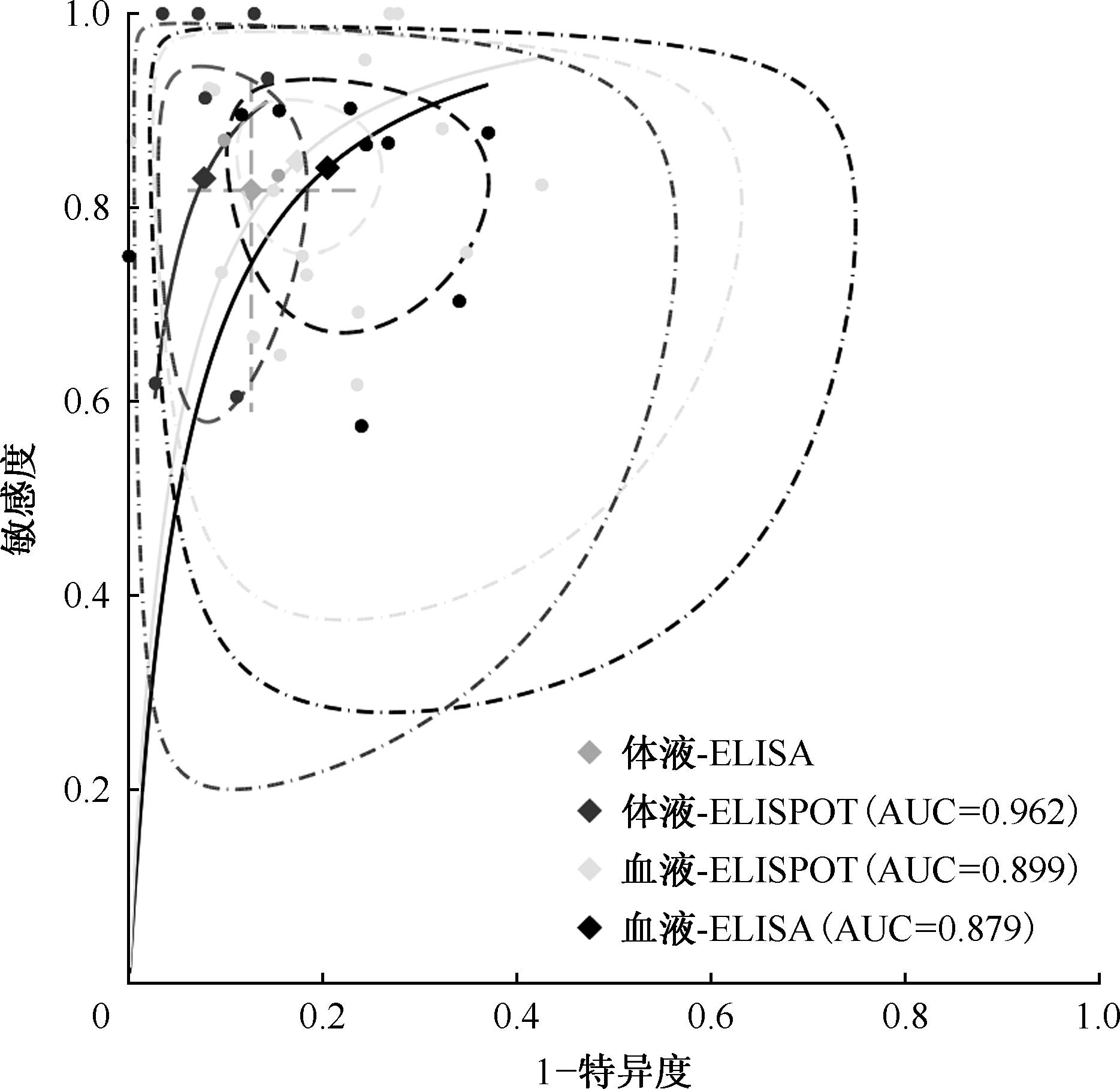
| 组别 | 研究数量 (篇) | 敏感度 (95%CI) | 特异度 (95%CI) | 阳性似然比 (95%CI) | 阴性似然比 (95%CI) | 诊断比值比 (95%CI) | AUC值 |
|---|---|---|---|---|---|---|---|
| 血液ELISPOT | 17 | 0.85 (0.84~0.86) | 0.86 (0.85~0.86) | 4.40 (2.81~6.91) | 0.22 (0.15~0.33) | 24.48 (11.48~52.23) | 0.899 |
| 血液ELISA | 9 | 0.77 (0.74~0.81) | 0.78 (0.76~0.80) | 3.61 (2.73~4.79) | 0.22 (0.13~0.38) | 17.91 (8.34~38.49) | 0.879 |
| 体液ELISPOT | 7 | 0.80 (0.72~0.86) | 0.91 (0.88~0.94) | 8.96 (6.30~12.73) | 0.17 (0.07~0.43) | 78.97 (35.73~176.6) | 0.962 |
| [1] | World Health Organization.Global tuberculosis reports 2025. Geneva: World Health Organization, 2025. |
| [2] | Zumla A, Raviglione M, Hafner R, et al. Tuberculosis. N Engl J Med, 2013, 368(8):745-755. doi:10.1056/NEJMra1200894. |
| [3] | Pai M, Behr MA, Dowdy D, et al. Tuberculosis. Nat Rev Dis Primers, 2016, 2:16076. doi:10.1038/nrdp.2016.76. |
| [4] | Goletti D, Lee MR, Wang JY, et al. Update on tuberculosis biomarkers: From correlates of risk, to correlates of active disease and of cure from disease. Respirology, 2018, 23(5):455-466. doi:10.1111/resp.13272. |
| [5] | Pai M, Denkinger CM, Kik SV, et al. Gamma interferon release assays for detection of Mycobacterium tuberculosis infection. Clin Microbiol Rev, 2014, 27(1): 3-20. doi:10.1128/CMR.00034-13. |
| [6] | Luo Y, Xue Y, Guo X, et al. Diagnostic value of pleural fluid T-SPOT for tuberculous pleurisy: An updated meta-analysis. Tuberculosis (Edinb), 2020, 122:101941. doi:10.1016/j.tube.2020.101941. |
| [7] | Lan Y, Chen W, Yan Q, et al. Interferon-γ release assays for tuberculous meningitis diagnosis: a meta-analysis. Arch Med Sci, 2020, 17(5): 1241-1250. doi:10.5114/aoms.2019.86994. |
| [8] | Liu Q, Li W, Chen Y, et al. Performance of interferon-yrelease assay in the diagnosis of tuberculous lymphadenitis : ameta-analysis. Peer J, 2017, 5:e3136. doi:10.7717/peerj.3136. |
| [9] | Wang F, Hou HY, Wu SJ, et al. Using the TBAg/PHA ratio in the T-SPOT(®).TB assay to distinguish TB disease from LTBI in an endemic area. Int J Tuberc Lung Dis, 2016, 20(4):487-493. doi:10.5588/ijtld.15.0756. |
| [10] | Wen A, Leng EL, Liu SM, et al. Diagnostic Accuracy of Interferon-Gamma Release Assays for Tuberculous Meningitis: A Systematic Review and Meta-Analysis. Front Cell Infect Microbiol, 2022, 12:788692. doi:10.3389/fcimb.2022.788692. |
| [11] | McInnes MDF, Moher D, Thombs BD, et al. Preferred Reporting Items for a Systematic Review and Meta-analysis of Diagnostic Test Accuracy Studies: The PRISMA-DTA Statement. JAMA, 2018, 319(4):388-396. doi:10.1001/jama.2017.19163. |
| [12] | Whiting PF, Rutjes AW, Westwood ME, et al. QUADAS-2: a revised tool for the quality assessment of diagnostic accuracy studies. Ann Intern Med, 2011, 155(8):529-536. doi:10.7326/0003-4819-155-8-201110180-00009. |
| [13] | Azghay M, Bouchaud O, Mechaï F, et al. Utility of Quanti-FERON-TB Gold In-Tube assay in adult, pulmonary and extrapulmonary, active tuberculosis diagnosis. Int J Infect Dis, 2016, 44:25-30. doi:10.1016/j.ijid.2016.01.004. |
| [14] | Shi X, Zhang L, Zhang Y, et al. Utility of T-Cell Interferon-γ Release Assays for Etiological Diagnosis of Classic Fever of Unknown Origin in a High Tuberculosis Endemic Area-a pilot prospective cohort. PLoS One, 2016, 11(1):e0146879. doi:10.1371/journal.pone.0146879. |
| [15] | Ji L, Lou YL, Wu ZX, et al. Usefulness of interferon-γ release assay for the diagnosis of sputum smear-negative pulmonary and extra-pulmonary TB in Zhejiang Province, China. Infect Dis Poverty, 2017, 6(1):121. doi:10.1186/s40249-017-0331-1. |
| [16] | Kim YJ, Kang JY, Kim SI, et al. Predictors for false-negative QuantiFERON-TB Gold assay results in patients with extrapulmonary tuberculosis. BMC Infect Dis, 2018, 18(1):457. doi:10.1186/s12879-018-3344-x. |
| [17] | Lee YM, Kim SM, Park SJ, et al. Factors Associated with a Strong Response to the T-SPOT.TB in Patients with Extrapulmonary Tuberculosis. Infect Chemother, 2014, 46(4):248-252. doi:10.3947/ic.2014.46.4.248. |
| [18] | Li S, Lin L, Zhang F, et al. A retrospective study on Xpert MTB/RIF for detection of tuberculosis in a teaching hospital in China. BMC Infect Dis, 2020, 20(1):362. doi:10.1186/s12879-020-05004-8. |
| [19] | Liang L, Shi R, Liu X, et al. Interferon-gamma response to the treatment of active pulmonary and extra-pulmonary tuberculosis. Int J Tuberc Lung Dis, 2017, 21(10):1145-1149. doi:10.5588/ijtld.16.0880. |
| [20] | Liu Q, Gao Y, Ou Q, et al. Differential expression of CD 64 in patients with Mycobacterium tuberculosis infection: A potential biomarker for clinical diagnosis and prognosis. J Cell Mol Med, 2020, 24(23):13961-13972. doi:10.1111/jcmm.16004. |
| [21] | Lv D, Liu Y, Guo F, et al. Combining interferon-γ release assays with lymphocyte enumeration for diagnosis of Mycobacterium tuberculosis infection. J Int Med Res, 2020, 48(6):300060520925660. doi:10.1177/0300060520925660. |
| [22] | Ma Y, Li R, Shen J, et al. Clinical effect of T-SPOT.TB test for the diagnosis of tuberculosis. BMC Infect Dis, 2019, 19(1):993. doi:10.1186/s12879-019-4597-8. |
| [23] | Mamishi S, Pourakbari B, Hosseinpour Sadeghi R, et al. Diagnostic accuracy of the IFN-γ release assay using RD1 immunodominant T-cell antigens for diagnosis of extrapulmonary tuberculosis. FEMS Microbiol Lett, 2024, 371:fnae023. doi:10.1093/femsle/fnae023. |
| [24] | Masood KI, Jamil B, Akber A, et al. Testing for Mycobacterium tuberculosis infection using the QuantiFERON-TB GOLD assay in patients with comorbid conditions in a tertiary care endemic setting. Trop Dis Travel Med Vaccines, 2020, 6:3. doi:10.1186/s40794-020-0102-z. |
| [25] | Pan L, Jia H, Liu F, et al. Risk factors for false-negative T-SPOT.TB assay results in patients with pulmonary and extra-pulmonary TB. J Infect, 2015, 70(4):367-380. doi:10.1016/j.jinf.2014.12.018. |
| [26] | Rumende CM, Hadi EJ, Tanjung G, et al. The Benefit of Interferon-Gamma Release Assay for Diagnosis of Extrapulmonary Tuberculosis. Acta Med Indones, 2018, 50(2):138-143. |
| [27] | Shin JA, Chang YS, Kim HJ, et al. Diagnostic utility of interferon-gamma release assay in extrapulmonary tuberculosis. Diagn Microbiol Infect Dis, 2015, 82(1):44-48. doi:10.1016/j.diagmicrobio.2015.02.002. |
| [28] | Wang F, Yu J, Zhou Y, et al. The Use of TB-Specific Antigen/Phytohemagglutinin Ratio for Diagnosis and Treatment Monitoring of Extrapulmonary Tuberculosis. Front Immunol, 2018, 9:1047. doi:10.3389/fimmu.2018.01047. |
| [29] | Wang L, Yu Y, Chen W, et al. Evaluation of the characteristics of the enzyme-linked immunospot assay for diagnosis of active tuberculosis in China. Clin Vaccine Immunol, 2015, 22(5):510-515. doi:10.1128/CVI.00023-15. |
| [30] | Yan L, Xiao H, Han M, et al. Diagnostic value of T-SPOT.TB interferon-γ release assays for active tuberculosis. Exp Ther Med, 2015, 10(1):345-351. doi:10.3892/etm.2015.2463. |
| [31] | Yang C, Zhang S, Yao L, et al. Evaluation of risk factors for false-negative results with an antigen-specific peripheral blood-based quantitative T cell assay (T-SPOT®. TB) in the diagnosis of active tuberculosis: A large-scale retrospective study in China. J Int Med Res, 2018, 46(5):1815-1825. doi:10.1177/0300060518757381. |
| [32] | Zhong H, Wu H, Yu Z, et al. Clinical evaluation of the T-SPOT.TB test for detection of tuberculosis infection in northeastern Guangdong Province, China. J Int Med Res, 2020, 48(5): 300060520923534. doi:10.1177/0300060520923534. |
| [33] | Zhu C, Liu Z, Li Z, et al. The performance and limitation of T-SPOT.TB for the diagnosis of TB in a high prevalence setting. J Thorac Dis, 2014, 6(6):713-719. doi:10.3978/j.issn.2072-1439.2014.04.38. |
| [34] | Qin L, Zhang L, Zhang Y, et al. Diagnostic Value of T-Cell Interferon-γ Release Assays on Cerebrospinal Fluid for Tuberculous Meningitis. PLoS One, 2015, 10(11):e0141814. doi:10.1371/journal.pone.0141814. |
| [35] | Hashim Z, Nath A, Agarwal V, et al. Use of pleural fluid interferon-gamma enzyme-linked immunospot (ELISPOT) assay in the evaluation of undiagnosed pleural effusion. Eur Respir J, 2018, 52(suppl 62): PA2760. doi:10.1183/13993003.congress-2018.PA2760. |
| [36] | Lee LN, Chou CH, Wang JY, et al. Enzyme-linked immunospot assay for interferon-gamma in the diagnosis of tuberculous pleurisy. Clin Microbiol Infect, 2009, 15(2):173-179. doi:10.1111/j.1469-0691.2008.02655.x |
| [37] | Lu D, Chen C, Yu S, et al. Diagnosis of Tuberculous Meningitis Using a Combination of Peripheral Blood T-SPOT.TB and Cerebrospinal Fluid Interferon-γ Detection Methods. Lab Med, 2016, 47(1):6-12. doi:10.1093/labmed/lmv010. |
| [38] | Luo Y, Yan F, Xue Y, et al. Diagnostic utility of pleural fluid T-SPOT and interferon-gamma for tuberculous pleurisy: A two-center prospective cohort study in China. Int J Infect Dis, 2020, 99:515-521. doi:10.1016/j.ijid.2020.08.007. |
| [39] | Zhang L, Zhang Y, Shi X, et al. Utility of T-cell interferon-γ release assays for diagnosing tuberculous serositis: a prospective study in Beijing, China. PLoS One, 2014, 9(1):e85030. doi:10.1371/journal.pone.0085030. |
| [40] | Pan L, Liu F, Zhang J, et al. Interferon-Gamma Release Assay Performance of Cerebrospinal Fluid and Peripheral Blood in Tuberculous Meningitis in China. Biomed Res Int, 2017, 2017:8198505. doi:10.1155/2017/8198505. |
| [41] | Fan L, Chen Z, Hao XH, et al. Interferon-gamma release assays for the diagnosis of extrapulmonary tuberculosis: a systematic review and meta-analysis. FEMS Immunol Med Microbiol, 2012, 65(3):456-466. doi:10.1111/j.1574-695X.2012.00972.x |
| [42] | Pathan AA, Wilkinson KA, Klenerman P, et al. Direct ex vivo analysis of antigen-specific IFN-gamma-secreting CD4 T cells in Mycobacterium tuberculosis-infected individuals: associations with clinical disease state and effect of treatment. J Immunol, 2001, 167(9):5217-5225. doi:10.4049/jimmunol.167.9.5217. |
| [43] | Lalvani A. Diagnosing tuberculosis infection in the 21st century: new tools to tackle an old enemy. Chest, 2007, 131(6):1898-1906. doi:10.1378/chest.06-2471. |
| [44] | Sethy SS, Deep G, Sudhakar PV, et al. Tissue-specific immunity in osteoarticular tuberculosis. Indian J Orthop, 2025, 59(6):768-773. doi:10.1007/s43465-025-01371-z. |
| [45] | Ren C, Tang J, Xia L. Interferon gamma release assays for diagnosis of osteoarticular tuberculosis: A systematic review and meta-analysis. PLoS One, 2022, 17(6):e0269234. doi:10.1371/journal.pone.0269234. |
| [1] | Yuan Shaoying, Cui Zhongfeng, Du Jiang, Cao Xuefang, Feng Boxuan, He Yijun, Li Zihan, Zhao Yaqi, Yu Yilin, Gao Lei, Xin He’nan, Li Hongzhi. The application value of the QuantiFERON-TB Gold Plus for active pulmonary tuberculosis diagnosis and treatment response monitoring [J]. Chinese Journal of Antituberculosis, 2026, 48(6): 865-873. |
| [2] | Gu Yuhong, Liu Zengwei, Wu Xiaoying, He Liqian, Zhang Yahui, Wu Guifeng. Analysis of the screening effectiveness and influencing factors of tuberculin skin test and interferon-gamma release assays for close contacts in schools: A retrospective real-world study [J]. Chinese Journal of Antituberculosis, 2026, 48(3): 377-385. |
| [3] | Yu Haiwei, Li Qian, Feng Fengquan, Li Sha. Association analysis between anti-interferon-γ auto-antibodies and interferon-gamma release assay results [J]. Chinese Journal of Antituberculosis, 2026, 48(2): 282-288. |
| [4] | Zhou Cang, Li Guoli, Jiang Hui, Shao Yan, Song Honghuan, Xue Hao, Ning Jingxian, Pan Yuchen, Fei Xinru, Sun Zheng, Chen Cheng, Zhu Limei, Liu Qiao. Evaluation of the diagnostic efficacy of AIMTB-fluorescent immunochromatography for screening latent tuberculosis infection [J]. Chinese Journal of Antituberculosis, 2026, 48(2): 289-298. |
| [5] | Wang Na, Wan Bin, Zhao Xia, He Ting, Zhang Miao, Yao Rong, Yang Xiaoyi. Meta-analysis of diagnostic delay rate among Chinese students patients with pulmonary tuberculosis [J]. Chinese Journal of Antituberculosis, 2026, 48(1): 73-83. |
| [6] | Kong Hanhan, Chen Zijiao, Zeng Jianfeng, Wu Dan, Tang Lin, Wen Min. Development and reliability and validity testing of the Pulmonary Tuberculosis Symptom Cluster Scale [J]. Chinese Journal of Antituberculosis, 2025, 47(8): 1062-1067. |
| [7] | Tuberculosis Control Branch of Chinese Antituberculosis Association, Standardization Professional Branch of Chinese Antituberculosis Association, Elderly Tuberculosis Control Branch of Chinese Antituberculosis Association. Expert consensus on the application of Mycobacterium tuberculosis infection detection technologies [J]. Chinese Journal of Antituberculosis, 2025, 47(7): 813-829. |
| [8] | Yang Zeliang, Ma Zichun, Shang Yuanyuan, Shi Jin, Jing Wei, Pang Yu, Qin Lin. The diagnostic value of targeted next generation sequencing in sputum-free pulmonary tuberculosis patients [J]. Chinese Journal of Antituberculosis, 2025, 47(7): 878-883. |
| [9] | Chen Shuangshuang, Wang Nenhan, Zhao Yanfeng, Fan Ruifang, Tian Lili, Chen Hao, Luo Ping, Li Jie, Li Chuanyou, Dai Xiaowei. Application value of MeltPro two-step method in tuberculosis diagnosis and drug resistance screening [J]. Chinese Journal of Antituberculosis, 2025, 47(7): 893-900. |
| [10] | Ou Xichao, Teng Chong, Song Yuanyuan, Zheng Yang, Chen Lei, Zhu Jun, Wang Jianguo, Pan Zhaobao, Kang Haitao, Wang Yan, Yao Hongyan, Huang Fei. Multicenter evaluation study on the application of a novel PCR fluorescence probe technology for early diagnosis of tuberculosis [J]. Chinese Journal of Antituberculosis, 2025, 47(6): 687-693. |
| [11] | Ying Guangzhi, Cai Qingshan, Ma Xiaoqing, Chen Lingyan, Chen Yuanyuan. Diagnostic value of Nanopore targeted sequencing for detecting nontuberculous mycobacteria in respiratory specimens [J]. Chinese Journal of Antituberculosis, 2025, 47(5): 589-596. |
| [12] | Luo Li, Luo Linzi, Yin Quhua, Zhou Lei, Lu Zhibin, Ding Yan, Xiao Yangbao. Progress in bronchoscopic diagnosis and treatment of lymph node fistula tracheobronchial tuberculosis [J]. Chinese Journal of Antituberculosis, 2025, 47(4): 505-512. |
| [13] | Song Feier, Mao Yanjun, Xia Qiuyue, Zhou Yang, Lin Huan. The prevalence and influencing factors of post-tuberculosis lung disease: A Meta-analysis [J]. Chinese Journal of Antituberculosis, 2025, 47(3): 322-330. |
| [14] | Yan Guangxuan, Wang Xueyu, Wang Yujin, Lan Tinglong, Nie Wenjuan. Diagnostic value of using metagenomic second-generation sequencing on suspected osteoarticular tuberculosis patients [J]. Chinese Journal of Antituberculosis, 2025, 47(2): 175-180. |
| [15] | Ming Yao, Chen Minghui, Wang Fang, Hu Feifei, Wang Zhi. Prevalence of latent tuberculosis infection and willingness for preventive treatment among Chinese students:A Meta-analysis and systematic review [J]. Chinese Journal of Antituberculosis, 2025, 47(12): 1556-1565. |
| Viewed | ||||||
|
Full text |
|
|||||
|
Abstract |
|
|||||
 京公网安备11010202007215号
Total visitors: Visitors of today: Now online:
京公网安备11010202007215号
Total visitors: Visitors of today: Now online:
 This work is licensed under Creative Commons Attribution 3.0 License.
